


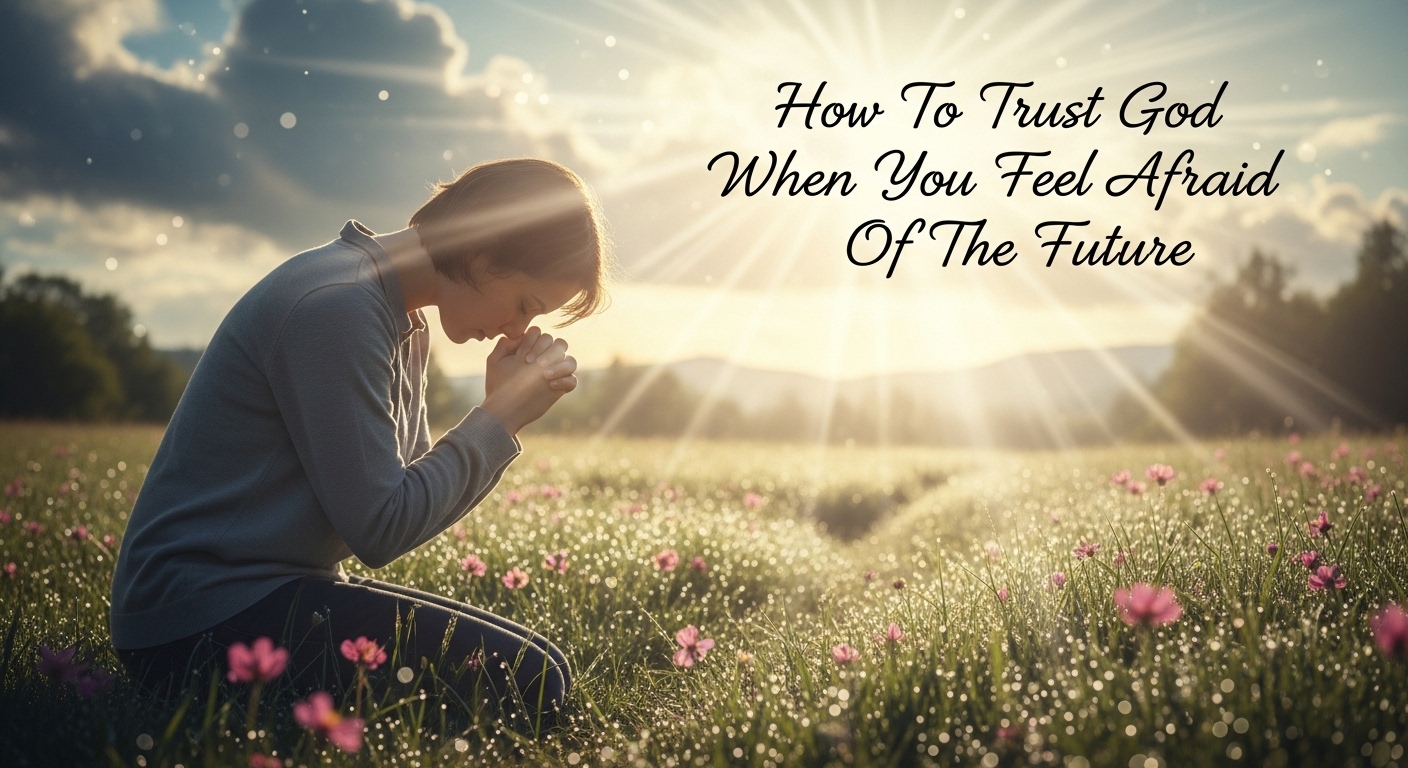
How To Trust God When You Feel Afraid Of The Future
Introduction
You wake up with a tightness in your chest before the coffee has even brewed. Your mind runs through a list of “what ifs” — what if things change, what if someone you love gets sick, what if you lose your job, what if plans fall apart? That restless energy feels louder at night, like a static that won’t quit. You’re not ashamed of the fear; you’re simply tired of how loud it’s become.
You are not alone. Many people of faith wrestle with future-oriented anxiety, even after seasons of prayer and growth. The truth is that fear of the future visits faithful people again and again. That doesn’t mean your faith is weak; it means you’re human. There is a way forward that doesn’t depend on pretending you’re not afraid. God’s presence, promises, and patient work in your life can become the steady ground beneath your feet when future uncertainty presses in.
This article will walk you through why this is so hard, what Scripture invites you to do, simple practices you can try right now, and how real change happens slowly over time. If you’re looking for deeper study and a fuller framework, keep an eye on the pillar resource mentioned below — it will help you build a strong biblical foundation for peace in anxious moments.
Sponsored recommendation


Why This Feels So Hard
When the future feels uncertain you don’t simply experience a passing worry. You experience a full-body, mind-wide cycle that is exhausting. Understanding the mechanics of that cycle will help you respond more kindly and wisely to yourself.
First, mental exhaustion lowers your capacity for perspective and for remembering truth. When you’re tired, your brain prioritizes threat detection. That’s good for immediate danger, but it makes every imagined scenario feel urgent and real. You find it harder to recall promises, harder to pray consistently, and more likely to spin into catastrophic thinking. That’s why the fear feels bigger than it would in a rested, quiet moment.
Second, repeated cycles of anxiety create a habit loop. Each time you ruminate about the future, your nervous system learns the route. The brain builds neural pathways that make future-focused fear quicker and easier next time. You don’t wake up one morning and suddenly feel steady; you are being reshaped, moment by moment, by the habits of attention you choose.
Third, fear of losing control is at the heart of future anxiety. Your plans meet limits — your plans don’t control seasons, other people, or unexpected events. The feeling that everything depends on you can be crushing. You may try to control outcomes by overplanning, overworking, or clinging too tightly to certainty. But control is a mirage in the face of a living, unpredictable world.
When you recognize these patterns — exhaustion, habit loops, fear of losing control — you’re already more empowered. You begin to see the problem in ways you can address. You also begin to see the hope: a different habit, a gentler rhythm, and a renewed sense of God’s presence can shift your inner life.

What Scripture Shows Us to Do
Scripture is not naïve about fear. It acknowledges human struggle and then gives you clear commands, invitations, promises, and inspiring examples to follow. These aren’t sticks for beating yourself up; they’re lifelines that guide your attention and practice.
Command: The New Testament gives a direct command about anxiety. Paul writes: “Do not be anxious about anything, but in every situation, by prayer and petition, with thanksgiving, present your requests to God” (Philippians 4:6-7). That directive is not a rebuke that you’re failing; it’s a posture to practice — prayer, petition, and thanksgiving — with the promise of God’s peace guarding your heart and mind.
Invitation: Jesus extends a tender invitation when you are weary of trying to carry burdens alone: “Come to me, all you who are weary and burdened, and I will give you rest” (Matthew 11:28). You are invited into rest — not just a quick calm, but a posture of trust where you lean into God’s care.
Promise: God repeatedly promises presence and help when future anxiety shows up. Isaiah records this comforting word: “So do not fear, for I am with you; do not be dismayed, for I am your God” (Isaiah 41:10). That promise anchors you in the character of God — steadfast, near, and powerful.
Example: The scriptures give you portrait stories of people who feared, doubted, or were uncertain, and yet were carried by God’s faithfulness. Consider Peter stepping out of the boat to walk toward Jesus. He took a terrifying step toward the unknown and began to sink when fear overwhelmed him, but Jesus reached out to save him (Matthew 14:29-31). These stories do not promise you will never fear; they promise God meets you when you do.
Scripture gives a rhythm, not an instant fix: bring your anxieties to God in prayer, receive His presence and promise, and remember how He has been faithful before. You’re invited into a steady practice of trust.
A Simple Way to Practice Faith Right Now
When fear of the future spikes, you need tools you can use quickly and often. The goal is not to make the feeling vanish instantly — that’s unrealistic — but to interrupt the fear cycle, bring your attention to truth, and let your body and mind experience a different way of being. Here are practical, sticky exercises you can try immediately.
Breathe + pray: Begin with a simple 60-second breathing prayer. Inhale slowly for four counts, exhale for six, and pray a short phrase on each exhale: “Lord, I trust You” or “God, I give this to You.” This calms your nervous system and starts shifting your attention.
Short verse meditation: Pick a short promise to repeat and reflect on for two minutes. Try Psalm 56:3: “When I am afraid, I put my trust in you.” Repeat the verse slowly, letting each phrase sink into your body. You can also whisper it on the exhale during your breathing practice.
Surrender statement: Write and say a 20-second surrender out loud: “God, I don’t know what will happen. I’m scared, but I’m giving this to You. I trust You with the not-yet.” Saying it aloud makes the surrender concrete and breaks the loop of private rumination.
Gratitude pivot: Name three small things you are thankful for right now. Gratitude shifts your attention from what might be lost to what you actually have. Pair the gratitude with a biblical phrase like 1 Thessalonians 5:18: “Give thanks in all circumstances.”
Safe sharing: If anxiety won’t quiet after five minutes of the above, text or call someone you trust and say, “I’m feeling afraid about the future. Can you pray with me now?” Community interrupts isolation.
Micro-habits win: Do one tiny practice daily — a breathing prayer in the morning, a verse repeated at lunch, or gratitude before bed. These micro-habits build trust muscle over time.
Each of these practices is simple enough to use wherever you are. They rewire attention from imagined disaster to present reality and God’s actual promises. Try them for a week and notice subtle changes: fewer spirals, quicker recovery after a worry, more moments of peace.

Where Real Change Slowly Happens
You want immediate relief. God often offers something deeper: real, lasting transformation that happens slowly, tenderly, and with grace. Trust is not merely a one-time decision but the fruit of a sustained relationship formed over time.
Healing and growth in the face of future-related fear follow a process. At first you’ll have small victories — a prayer that calms you, a night’s sleep that’s more restful. These are the building blocks. Over weeks and months, these small moments of faithfulness add up. Your nervous system begins to learn a new rhythm. Your brain rewires away from the old fear habit loops and toward patterns of trust.
Daily practice matters. When you choose one spiritual exercise each day and practice it intentionally, you create conditions for long-term change. The Bible describes this as “walking by faith” — daily choices that shape your character. You don’t suddenly become fearless; you become steadier, more resilient, and more ready to face uncertainty with God’s help.
Grace drives the process. You won’t be perfect. When fear returns — and it will — don’t use it as evidence that you’ve failed. Instead, receive God’s grace, pick up a simple practice, and keep moving forward. The grace-driven rhythm looks like humility when you fall, persistence when you’re tempted to quit, and gentleness with yourself.
Community supports the slow work. Real change happens as you share the journey with others. Trusted companions, spiritual mentors, or a small group provide perspective and encouragement. They remind you of the ways God has shown up, help you remember Scripture when your mind goes blank, and pray for you when your faith feels small.
Finally, keep your eyes on the long story. The Christian life is oriented around a narrative — God’s ongoing work of redemption. When you situate your fear within that bigger story, you can live with hope even when outcomes are uncertain.

Learn the Bigger Picture of Mental Health & Faith
Your fear of the future sits at the intersection of theology and mental health. Both matter. Faith without insight into the workings of your body and brain can feel unhelpful; psychology without spiritual truth leaves you uneasy about meaning. The good news is these disciplines can and should inform one another.
A healthy approach recognizes that anxiety is not simply a spiritual failing. It has physical, psychological, and relational components. These may require practical supports like rest, professional care, medication, therapy, or expert guidance — and they should coexist with prayer, Scripture, and Christian community. You don’t have to choose between clinical help and spiritual reliance.
At the same time, theology offers lasting truths that shape your interior life: God’s sovereignty, His intimate care for you, and the invitation to live by faith rather than by fear. Those truths reframe your relationship to uncertainty. They don’t guarantee a specific outcome, but they guarantee a trustworthy God who walks with you through the unknown.
For a fuller biblical foundation on how God brings peace and stability to our inner life, see Faith Over Fear: How God Helps Us in Anxious Moments. That resource explores Scripture, practical rhythms, and faith-based strategies that anchor your heart long term.
Other Biblical Stories That Give Hope
The Bible is full of people who faced terrifying unknowns and yet experienced God’s faithfulness. Their stories don’t erase fear; they show how trust grew in the middle of uncertainty.
David: David faced danger, exile, and the unpredictability of life as a young shepherd turned king. His words in the Psalms model how to bring fear to God: “When I am afraid, I put my trust in you” (Psalm 56:3). David’s life shows you can be honest about fear and still deepen in trust.
Joseph: Sold into slavery, falsely accused, and imprisoned, Joseph’s future looked bleak. Yet God used those very circumstances to preserve many lives, culminating in Joseph’s profound proclamation that God turned evil intended for harm into something good (Genesis 50:20). Joseph’s story reminds you that God can work through what you cannot control.
Ruth: Ruth steps into a future with no guarantees, leaving homeland and family. Her faithful trust and loyalty lead to redemption and a place in God’s people and ultimately the lineage of Jesus (Ruth 1–4). Ruth’s path shows that courageous steps of faith can lead to unexpected blessing.
Esther: Esther faced a terrifying “what if” not just for her own future but for the fate of her people. Her courage to act, coupled with fasting and seeking God’s guidance, led to deliverance (Esther 4:14-16). Esther shows you that faith can be active, even in fearful seasons.
These stories don’t promise everything will turn out exactly as you want. They do show a pattern: honest fear, courageous faithfulness, and a God who is present and powerful in the unknown.
A Short Prayer for This Moment
God, I admit I’m afraid of what’s coming. My mind runs ahead of my feet and my heart feels heavy. I need Your help. Remind me that You are with me; help me to breathe, to trust, and to surrender what I cannot carry. Give me small, steady steps of faith today. Fill the places where anxiety lives with Your peace that surpasses understanding. Teach me how to rest in You. Amen.
If you’d prefer a Scripture-based prayer, try this short breath prayer with Psalm 46:1 — “God is our refuge and strength.” Inhale “God is our refuge,” exhale “and strength.” Repeat slowly and let the words settle.
Final Encouragement
You’re not expected to be brave all the time. You’re invited to be honest with God and with yourself. Fear about the future is not a sign of spiritual inadequacy; it’s a place where God often meets you with grace. Take one small step today: a short prayer, a verse on your phone, a conversation with a friend, or a minute of breathing. Those tiny acts are the textures of a life that learns to trust.
Remember the promise: you don’t face tomorrow alone. God’s presence goes with you into the unknown. Each small practice you choose rewires your attention and grows your capacity to trust. Let your heart be patient. Trust is built, not forced.
If this encouraged you, continue reading more on these themes. For a bigger picture of how faith replaces fear, read Faith Over Fear: How God Helps Us in Anxious Moments. If you need Scripture right away, visit Bible Verses to Read During a Panic Attack. If your fear is about what lies ahead, keep practicing the short exercises in this article and remember Peter’s story: even when you begin to sink, Jesus is ready to reach out and lift you (Matthew 14:29-31).
Sponsored recommendation
Acknowledgment: All Bible verses referenced in this article were accessed via Bible Gateway (or Bible Hub).
“Want to explore more? Check out our latest post on Why Jesus? and discover the life-changing truth of the Gospel!”