

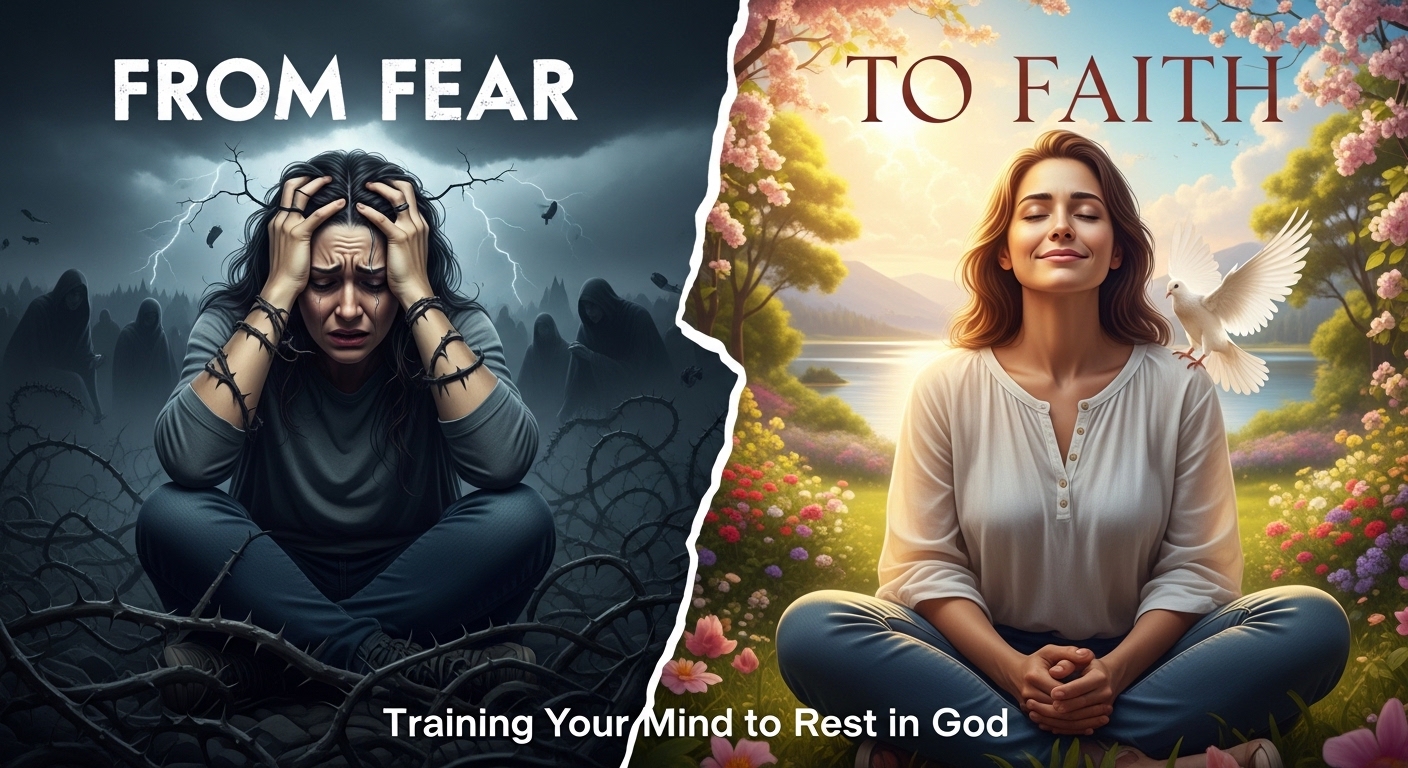
From Fear to Faith: Training Your Mind to Rest in God
Introduction
You wake in the middle of the night with your mind racing, replaying worries about work, health, relationships, or the future. You’ve prayed, you’ve read Scripture, and yet the same anxious loop can return like a familiar song you didn’t ask to hear. That heavy tightness in your chest and the whisper that you’re not enough—those are real, and they matter.
You’re not the only one who feels this. Many believers discover that anxiety can return even after sincere prayer. You may feel ashamed, exhausted, or discouraged because faith hasn’t eliminated your fear the way you expected. But God meets you in that honest place, and He invites your mind to learn a new rhythm—a rhythm of resting in Him rather than wrestling alone.
There’s a deeper understanding that can become a practical pillar in your life. This article will walk you through why staying anchored feels so hard, what Scripture actually asks you to do, simple practices you can start today, and how slow, steady change happens when you train your mind to rest in God.
Sponsored recommendation


Why This Feels So Hard
You’re tired. Not just physically, but mentally and emotionally worn down by repeated cycles of worry. That chronic fatigue makes it harder to respond in faith because your willpower is depleted, your thoughts feel scattered, and your default is to protect yourself by controlling whatever you can. When you’re exhausted, fear gets louder, and patience gets quieter.
There’s also the pattern-of-return: you pray, you experience relief, and then life presses again, and the old worries resurface. That cycle can feel like failure. But it’s actually a sign your mind and heart are still learning. Training any habit—healthy eating, exercise, learning a language—requires repetition. Your mind has been trained for years to run anxious scripts; rewiring it takes time and consistent practice.
Fear also wants control. When you feel vulnerable, your instinct may be to clutch outcomes, make contingency plans, or try to troubleshoot the future. That sense of needing to manage everything prevents you from surrendering to God’s care. You think that letting go equals passivity or irresponsibility, but true surrender is an act of strength: it’s choosing trust over exhaustion, opening your grip so God can hold the outcome.
Finally, you might judge yourself for feeling afraid. You worry that your faith should mean you don’t feel this way. That judgment creates shame and isolation, rather than the humility and dependence that invite God’s comfort. Recognize this: your experience is understandable, you aren’t alone, and you can learn new patterns that align your mind and heart with God’s truth.

What Scripture Shows Us to Do
Scripture is both gentle and direct about fear. It gives commands to trust, invitations to rest, promises of peace, and examples of people who walked through fear toward faith. Those anchors help you move from reaction to response.
First, there’s a command to let go of anxious striving and give it to God. You’re told to “cast all your anxiety on him because he cares for you”—a picture of placing burdens in loving hands rather than carrying them alone (1 Peter 5:7). That’s an invitation to practical surrender, not a platitude.
You’re also invited to come and find rest. Jesus says, “Come to me, all you who labor and are heavy laden, and I will give you rest”—an open hand toward your exhaustion and a promise of relief rooted in a relationship with Him (Matthew 11:28).
God promises peace when you don’t let anxious thoughts run the conversation in your mind. In one of the clearest assurances, you’re told not to be anxious about anything but instead to bring your requests to God through prayer and thanksgiving. The result? “And the peace of God, which transcends all understanding, will guard your hearts and your minds in Christ Jesus” (Philippians 4:6-7). That peace is a reality to pray for and expect.
Scripture also exhorts you to practice trust as a posture of life: “Trust in the LORD with all your heart and lean not on your own understanding” (Proverbs 3:5). This isn’t naïveté; it’s a steady decision to orient your thinking around God’s wisdom rather than your immediate fear.
Finally, you’re reminded that God’s Spirit isn’t the source of fear: “For God gave us a spirit not of fear but of power and love and self-control” (2 Timothy 1:7). That truth frees you to ask God to replace fearful impulses with courage, compassion, and a calm mind.
When Scripture offers commands, invitations, promises, and examples, it’s giving you both the expectation and the means to move from fear to faith. The next section shows practical ways to practice that shift right now.
A Simple Way to Practice Faith Right Now
When anxiety flares, you need tools that are immediate, accessible, and spiritually aligned. The practices below are short, repeatable, and shaped by Scripture. You can do most of them in a few minutes—some even while you’re in the middle of an activity.
Breathe + Pray: Start with three intentional breaths. Inhale slowly for four counts, hold for two, exhale for six. As you breathe, pray a simple line: “Lord, I bring this fear to You.” Breath anchors your nervous system; prayer anchors your heart. Combine them, and you shift both body and soul.
Short Verse Meditation: Pick a short promise and repeat it slowly. Use something like “The LORD is my shepherd” (Psalm 23:1), or “Do not be anxious” (Philippians 4:6). Say it aloud or in your head. Let one phrase sink into your thoughts for a minute or two. This trains your mind to replace anxious narratives with truth.
Surrender Statement: Have go-to sentences that express surrender. For example: “I surrender control. I trust God to steward this.” Or echo Scripture: “I cast this on You because You care for me” (1 Peter 5:7). Say it as often as needed during the day until surrender becomes a reflex rather than a rare act.
Gratitude Pivot: Anxiety narrows your view to worst-case scenarios. Pause and name three specific gifts or mercies right now—maybe a friend who texted, a roof over your head, or coffee that warmed you this morning. Thanksgiving rewires your attention toward God’s present goodness and interrupts the fear loop. You can say a brief prayer of thanks after each item: “Thank You, Lord, for this.”
Micro-Acts of Trust: Do one small outward act that embodies trust. That might mean forwarding an important email you’ve been avoiding, letting someone else make a small decision, or stepping outside for a five-minute walk without solving the problem in your head. Each micro-act proves to your mind that trust is possible in practical ways.
Use an anchor sentence when fear returns. Anchor sentences are short, theological truths you can carry in your pocket mentally—like “God is for me” (Romans 8:31), “God cares for me” (1 Peter 5:7), or “Jesus gives me peace” (John 14:27). Repeat them quietly when your mind starts spiraling.
Structured Prayer List: When anxiety is about many things, write them down. This clears your mind and creates a physical place to entrust worries to God. Spend five minutes listing concerns, then spend five minutes handing each item to God in prayer. Close by writing one line: “I trust You, God.” Keep that list and come back to it—often you’ll find solutions or peace arriving more slowly than you expect.
Short Rhythm Practice (3–5 minutes total): Breathe (1 minute), read one verse (30 seconds), pray one sentence (1 minute), express gratitude (30 seconds), and make a surrender statement (30–60 seconds). That compact ritual gives your nervous system and your soul a reliable way to reset.
These are simple, sticky practices. The point isn’t to perform perfectly but to create repeated, tiny moments where your mind takes in God’s truth, and your body learns the language of rest.

Where Real Change Slowly Happens
You want quick transformation—and who doesn’t? But lasting change rarely arrives as a one-time event. It’s more like the work of a gardener: daily, patient, often unseen. Training your mind to rest in God is a long obedience in the same direction.
Start with the idea of small wins. Each time you choose one of the practices above, you’re forming a new neural pathway—a new default. Those pathways strengthen through repetition. So don’t be discouraged by setbacks. They’re part of the learning process, not evidence you failed.
Culture of Daily Habits: Make small spiritual disciplines part of your daily cadence. Morning devotionals, short prayer breaks mid-day, and intentional evening reflection are like daily workouts for faith. Over time, your default responses shift from anxiety to spiritual habits of surrender and gratitude.
Grace-Driven Growth: Remember the role of grace. You aren’t building your peace by sheer willpower. God’s Spirit works within you as you cooperate. You practice, you fail, you confess, you try again—and God meets you with kindness. The Christian life depends on both effort and dependence: pursue habits, but rest in grace.
Community Matters: Change happens with others. Tell a trusted friend or mentor that you’re intentionally practicing trust, and invite them to check in. Accountability doesn’t fix everything, but it normalizes the struggle and provides encouragement when you’re discouraged.
Measure progress differently. Instead of counting the number of worry-free days, look for changes in how you respond. Are you quicker to pray? Do you notice your thoughts and choose to redirect them? Do you choose to surrender earlier instead of later? These markers show real growth.
Finally, give it time. Brain patterns and spiritual muscles are strengthened through ongoing small choices. Trust that God is at work even when progress seems fragile or slow. You’re learning to live into a new reality where faith can outlast fear.

Learn the Bigger Picture of Mental Health & Faith
Your journey from fear to faith isn’t only personal—it’s theological. God created you as a whole person—body, mind, and spirit—and He cares about your mental health the same way He cares about your heart and soul. That means practicing faith doesn’t replace wise care. It complements it.
Christian mental health integrates spiritual practices, wise community, rest, and sometimes professional help. Scripture gives the foundation: God meets you in suffering, He gives wisdom for living, and He invites you into relationships that heal. At the same time, counseling, medical help, and practical routines are tools God can use to restore your mind.
For a fuller biblical foundation on how God brings peace and stability to your inner life, see Faith Over Fear: How God Helps Us in Anxious Moments. That resource can serve as a roadmap for combining spiritual disciplines with practical mental-health strategies so your inner life becomes more resilient and anchored.
Other Biblical Stories That Give Hope
You don’t have to invent a model of faith—you can learn from the stories of others who walked with God through fear and uncertainty. These characters didn’t arrive at perfect faith overnight; they learned trust through trials.
David: In seasons of fear and pursuit, David repeatedly affirmed God as shepherd and refuge. When overwhelmed, he wrote, “Even though I walk through the darkest valley, I will fear no evil, for you are with me” (Psalm 23:4). His psalms model honest lament, turning to God with both complaint and trust.
Joseph: Sold into slavery and later imprisoned, Joseph faced betrayal and long suffering. Yet he later testifies to God’s purpose: “You intended to harm me, but God intended it for good” (Genesis 50:20). Joseph’s story shows how faithfulness through hardship can yield unexpected restoration and perspective.
Job: Job sat in the center of unbearable loss and confusion, asking hard questions about God. In the midst of pain, he modeled raw lament and sought God’s face rather than retreating from faith. Job’s honesty is a permission slip for you to bring your deepest fears to God without pretending everything is fine (Job 1:21).
Ruth: In the anxious uncertainty of widowhood and displacement, Ruth chose loyalty and quiet faithfulness. Her story is a reminder that brave, ordinary choices—like clinging to God and people—can reorder your future (Ruth 1:16).
Esther: Facing a terrifying, unexpected responsibility, Esther modeled courage and spiritual preparation: she asked others to fast and pray with her before she acted. Her faithfulness in a moment of fear changed the future of her people (Esther 4:14).
These lives show different ways of moving from fear toward faith: lament, loyalty, prayerful action, and perspective. Their stories give you companions on your path and practical models for how trust grows amid real-life pressures.
A Short Prayer for This Moment
Lord, I bring my fear to You. I’m tired of carrying worries alone; I long for Your peace. Help me breathe in Your presence and breathe out control. Teach my heart to trust You more than my strategies. Remind me of Your promises when my mind races: that You care for me (1 Peter 5:7), that You give rest (Matthew 11:28), and that Your peace can guard my mind (Philippians 4:7). Give me small, steady steps of trust today. Amen.
Final Encouragement
You don’t have to carry fear as your default. God is patient with you and meets you in the small choices you make each day. When you practice brief rhythms of surrender, anchor your thoughts in Scripture, and invite friends to walk with you, you’re training a new pattern of mind that rests in God’s presence.
Be patient. Celebrate small shifts. When anxiety arrives, see it as a cue to practice a spiritual habit rather than a verdict on your faith. Over time, the muscle of trust will grow, and the peace God promises will feel more real and more present in your everyday life.
For now, take one small step: pick one practice from this article—three deep breaths plus a short verse, a gratitude list, or a surrender statement—and do it right now. That moment is a beginning. God is with you as you learn to live from faith instead of fear.
🙏 Read Next
If this encouraged you, continue here:
- To see how God meets us in urgent fear, read Faith Over Fear: How God Helps Us in Anxious Moments.
- For verses you can turn to in intense panic, visit Bible Verses to Read During a Panic Attack.
- If your anxiety centers on tomorrow, continue with How to Trust God When You Feel Afraid of the Future.
Sponsored recommendation
Acknowledgment: All Bible verses referenced in this article were accessed via Bible Gateway (or Bible Hub).
“Want to explore more? Check out our latest post on Why Jesus? and discover the life-changing truth of the Gospel!”