


Can The Dead See Us? (Hebrews 12:1)

Introduction
Have you ever caught yourself looking up at the sky during a tough moment and wondered, “Can those who’ve gone before me see what I’m doing?” Maybe you picture a loved one cheering you on, or you feel a momentary nudge that someone unseen is watching over you. That question—Can the dead see us?—is not just curiosity; it touches how you grieve, how you find encouragement, and how you imagine God’s family stretching beyond this life.
This article walks with you through Hebrews 12:1 and related Scripture to unpack what the Bible actually says, what it might mean for your daily life, and how to live confidently as someone surrounded by a great cloud of witnesses. You’ll get clear explanation, faith-filled reflection, and practical steps that help you apply the truth today.

📖 The Bible Foundation
Hebrews 12:1 (NIV): “Therefore, since we are surrounded by such a great cloud of witnesses, let us throw off everything that hinders and the sin that so easily entangles. And let us run with perseverance the race marked out for us.”
Hebrews 12:1
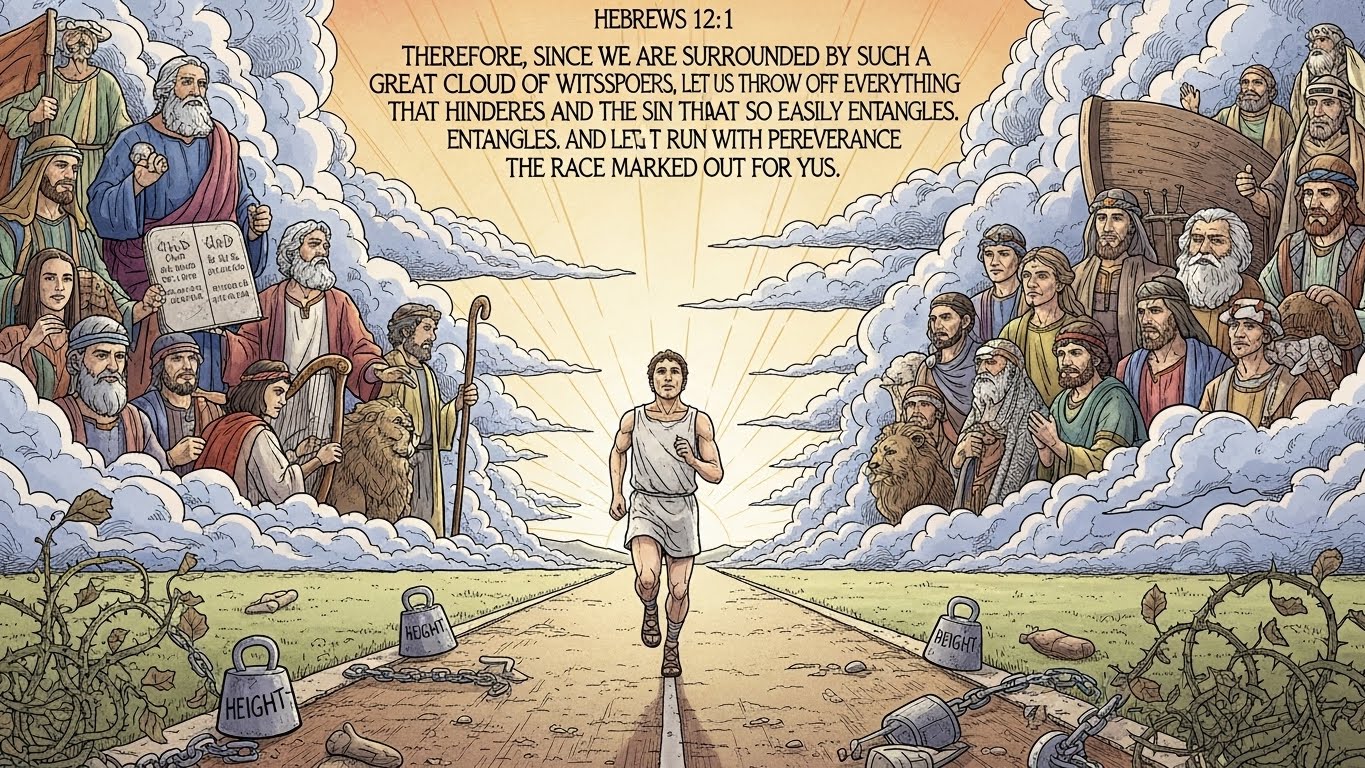
This verse sits in a passage where the writer of Hebrews points back to chapter 11—the hall of faith—full of people like Abel, Noah, Abraham, and Moses. These were faithful people whose stories prove that faith matters. When the author says “surrounded by such a great cloud of witnesses,” he’s pointing to those faithful examples as encouraging observers of your race of faith.
In simple terms: the people of faith who went before you are examples that testify to God’s truth. They have run their race and now, in their stories, they bear witness that trusting God is real. The phrase doesn’t primarily teach about seeing with physical eyes, but about the testimony and example they leave behind to spur you on.
🧠 Understanding the Core Truth
The core idea of Hebrews 12:1 is encouragement toward endurance. You’re pictured as a runner in a race. The “cloud of witnesses” are those who testify—by their lives and by Scripture—that faithfulness to God is worth the cost. Their stories are not just ancient history; they are testimonies that shape your confidence today.
So when you ask, “Can the dead see us?” the biblical thrust is slightly different: you aren’t being watched for performance so much as supported by testimony. Their lives testify to God’s faithfulness, showing you what perseverance looks like so you don’t give up when the race gets hard.
🌊 Going Deeper — The Hidden Meaning
Beneath the encouragement to endurance is a deeper spiritual rhythm: continuity. God’s work spans generations. The “witnesses” point to a community that transcends death—the story of God’s people across time. This isn’t spiritual voyeurism; it’s family legacy. Their faithfulness forms a lineage of hope you now inherit.
Think of Abraham: he left home by faith and later received God’s promise (see Genesis 12:1–3). His life witnessed to future generations. Or take Moses, whose leadership and trust in God shaped a nation (see Hebrews 11:24–27). Their lives don’t become ghostly surveillance; they become instructive examples etched into Scripture, calling you to run with the same trust.
A personal example: when you face a moral crossroads and remember a grandparent’s steady faith, that memory is not just nostalgia; it’s a living witness nudging you toward obedience and trust.
💡 Modern Connection — Relevance Today

How does this ancient metaphor land in 21st-century life? It matters in how you fight discouragement, how you grieve, and how you build your spiritual identity. When you’re tempted to quit, remember that you’re part of a family whose faithful ancestors faced real hardship and trusted God. That truth can change how you respond at work, in parenting, or during illness.
In grief, you might wonder if your loved one is aware of you. Scripture emphasizes relationship with God and the continuity of the family of faith. You can find comfort in knowing your loved one’s faith is part of the testimony that inspires you, even when the Bible doesn’t give a clear, universal answer about spiritual sight or sensory awareness after death.
Practically, remembering the cloud of witnesses can help you replace shame, isolation, or self-centered fear with a sense of being enlisted in a much bigger story—one that includes people who’ve already modeled perseverance.
❤️ Practical Application — Living the Message
This is where faith meets daily life. Here are simple, doable ways to live out the encouragement of Hebrews 12:1:
- Remember the stories: Read a chapter from Hebrews 11 this week. Let one story encourage your next step.
- Throw off what hinders: Identify one habit or distraction that saps your spiritual energy and take a small step to remove it this week.
- Share testimony: Tell someone how an ancestor’s or mentor’s faith helped you. Testimony strengthens both the giver and the listener.
- Persevere practically: Commit to one spiritual discipline—prayer, Scripture reading, or service—for 21 days and track small wins.
These steps help you internalize the witness of the faithful and run your race with renewed resilience.
🌿 Faith Reflection Box
Pause for a moment and ask:
- Who are the people whose faith stories have shaped you?
- How can you honor their witness by living faithfully today?
Key Takeaways:
- The “cloud of witnesses” in Hebrews 12:1 points you to example and testimony more than ghostly observation.
- Those who’ve gone before you form a spiritual lineage that encourages perseverance.
- Apply this by remembering stories, removing hindrances, sharing testimony, and committing to practical faith habits.
👉 Q&A
Q1: Does Hebrews 12:1 mean that the dead are watching me like angels do? Answer: Hebrews 12:1 emphasizes testimony and example rather than a literal picture of the dead peering at you. The “witnesses” are those commended for faith in chapter 11—people whose lives testify to God’s trustworthiness. While Scripture does describe angels watching and ministering (see Hebrews 1:14), the point in Hebrews is encouragement: the faithful of the past urge you on by their stories. Think of it as spiritual mentorship across time, not surveillance. Their lives validate God’s promises and inspire your endurance.
Related: Running the Race of Faith: Hebrews 12:1-2 Devotional
Q2: Can my deceased loved ones see me and comfort me? Answer: The Bible affirms a continued relationship with God after death for believers (see Luke 16:19–31 and 2 Corinthians 5:8). However, Scripture doesn’t give a definitive play-by-play about the sensory experience of the dead observing the living. What you can hold onto is this: their lives and faith remain part of God’s story, and that truth brings comfort. You are encouraged to remember them, celebrate their testimony, and trust that God’s presence brings ultimate connection.
Q3: Should I talk to or pray to my dead relatives? Answer: Scripture directs prayer to God alone (see Matthew 6:9), and the Bible doesn’t endorse attempting to summon or communicate with the dead. However, remembering loved ones, praying for comfort, and thanking God for their influence is both appropriate and healing. You can speak to God about them, ask God to comfort you, and honor their memory through acts of service or legacy. This keeps your focus on God’s presence while commemorating those who inspired your faith.
🙏 Conclusion & Reflection
So can the dead see us? Hebrews 12:1 gives a rich, pastoral image: you are surrounded by a great cloud of witnesses—people of faith whose lives testify to God’s faithful purposes. Whether or not they literally observe you with eyes, their testimony endures and calls you to perseverance. Let that truth shape how you grieve, how you find courage, and how you run your race.
A short prayer you can pray now: Lord, thank you for the faithful witnesses who have gone before me. Help me to learn from their lives, to throw off what holds me back, and to run my race with endurance. Comfort me when I grieve and remind me that I’m part of a lasting story shaped by your love. Amen.

More Inspiration Awaits — Read These Next
 For deeper insight into Isaiah 40:31 and how it renews your strength in both faith and daily life
For practical lessons on compassion and neighborliness from the Good Samaritan
For a clear explanation of what we can learn from the Parable of the Good Samaritan
For meaningful insights from the Parable of the Pearl and its hidden treasures
For a deeper look at the Rich Man and Lazarus and what it reveals about the afterlife
For guidance on the Parable of the Ten Virgins and preparing for God’s Kingdom
For clarity on the Parable of the Lamp and how it calls us to shine our light
For insights from the Parable of the Wedding Feast and the meaning behind the invited guests
 Jesus and the Woman Caught in Adultery – Grace and Mercy Over Judgement
A powerful retelling of John 8:1-11. This book brings to life the depth of forgiveness, mercy, and God’s unwavering love. Check it now on Amazon 


 “Every great message deserves a home online.”


Don’t let your calling stay hidden. Start a Christian blog or website using Hostinger — with 99.9% uptime, a free domain, and SSL, your voice can shine for God’s glory anytime, anywhere. Begin today. Try it RISK-FREE! 

 “Your body is God’s temple — care for it with purpose.”


Renew your energy and restore balance naturally. Mitolyn helps support a healthy metabolism, giving you the vitality to live out God’s calling with strength and confidence.
Unlock Your Metabolic Power!  Burn More Calories & Feel Great With Mitolyn.
Start Today.  Check Price Now.
As a ClickBank & Amazon Affiliate, I earn from qualifying purchases.
 Acknowledgment: All Bible verses referenced in this article were accessed via Bible Gateway (or Bible Hub).
Want to explore more? Dive into our new post on Why Jesus? and experience the life-changing truth of the Gospel!