

What Does The Bible Say About Ghosts And Spirits? (Luke 24:39)

You’ve probably heard a dozen stories—creaky floors at night, an unexplained voice at a family gathering, someone swearing they saw a loved one visiting after they died. You might wonder: what does the Bible actually say about ghosts and spirits? Is there room in Scripture for apparitions and hauntings, or are those experiences something else entirely? Luke 24:39 is a good place to start, because it puts a clear, surprising image in front of you: the risen Jesus inviting skeptics to touch his hands and feet. Let’s walk through that verse and related Scriptures so you can better understand what the Bible teaches—and how that changes the way you think about ghosts, spirits, and encounters with the supernatural.

Introduction
Have you ever wondered whether the TV shows and ghost stories reflect anything in the Bible? Or maybe you’ve wrestled with a personal experience—an unexplainable noise, a vivid dream, or an impression that someone who died is near. Those moments can leave you curious, afraid, or hoping for reassurance. The Bible doesn’t leave you entirely in the dark. Luke 24:39 sits at the heart of this conversation because Jesus addresses the disciples’ fear directly: he shows them that his resurrected body is real and physical, not a mere spirit in the ghostly sense. That matters for your faith and for how you interpret supernatural experiences today.
📖 The Bible Foundation

Luke 24:39 (NIV): “Look at my hands and my feet. It is I myself! Touch me and see; a ghost [or “spirit” in some translations] does not have flesh and bones, as you see I have.”
In context: Luke 24 opens with the women finding the empty tomb, then two disciples on the road to Emmaus, and finally Jesus appearing to the gathered disciples. They are startled and frightened, thinking they see a spirit. Jesus replies with Luke 24:39, inviting them to touch and observe that he has flesh and bones. He even eats a piece of broiled fish to prove his physicality (Luke 24:41-43).
What is Luke doing here? He’s addressing a real fear among the disciples: if Jesus had risen as a ghost, that would change everything about the resurrection. But Luke insists the resurrection is bodily. This verse helps you see that the New Testament distinguishes between the living, embodied resurrection and ghostly apparitions.
🧠 Understanding the Core Truth
At its heart, Luke 24:39 teaches you a simple but powerful truth: Jesus’ resurrection is physical and real. The disciples thought they might be seeing a ghost, but Jesus showed them otherwise. The Bible uses different words for “spirit” and “ghost,” and it’s important to catch that difference. The Greek and Hebrew words behind “spirit” or “ghost” can mean breath, life, or a supernatural being—but Luke intentionally points to the physical evidence of Jesus’ body.
Why does that matter? Because some popular ideas about “ghosts” assume that the dead simply float back and forth in a spectral form. Scripture, however, makes a clear distinction: the believer’s hope is resurrection—a restored, transformed body (see 1 Corinthians 15:42-44). That changes the way you approach stories about hauntings.
🌊 Going Deeper — The Hidden Meaning
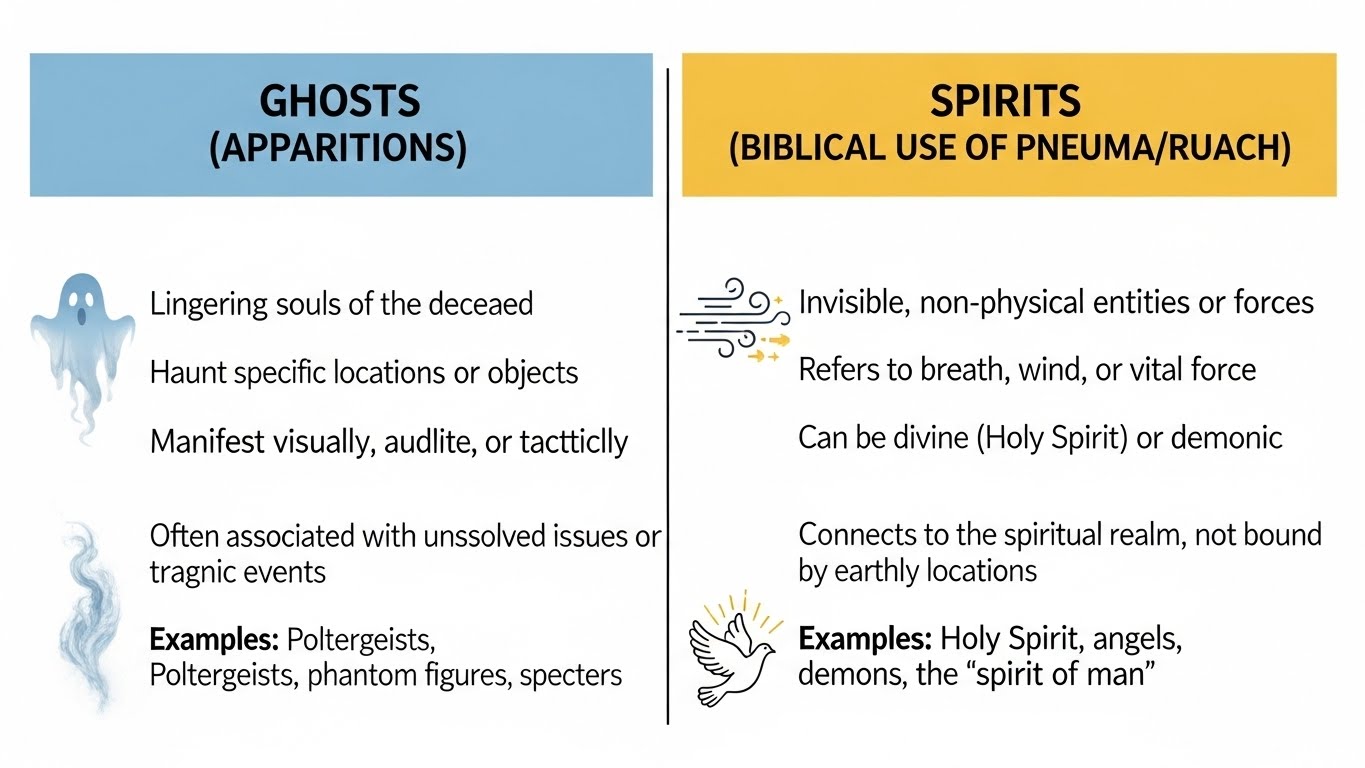
Digging deeper, you’ll find two overlapping biblical truths: (1) There are spiritual beings that aren’t human—angels and demons—and (2) humans die and face judgment (Hebrews 9:27). The Bible records instances where spirits appear—sometimes as angels, other times as demonic deceptions. Consider Acts 16:16-18, where a spirit of divination follows a slave girl—clearly a spiritual being active in the physical world. Then consider 1 Samuel 28:7-20, where Saul seeks the medium of Endor, and an apparition identified as Samuel appears. That strange passage raises difficult questions: was it really Samuel, a demonic impersonation, or a different kind of prophetic event? Many scholars lean toward demonic deception or a unique, God-allowed appearance rather than evidence that the dead routinely roam and appear as ghosts.
A relatable example: imagine someone hears a voice at night that seems like a loved one. The Bible would invite you first to test that experience through Scripture, prayer, and wise counsel (1 John 4:1). You’d be encouraged to look for consistency with God’s character and truth rather than assume the supernatural experience is simply a “ghost visit.”
💡 Modern Connection — Relevance Today
In today’s world, you’ll hear three common responses to supernatural experiences: fear, curiosity, or comfort. The Bible helps you navigate each.
- If fear grips you, Luke’s reassurance about Jesus’ bodily resurrection can be grounding. The Christian hope isn’t a phantom visitation but a future bodily reunion in the presence of God (1 Thessalonians 4:13-18).
- If curiosity draws you to ghost tours or online forums, Scripture invites testing and wisdom (Proverbs 3:5-6).
- If you seek comfort because you miss someone, Scripture offers a richer hope than a ghostly visit—eternal life in a renewed, bodily existence with God (Revelation 21:3-4).
In practical terms: when someone claims a haunting, you can respond calmly—pray, seek biblical counsel, and evaluate whether what’s described aligns with God’s Word. Some situations have natural explanations (grief, sleep paralysis, anxiety), others might involve spiritual opposition that needs prayer and pastoral care.

❤️ Practical Application — Living the Message
So how do you apply Luke 24:39 and the wider biblical picture about spirits and ghosts?
- Anchor your nervousness in truth. Repeat the reality: Jesus rose bodily. That truth reshapes your longing for the dead and your fear of the unknown.
- Test experiences by Scripture. If something contradicts God’s character or the gospel, it’s not from God (1 John 4:1-3).
- Seek wise spiritual help. Pastors, trusted Christian counselors, and mature believers can help discern whether an experience needs prayer, practical care, or medical attention.
- Practice comforting discipline. If you’re grieving, focus on prayers of surrender, reading resurrection passages (1 Corinthians 15, 1 Thessalonians 4), and memorial practices that point to hope rather than lingering in the idea of ghostly encounters.
These steps help you move from fear or speculation into faith-filled, wise action.
🌿 Faith Reflection Box
Take a quiet moment: What do you most fear about death and the unknown—loss of relationship, being alone, or something else? How does the reality of Jesus’ resurrection change that fear?
Key Takeaways
- The Bible on ghosts and spirits distinguishes between bodily resurrection and ghostly apparitions.
- Luke 24:39 shows Jesus’ resurrection was physical—he wasn’t a ghost.
- Test supernatural experiences by Scripture, prayer, and wise counsel.
- Your hope is bodily resurrection and eternal life, not spectral visits.
👉 Q&A
Q1: Does Luke 24:39 mean ghosts don’t exist at all?
Answer: Luke 24:39 doesn’t deny the existence of spiritual beings; it specifically denies that Jesus’ resurrection was a ghostly apparition. The Bible affirms spiritual realities—angels, demonic forces, and the unseen world (Ephesians 6:12). But it also clarifies that the dead don’t simply wander back as ordinary ghosts. Instead, biblical hope centers on resurrection. So, while the Bible recognizes spirits, it gives a different framework than popular ghost stories. Test any claimed supernatural encounter against Scripture, wise counsel, and the character of God.
Related: What Does The Bible Say About Life After Death? (John 11:25–26)
Q2: What about the Witch of Endor (1 Samuel 28)—did Samuel really appear?
Answer: 1 Samuel 28 is a complex and debated episode. Some read it as the true appearance of Samuel (allowed by God); others see it as demonic deception through the medium or a prophetic act. Either way, it’s not a template that says the dead freely appear to us. The passage warns against seeking mediums (Leviticus 19:31) and directs people to trust God’s revelation instead. So treat the story as cautionary and theologically complex, not proof that ghostly visits are normal or safe. Scripture prioritizes God’s authority over occult practices. (See 1 Samuel 28:7-20)
Q3: How should I respond if someone says they saw a dead relative?
Answer: Be compassionate and gentle—grief can take many forms. At the same time, encourage biblical testing. Ask for details, pray with the person, and help them reflect on whether the experience aligns with Scripture’s character of God (1 John 4:1). If the person is distressed, recommend pastoral care or counseling. Remind them gently of the biblical hope of resurrection and reunion (1 Thessalonians 4:13-18), which offers deeper comfort than a single unexplained occurrence.
See also: What Is The Spirit Of Man?
🙏 Conclusion & Reflection
Luke 24:39 invites you to touch reality: your Savior rose in a body that could be seen and touched. That anchors you in the hope of resurrection, not in fleeting ghost stories. The Bible recognizes a world of spiritual forces, but it invites you to respond with Scripture, prayer, and wise community. When the creaky floorboards at night or the sudden dream of a loved one surfaces, you don’t have to panic. Anchor your heart in Jesus’ resurrection, test the experience biblically, and seek care when you need it.
A short prayer: Jesus, thank you that you rose bodily and that death does not have the last word. Help me to test what I experience, to seek wisdom, and to cling to the hope of resurrection. Comfort me in grief and guard my heart against fear. Amen.

More Inspiration Awaits — Read These Next
 For deeper insight into Isaiah 40:31 and how it renews your strength in both faith and daily life
For practical lessons on compassion and neighborliness from the Good Samaritan
For a clear explanation of what we can learn from the Parable of the Good Samaritan
For meaningful insights from the Parable of the Pearl and its hidden treasures
For a deeper look at the Rich Man and Lazarus and what it reveals about the afterlife
For guidance on the Parable of the Ten Virgins and preparing for God’s Kingdom
For clarity on the Parable of the Lamp and how it calls us to shine our light
For insights from the Parable of the Wedding Feast and the meaning behind the invited guests
 Jesus and the Woman Caught in Adultery – Grace and Mercy Over Judgement
A powerful retelling of John 8:1-11. This book brings to life the depth of forgiveness, mercy, and God’s unwavering love. Check it now on Amazon 


 “Every great message deserves a home online.”


Don’t let your calling stay hidden. Start a Christian blog or website using Hostinger — with 99.9% uptime, a free domain, and SSL, your voice can shine for God’s glory anytime, anywhere. Begin today. Try it RISK-FREE! 

 “Your body is God’s temple — care for it with purpose.”


Renew your energy and restore balance naturally. Mitolyn helps support a healthy metabolism, giving you the vitality to live out God’s calling with strength and confidence.
Unlock Your Metabolic Power!  Burn More Calories & Feel Great With Mitolyn.
Start Today.  Check Price Now.
As a ClickBank & Amazon Affiliate, I earn from qualifying purchases.
 Acknowledgment: All Bible verses referenced in this article were accessed via Bible Gateway (or Bible Hub).
Want to explore more? Dive into our new post on Why Jesus? and experience the life-changing truth of the Gospel!