


Spiritually Exhausted? How God Renews Your Strength
Intro
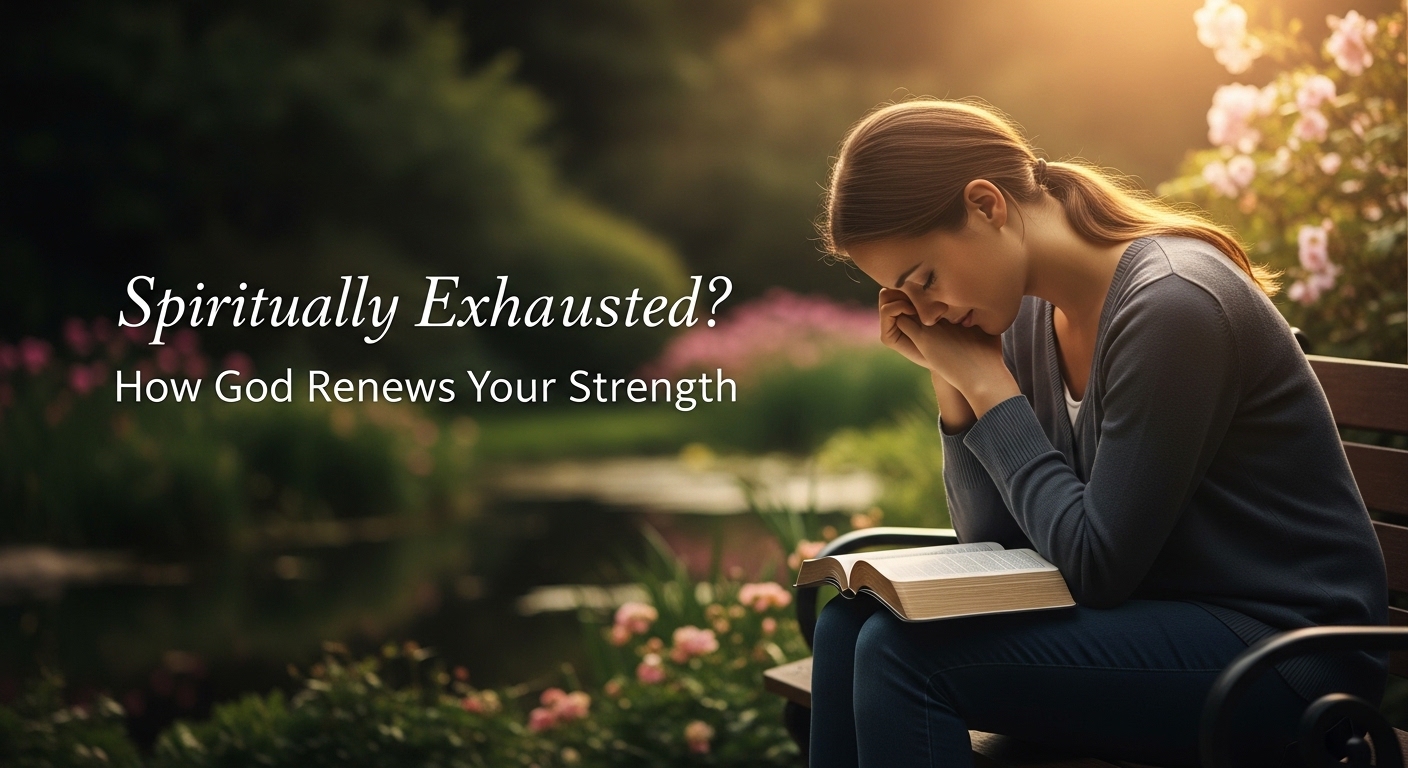
You’re tired in a way that doesn’t go away with sleep. You feel thin at the edges—fewer reserves, fewer prayers that land, fewer mornings that feel hopeful. Maybe you’ve been doing the right things: showing up for worship, praying, reading Scripture, but the heaviness keeps returning. That kind of exhaustion can feel personal, shame-filled, and confusing because you expected faith to fix this faster.
You’re not the only one. Many people who follow Jesus find themselves returning to the same valley—anxiety or spiritual numbness that reappears even after seasons of growth. The Bible shows honest saints who were worn out, bewildered, and ready to quit. Their stories remind you that exhaustion doesn’t mean you’ve failed; it means you’re human and in need of God’s renewing touch.
There is good news: God promises to renew strength. Over the next few minutes you’ll find compassionate explanation, biblical pathways to rest, simple practices to help you breathe and pray, and a steadier, slower map for deep change. If you want a fuller biblical foundation for sustained spiritual health, I’ll point you to a longer pillar resource at the end. For now, let’s begin where you are—worn, hopeful, and wanting God to do what only He can do.
Sponsored recommendation

Why This Feels So Hard
When you’re spiritually exhausted, the experience is more than just being tired. It’s mental, emotional, and visceral. Your mind replays the same worries and defeats, and you begin to fear that your faith isn’t enough. That fear drains your energy and sometimes keeps you from praying the honest prayers you need to say.
Part of the weight is mental exhaustion. You’ve likely been carrying responsibilities, decisions, and relational strain for a long time. Cognitive load makes everything feel heavier; simple choices are draining. This mental fatigue makes spiritual practices feel like chores instead of lifelines, because your capacity to engage thoughtfully is low.
You’re also stuck in repeated cycles. Maybe you pray earnestly for a season and experience relief, only to return to worry or bitterness later. Those starts and stops wear you down. Every relapse leaves you feeling exposed and ashamed: why didn’t you stay “fixed”? That pattern erodes trust in yourself and, briefly, in God’s provision.
Fear of losing control is another major factor. When your spiritual life feels fragile, you instinctively tighten your grip—trying harder to manage your prayers, your behavior, and your image. That hard grip exhausts you more. The paradox of rest in the Christian life is that the stronger you try to hold on to control, the more your strength leaks away. You’re thinking: “This understands me,” and it does—because these are common dynamics. You’re not failing; you’re human and in need of a different, gentler way.

What Scripture Shows Us to Do
Scripture gives you commands, invitations, promises, and examples that point toward renewal, and these are meant to guide you, not shame you. One of the clearest invitations is Jesus’ offer: “Come to me, all you who are weary and burdened, and I will give you rest.” This is not a one-time sales pitch; it’s an ongoing invitation to trade your heavy load for his sustaining presence.
The Bible also offers commands that help shape a life of renewal when you’re ready to receive them. For example, God tells you to “be still” and recognize his sovereignty: “Be still, and know that I am God.” That stillness is not passivity; it’s an intentional posture of trust that breaks the cycle of frantic control.
There are promises you can cling to when exhaustion steals your hope. Isaiah assures you that those who wait on the Lord will renew their strength: “Those who hope in the Lord will renew their strength. They will soar on wings like eagles.” That image of being lifted is not a one-off miracle but the steady rebuilding of life by God’s power.
Scripture also gives examples of people who were spiritually depleted and received God’s renewal. Elijah, for example, fled into the wilderness and begged for death; God met him in that broken place with rest, food, and a renewed mission 1 Kings 19:4-8. Seeing Elijah’s story helps you notice that God often meets you gently—rather than with a scolding—and that rest can be a divine provision, not a personal luxury.
A Simple Way to Practice Faith Right Now
You don’t need a long checklist or a perfect morning routine to invite God’s renewal. You can practice small, repeatable habits that reorient your body and mind toward God’s presence. The aim is to create sticky, simple practices you will actually use when you’re tired.
Start with breath and prayer. Take three slow, steady breaths. On the inhale, name one thing that is true about God in your mind. On the exhale, offer a short prayer phrase: “Lord, I need you.” Repeat this rhythm five or ten times. The combination of breath and a short prayer calms your nervous system and gives your wandering mind something to anchor to.
Use a short verse for meditation. Pick one verse you can repeat for a week. Try Philippians 4:6–7 as a two-line meditation: “Do not be anxious about anything. Pray with thanksgiving.” Repeat it slowly three times when you feel your heart accelerate. Let the phrase be your practice, not your performance.
Use a surrender statement. When control is tempting, speak a simple sentence out loud: “I surrender this to you, Lord. Help me trust.” Surrender doesn’t mean passivity; it redirects your energy from fixing everything to placing what you can’t carry into God’s hands.
Pivot with gratitude. When exhaustion makes everything gray, identify one small gift—sunlight on your hand, a kind text, a hot cup of something—and thank God for it. Gratitude is not a way to deny pain; it’s a reorientation that makes space for hope.
These methods are practical and sticky because they require very little and can be repeated anywhere. They are meant to help you practice faith in manageable ways, not to add obligations to your plate.

Where Real Change Slowly Happens
If the simple practices help you breathe today, know that deep change often unfolds more slowly. Renewal is not a single breakthrough but a daily, grace-driven process that reshapes your character and recalibrates your rhythms.
Real transformation usually follows a pattern: small repeated actions that bend your life toward God’s reality. You might begin with a five-minute verse practice that eventually grows into a daily habit of Scripture and silence. You might start by surrendering one small worry each morning and find that your capacity for trust widens over months.
Allow grace one step at a time. You will have setbacks. Some days you’ll sleep poorly or return to old patterns. That doesn’t erase progress. The Christian life is framed by God’s patience. “The Lord is compassionate and gracious, slow to anger, abounding in love.” When you stumble, God continues to lead you gently forward.
Community matters in this slow work. Real change is rarely solitary: a trusted friend, a small group, or a mentor can help you stay accountable, process your pain, and celebrate incremental progress. You can’t carry everything alone, and God often uses others as instruments of your rest.
Finally, measure success differently. Instead of success = absence of struggle, consider success = increased capacity to come back to God in honesty. If you find yourself able to say, “I’m broken and I need help,” that moment is a marker of change. It shows your heart is learning to rely on God rather than on your own performance.

Learn the Bigger Picture of Mental Health & Faith
Your spiritual exhaustion sits at the intersection of mental, emotional, and spiritual life. A healthy theology recognizes that God cares for your whole person—mind, body, and soul. The Christian story doesn’t force faith and mental health into competition; instead, it invites an integrated approach where prayer, rest, medical care, counseling, and community all have roles in your healing.
For a fuller biblical foundation on how God brings peace and stability to your inner life, see Finding Rest for Your Soul: Jesus’ Invitation to the Weary. That pillar resource lays out a sustained framework for how prayer, rhythm, and theological formation work together to produce long-lasting restoration. If you want to build a durable spiritual life that weathers hard seasons, that resource will guide you deeper into the practices and theology you need.
Also consider reading sibling guides that work well with this piece: Too Tired To Pray? What To Do Instead and How Sabbath Principles Restore Mental Health. Those micros offer practical next steps and complementary exercises to the ones here. If you want a biblical character example of someone who wrestled with despair and found God’s care, explore Lessons From The Life Of David—his Psalms are honest prayers from a wounded but trusting heart.
Other Biblical Stories That Give Hope
The Bible is full of people who experienced deep exhaustion and found God’s renewal in surprising ways. Their stories give you permission to be honest and examples of how God’s care looks in different seasons.
David: A shepherd, warrior, and poet, David wrote many Psalms from places of fear and exhaustion. His honesty gives you language for lament and a model for bringing raw emotion before God. See David’s laments and trust in passages like Psalm 23 and Psalm 51.
Joseph: Sold into slavery, betrayed by brothers, and imprisoned, Joseph’s journey shows long seasons of waiting and the slow unfolding of God’s purpose. Your waiting may feel indefinite, but Joseph’s story reminds you that God can redeem a painful timeline. Read Joseph’s early trials in Genesis 37 and his later vindication.
Job: In the depths of loss and confusion, Job represents raw questioning and the process of wrestling with God when life makes no sense. His honesty shows that faith can include complaint, and that God’s presence remains even when answers are absent. Start at Job 1 to see his initial losses and move through his dialogues.
Ruth and Esther: These women provide hope in different ways—Ruth through faithful perseverance in quiet hardship, and Esther through courage and trust in a scary season. Their lives remind you that faithful endurance and brave faith are both honored by God. See Ruth’s loyalty in Ruth 1 and Esther’s courage in Esther 4.
Each character’s story invites you to bring your own exhaustion to God, trusting that He can use your fatigue to refine faith and reveal unexpected strength.
A Short Prayer for This Moment
When you’re pressed and unsure what to say, a short prayer can carry your heart into God’s hands. You can use this as a template and speak it slowly, aloud or inside:
Lord, I come to you tired and worn. I don’t have words for everything I feel, but I bring what I have. Renew my strength today. Help me to trust you with my fear, to rest when you call me to rest, and to receive your kindness without guilt. Guard my mind from spirals and help me see one small step toward you right now. Amen.
If it helps, close your eyes and breathe slowly as you pray, repeating the phrase “renew my strength” quietly on each exhale. Let the prayer be less about getting it right and more about opening your hands to God’s care.
Practical Steps You Can Start This Week
Change feels less daunting when you focus on tiny, consistent steps. Try these practical actions and tailor them to your life:
- Pick one short verse for the week, like Psalm 46:10, and say it slowly each morning.
- Block one 15-minute slot in your calendar for silence—no phone, no tasks—just your breath and a simple prayer.
- Tell one trusted friend or small group that you’re struggling and ask them to check in midweek.
- Replace one “should” with a “thank you” each day—turn a self-demanding thought into a simple gratitude.
These actions build momentum. They are small enough that you can do them on tired days but meaningful enough to shift your trajectory over time.
How to Notice God’s Work Over Time
God’s renewing work is often quiet. To see it, pay attention to small inner shifts rather than dramatic overnight fixes. Notice if you:
- Can pray with a little more honesty than before.
- Feel less compelled to manage every outcome.
- Experience brief pockets of calm in a previously chaotic day.
- Return more quickly from a spiral than you used to.
Keep a simple journal—one sentence each evening about where you saw God at work. Over weeks, those sentences create a visible trail of grace. When you look back, you’ll see patterns you would have missed in the daily fog.
When to Seek Additional Help
Renewal includes wise, practical help. If you experience severe depression, suicidal thoughts, or persistent inability to function, seek professional support. A counselor, pastor, or medical professional can walk alongside you with tools and care that complement spiritual practices. Faith and therapy are not opposed; they are companions in the work of healing.
If you’re unsure where to start, ask a trusted church leader for a referral or call your doctor. If you’re in immediate danger, reach emergency services right away. Seeking help is not a sign of weak faith; it’s an act of stewardship of the life God has given you.
Small Rhythms That Anchor Your Day
Rhythms are not rigid rules; they are gentle structures that help your life pattern toward God. Consider a few anchors you can adapt to your schedule:
- Morning anchor: a 5-minute prayer and a single verse.
- Midday anchor: a two-minute breathing prayer or a gratitude note.
- Evening anchor: a brief reflection on one good thing from the day.
These simple rituals help you reclaim your inner life gradually. Over time, those small habits form a scaffold for the deeper rest God offers.
Recommended Resources & Next Steps
If this article encouraged you, keep going with resources that expand the ideas here. For a deeper, biblical foundation about resting in Jesus and building a resilient inner life, read Finding Rest for Your Soul: Jesus’ Invitation to the Weary. It offers theological depth, pastoral guidance, and practical rhythms for sustained restoration.
Also explore sibling micros that offer practical next steps: Too Tired To Pray? What To Do Instead and How Sabbath Principles Restore Mental Health. These short guides will give you exercises and templates to use in daily life. If you want an example of a biblical heart that wrestled honestly and found God’s presence, spend time in the Psalms of David—his prayers are a companion to your own.
Final Encouragement
You don’t have to pretend you’re fine. God meets you in your low places, often with quiet care rather than dramatic fixes. When you bring your exhaustion to him, you’re not showing failure—you’re practicing trust. Allow yourself small, faithful steps today: a breath, a verse, a prayer, a short rest. Over time, those tiny practices invite God to rebuild you from the inside out.
Remember that renewal is a relationship, not a checklist. God walks beside you through slow progress, repeated setbacks, and surprising awakenings. Keep returning to him in honesty. He is patient, present, and committed to lifting you up.
Sponsored recommendation
Acknowledgment: All Bible verses referenced in this article were accessed via Bible Gateway (or Bible Hub).
“Want to explore more? Check out our latest post on Why Jesus? and discover the life-changing truth of the Gospel!”