

What Is Sheol In The Bible? (Psalm 16:10)

Have you ever read a Bible verse that made you pause, feeling like you’re peeking into a world you don’t fully understand? Psalm 16:10 is one of those lines. It says something about not being abandoned to Sheol — a word that doesn’t show up in everyday conversation. You might wonder: What exactly is Sheol in the Bible? Is it the same as hell? Did Jesus go there? Why does this matter for your faith today?
You’re not alone in asking these questions. Understanding Sheol helps you read Scripture more faithfully, wrestle with death and hope, and see how the Bible points you to Jesus. In this article, you’ll get a clear, accessible explanation of Sheol in the Bible, why Psalm 16:10 matters, and how this ancient idea connects to your life and hope today.

Introduction
You’ve likely encountered the word Sheol while reading the Old Testament or hearing a sermon. It can feel foreign, almost like a biblical technical term tucked away in the margins. But Psalm 16:10 brings Sheol into the center of a promise: God will not abandon the faithful to Sheol. That promise grips the heart because it touches the deepest fear you have — being abandoned by God after death.
This matters because how you understand Sheol shapes how you read stories about death, resurrection, and God’s final victory. When Psalm 16:10 is read in the light of Scripture, it doesn’t leave you stuck in ancient ambiguity — it points you toward the gospel and the hope you can hold even in the face of death.
📖 The Bible Foundation
Psalm 16:10 (NIV): “because you will not abandon me to the realm of the dead, nor will you let your faithful one see decay.”
Psalm 16 is traditionally attributed to David, though scholars sometimes discuss authorship more broadly. The verse is a confident declaration: the psalmist trusts God not to abandon him “to the realm of the dead” — that Hebrew word often translated “Sheol.” In plain terms, the psalmist is saying, “God, you won’t let me be left in that shadowy state where life is extinguished and decay rules.”
The New Testament quotes this verse in two important places. Peter cites it in his sermon at Pentecost, applying it to Jesus and the promise of resurrection (Acts 2:25-31). Paul also uses the idea when explaining Christ’s victory over death (Acts 13:35-37). These New Testament uses help you see that Psalm 16:10 doesn’t just reflect an Old Testament hope — it becomes part of the fuller biblical story about God bringing life out of death.
Acts 2:27 (NIV) — “because you will not abandon me to the realm of the dead, you will not let your holy one see decay.”
🧠 Understanding the Core Truth
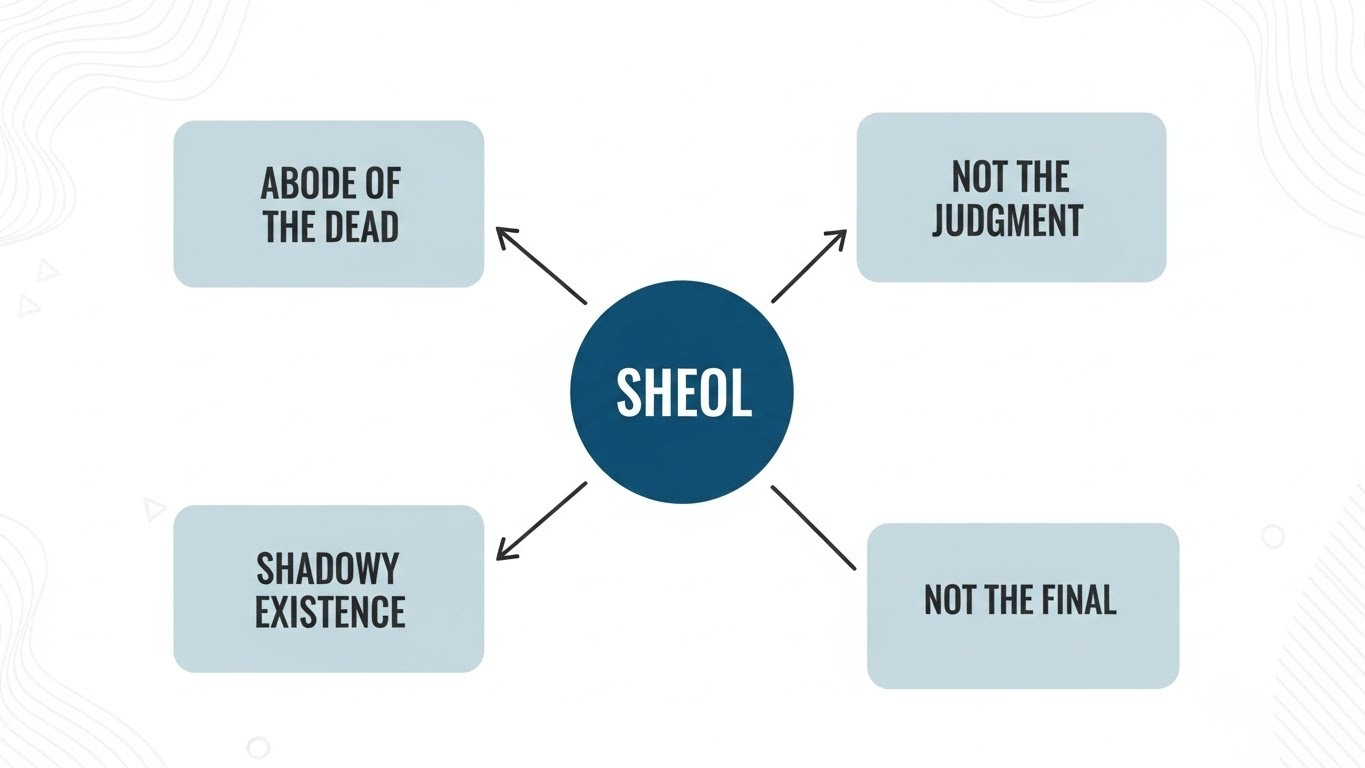
In simple words, Sheol in the Bible refers to the abode of the dead — a place or state where people go after death. For the ancient Hebrews, Sheol was not the hot, fiery place of later Christian imagery (that’s a different word, Gehenna). Instead, Sheol was often pictured as a shadowy, silent domain where life continued in a diminished way — no more direct participation in the living world’s joys and duties.
The core truth Psalm 16:10 communicates is trust: God acts to defeat the finality of death. Whether the psalmist, the community, or later New Testament writers saw Sheol as a place of punishment or simply the grave, the promise is clear — God does not abandon His faithful to that state forever. This points forward to resurrection and restoration, the central hope of Christian faith.
🌊 Going Deeper — The Hidden Meaning
When you unpack the deeper lesson behind Sheol, you see a spiritual pattern: Scripture moves from recognizing death’s reality to revealing God’s plan to overcome it. In early Hebrew thought, Sheol was often a neutral or gloomy state (e.g., Ecclesiastes 9:10 notes the end of activity at death), but later biblical texts and the New Testament show God’s work to redeem life from death.
Example: Jonah cries out from the belly of the fish, using language close to Sheol, and God rescues him (Jonah 2:2). More significantly, the apostles interpret Psalm 16 as a prophecy pointing to Jesus’ resurrection from the dead. That tells you the Bible doesn’t leave Sheol as an eternal endpoint; God’s redemptive movement climbs out of that shadow and into resurrection life.
This hidden meaning matters because it reframes death from being the final catastrophe to being a conquered enemy through Christ (see Hebrews 2:14-15). God’s plan rescues, restores, and re-creates.
💡 Modern Connection — Relevance Today
You probably don’t talk about Sheol in casual conversation, but the question behind it — what happens after death? — is one you face regularly: in funerals, in grief, or when confronting your own mortality. Psalm 16:10’s promise offers a practical comfort: God is not passive in death. He acts.
For you, that means grief is not the last word. While the emotional reality of loss lingers, the Christian message reassures you that death does not finally separate you from God’s purposes. This transforms how you grieve, how you live with loved ones, and how you approach fear. You can face mortality with faith because God’s story includes resurrection and restoration.
❤️ Practical Application — Living the Message
How do you live out this truth today? Start simple:
- Name your fears about death in prayer. Honest talk with God opens the door to peace.
- Anchor your hope in Scripture that points to resurrection and life in Christ. Let passages like Psalm 16 and the resurrection accounts shape your hope.
- Let the reality of hope change how you care for others. When you believe God redeems suffering and death, your compassion becomes deeper and more courageous.
These small actions aren’t just religious tasks — they form a faith that meets real life, comfort for the grieving, and courage for the living.
🌿 Faith Reflection Box
Take a moment. Where do you feel stuck between fear and hope about death? How might trusting God’s promise in Psalm 16:10 change the way you pray, love, or grieve this week?
Key Takeaways
- Sheol in the Bible is the Hebrew concept of the realm or state of the dead — often shadowy, not final.
- Psalm 16:10 promises that God will not abandon the faithful to Sheol — a foreshadowing of resurrection.
- The New Testament applies this promise to Jesus’ victory over death, giving you a living hope.
- Practically, this truth invites honest prayer, Scripture-rooted hope, and acts of compassionate living.
👉 Q&A
Q1: Does Psalm 16:10 prove Jesus descended into Sheol and was resurrected?
Answer: Psalm 16:10 doesn’t function as a step-by-step biography, but the New Testament interprets it in light of Jesus’ death and resurrection. Peter quotes the verse in Acts 2:27-31 to argue that David foresaw the Messiah’s victory over death — that the Holy One would not remain in the realm of the dead. The apostles use Psalm 16 as part of their case that Jesus’ resurrection fulfills God’s promise to defeat the finality of death. This doesn’t create a rigid chronological itinerary of where Jesus went after death, but it affirms the theological truth: death did not have the last word. See: Acts 2:27.
Related: What Happens After We Die According To The Bible? — Hebrews 9:27
Q2: Is Sheol the same as hell in the New Testament?
Answer: Not exactly. In the Old Testament, Sheol generally means the abode of the dead — a shadowy, neutral realm. New Testament Greek uses Hades in similar ways, but the word “hell” in many English translations often represents Gehenna, a separate idea tied to final judgment. Over time, theological usage shifted and sometimes merged these images, but originally Sheol/Hades and Gehenna served different functions: one describes the state/place of the dead, the other describes final, punitive judgment. Context matters for accurate interpretation. See: Ecclesiastes 9:10 and Matthew 10:28.
See also: Do Christians Go To Heaven Immediately After Death? (2 Corinthians 5:8, Philippians 1:23)
Q3: How should belief in Sheol shape my hope for loved ones who have died?
Answer: Belief about Sheol should lead you to trust God’s character — His love, justice, and power to redeem. Psalm 16:10 and New Testament teaching point you toward resurrection hope: death is not the final defeat. While grief and questions remain, the Christian hope is rooted in the promise that God acts to bring life out of death. This doesn’t erase sorrow but gives you a confident expectation that God’s story includes renewal. Let Scripture and prayer be your companions in grief. See: 1 Thessalonians 4:13-14 and John 11:25-26.
🙏 Conclusion & Reflection
Sheol in the Bible began as an honest attempt to name the mystery and sorrow of death. Psalm 16:10 turns that naming into a promise: God will not leave you in the shadows. The New Testament reads this promise through the life, death, and resurrection of Jesus, revealing that God’s ambition is not merely to explain death but to defeat it and bring you into restored life.
Let that sink in. When you face loss or fear, you have a hope bigger than your questions. Pray with honesty, cling to Scripture, and let the community of faith carry you forward. May you live in the confidence that the God who refused to abandon His own to the realm of the dead is the same God who walks with you now and forever.
A short prayer: Lord Jesus, thank you that death is not the end. You conquer the darkness and bring life. Help me trust your promise, grieve with hope, and live with bold compassion until you make all things new. Amen.

More Inspiration Awaits — Read These Next
 For deeper insight into Isaiah 40:31 and how it renews your strength in both faith and daily life
For practical lessons on compassion and neighborliness from the Good Samaritan
For a clear explanation of what we can learn from the Parable of the Good Samaritan
For meaningful insights from the Parable of the Pearl and its hidden treasures
For a deeper look at the Rich Man and Lazarus and what it reveals about the afterlife
For guidance on the Parable of the Ten Virgins and preparing for God’s Kingdom
For clarity on the Parable of the Lamp and how it calls us to shine our light
For insights from the Parable of the Wedding Feast and the meaning behind the invited guests
 Jesus and the Woman Caught in Adultery – Grace and Mercy Over Judgement
A powerful retelling of John 8:1-11. This book brings to life the depth of forgiveness, mercy, and God’s unwavering love. Check it now on Amazon 


 “Every great message deserves a home online.”


Don’t let your calling stay hidden. Start a Christian blog or website using Hostinger — with 99.9% uptime, a free domain, and SSL, your voice can shine for God’s glory anytime, anywhere. Begin today. Try it RISK-FREE! 

 “Your body is God’s temple — care for it with purpose.”


Renew your energy and restore balance naturally. Mitolyn helps support a healthy metabolism, giving you the vitality to live out God’s calling with strength and confidence.
Unlock Your Metabolic Power!  Burn More Calories & Feel Great With Mitolyn.
Start Today.  Check Price Now.
As a ClickBank & Amazon Affiliate, I earn from qualifying purchases.
 Acknowledgment: All Bible verses referenced in this article were accessed via Bible Gateway (or Bible Hub).
Want to explore more? Dive into our new post on Why Jesus? and experience the life-changing truth of the Gospel!