


What Is Soul Sleep? (2 Corinthians 5:8)

TL;DR — Simple Answer
You’ll find two main biblical views on what happens after death: “soul sleep” says the believer is unconscious until the resurrection, while the more common New Testament picture emphasizes conscious presence with Christ at death (see 2 Corinthians 5:8). The core biblical meaning centers on hope in Christ’s victory over death — whether you interpret the intermediate state as restful sleep or immediate fellowship with Jesus, the promise is resurrection, restoration, and being with the Lord.

Introduction
This question matters because death presses on every disciple’s life — your grief, your fear about the future, your hope for eternity. How you understand the moment between death and the final resurrection shapes your prayer life, your comfort when you lose a loved one, and your confidence in God’s plan for salvation. As a Christian, you don’t come to the Bible as a neutral spectator; you come as someone trusting Jesus, wanting clarity that points you to Him rather than to speculation. In that spirit, we’ll look at the phrase tucked into 2 Corinthians 5:8 and wider Scripture to show what God reveals about death, presence with Christ, and the promise of resurrection.
I’ll keep it pastoral and text-driven: Scripture will guide us, and Jesus will remain the center of our hope. You’ll get a straightforward explanation of common claims, a survey of the key biblical passages, and practical application so this doctrine helps rather than frightens you.
Simple Biblical Meaning
“Soul sleep” is a theological term that tries to describe what happens to a person’s conscious state after death and before the final resurrection. In plain language, it says that when you die you enter an unconscious “sleep” until Christ returns and raises the dead. Proponents say this view preserves the biblical imagery of death as sleep (e.g., John 11:11; 1 Thessalonians 4:13–15) and guards against notions of an immortal soul that lives apart from God.
But the Bible uses varied images. Some passages describe death as sleep (the dead “sleep in Jesus” in 1 Thessalonians), while other verses describe being “present with the Lord” immediately after death (Philippians 1:23; Luke 23:43). The simple biblical meaning you should carry away is this: death is not the end. God, through Christ, has defeated death. Whether the intermediate state is best described as unconscious rest or conscious fellowship with Christ, Scripture’s central teaching is hope: believers belong to Jesus, and death leads to resurrection and eternal life with Him.
What Does the Bible Say?
When you study Scripture, you’ll notice a few recurring themes: death is sometimes pictured as “sleep,” the righteous are destined to rise at the last day, and there are texts that depict immediate presence with the Lord. Let’s summarize a few key passages in context — who is speaking, who is being addressed, and what is happening.
- 2 Corinthians 5:8 (Paul writing to the Corinthian church): Paul comforts believers with confidence that to be “absent from the body” is “to be present with the Lord.” He’s addressing concerns about mortality and encouraging faithful living while awaiting the eternal home.
- 1 Thessalonians 4:13–18 (Paul’s pastoral encouragement): Paul uses “sleep” imagery for the dead in Christ and promises the Lord’s return, when those who have died will be raised. This passage comforts churches’ grieving believers.
- Philippians 1:21–24 (Paul’s personal reflection): Paul expresses a tension — wanting to remain for ministry, but also desiring to depart and be with Christ. This sounds like an immediate experience of being “with Christ” at death.
- Luke 23:43 (Jesus to the thief on the cross): “Today you will be with me in paradise.” Jesus promises immediate presence, which many read as evidence against soul sleep.
- See Luke 23:43 (NIV).
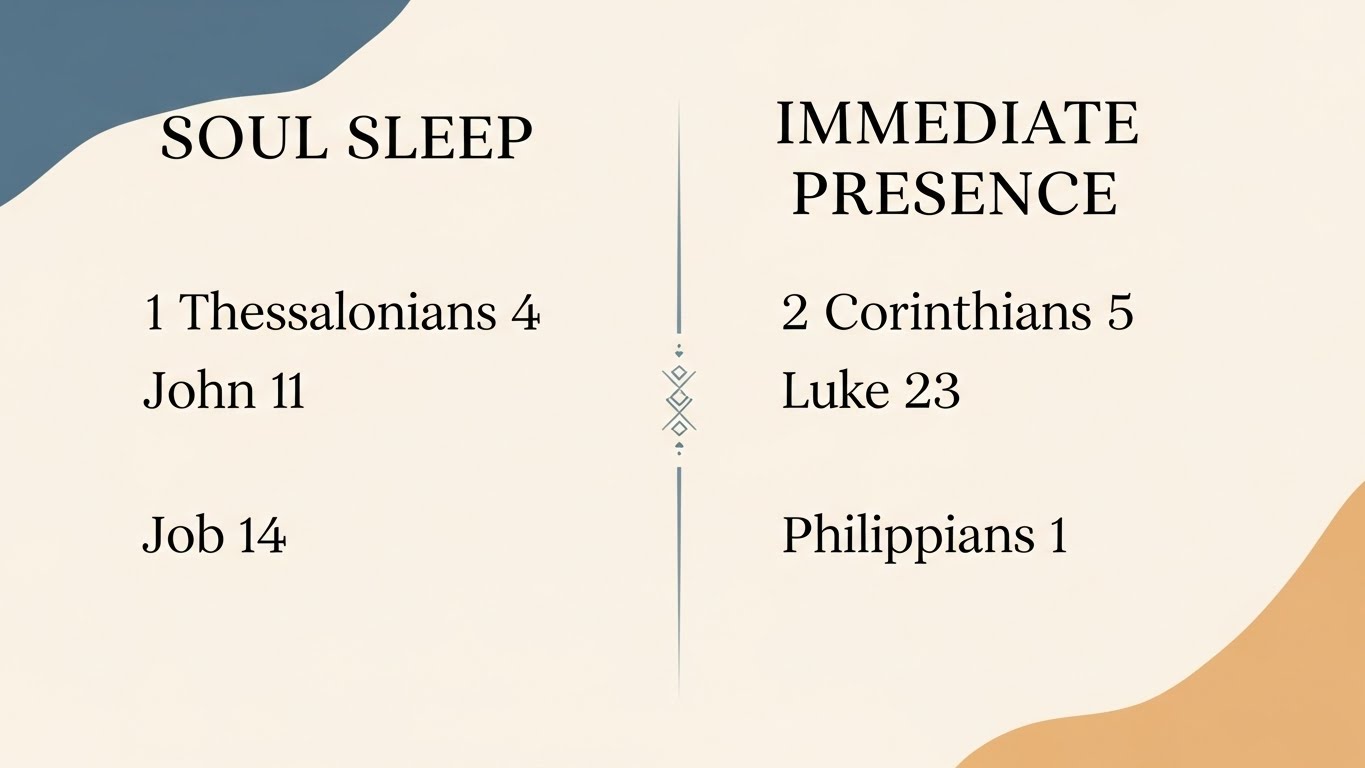
These passages show the Bible uses a mix of imagery and teaching. The pastoral takeaway: Scripture encourages you to trust Christ about death, not to win a debate about how consciousness functions after death.
The Bible Foundation
Bible verse here — 2 Corinthians 5:8 (NIV): “We are confident, I say, and would prefer to be away from the body and at home with the Lord.”
Read the verse on Bible Gateway: 2 Corinthians 5:8 (NIV).
This verse is central to the conversation because Paul uses it to comfort and direct attention away from the fear of dying. He’s not laying out philosophical anthropology; he’s offering pastoral assurance: death does not separate the believer from Christ’s presence.
QUICK ANSWERS PEOPLE ASK (PAA SECTION)
- What does “soul sleep” mean?
Soul sleep teaches that after death, a person is unconscious and “asleep” until the final resurrection. It leans on sleep imagery in Scripture and argues against the immortality of the soul as independent of God. - Does the Bible clearly teach soul sleep?
The Bible does not give a single, unambiguous statement that fits the modern “soul sleep” system. Instead, Scripture mixes images — sleep, immediate presence with Christ, and future resurrection — and centers on Christ’s victory over death. - If soul sleep isn’t clearly taught, does that mean we can’t hope?
Not at all. Regardless of the intermediate-state model you prefer, Scripture is unified in its hope: Jesus has conquered death, and believers will be raised and be with the Lord forever.
GOD’S PURPOSE, PROTECTION & PROMISE
God’s sovereign purpose in death and resurrection is redemptive and relational. He does not abandon you to oblivion nor to isolation. In Christ, God promises restoration: you are being made ready for an eternal, glorified life in the presence of the Father through the Spirit.
Christ’s role is central. Jesus’ death and resurrection change the meaning of death: it’s no longer a final defeat but a doorway to fullness in Christ. The Spirit is the guarantee of your future resurrection (Ephesians 1:13–14). Death is under God’s jurisdiction, not a random end. You can trust God’s protection: He preserves you for an inheritance (1 Peter 1:3–5).
Importantly, this perspective rejects cheap prosperity teachings and fear-driven “work harder so you don’t lose this” messages. Instead, it offers quiet hope: live faithfully, knowing that Christ will finish what He began. That promise comes with pastoral warnings about repentance and faith — the Scripture calls you to trust Christ now so you share in the promise of the resurrection and eternal life.
GOING DEEPER — BIBLICAL CONTEXT
To read the Bible faithfully on this topic, look for continuity across the Old Testament, Gospels, and Epistles.
- Old Testament: The “sleep” metaphor appears in passages such as Daniel 12:2, which speaks of many who sleep in the dust of the earth rising at the end. The OT anticipates resurrection and final judgment rather than establishing a fully-formed doctrine of the intermediate state.
- See Daniel 12:2 (NIV).
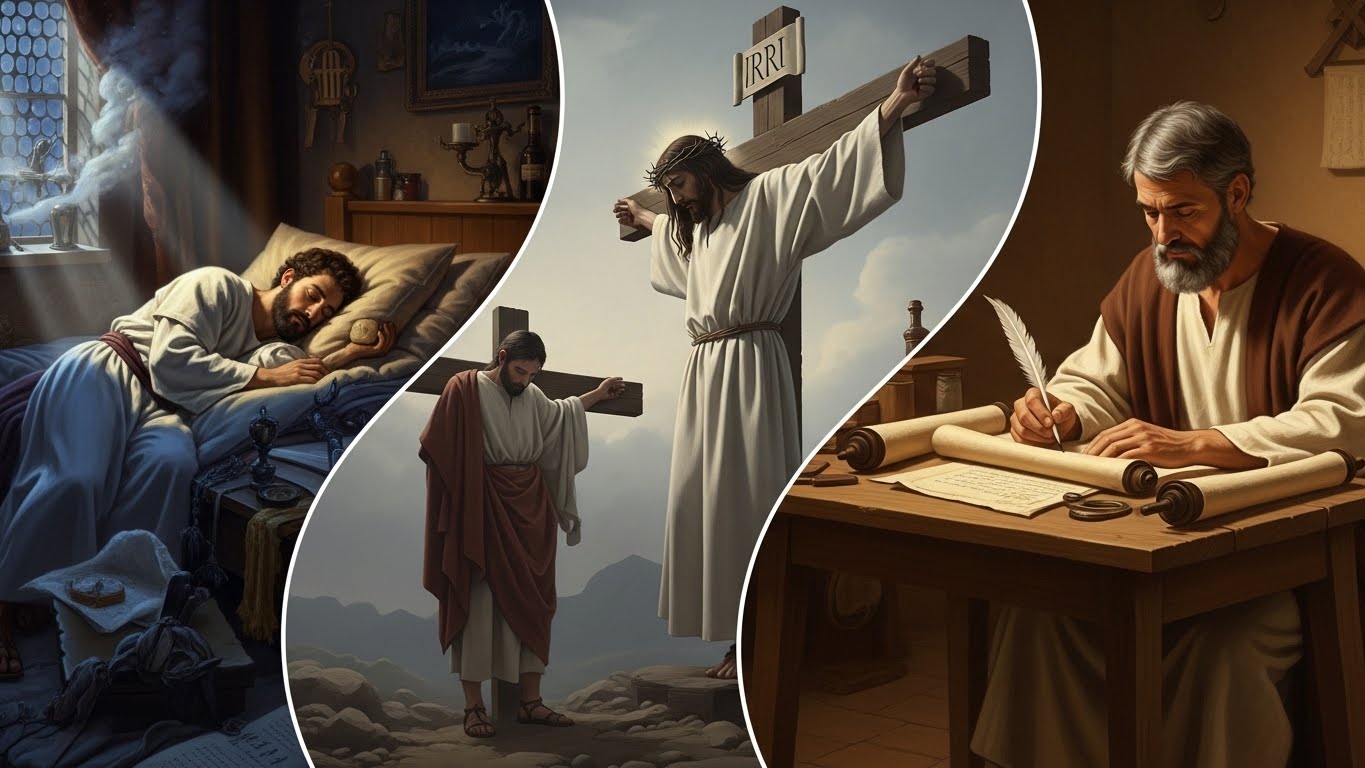
- Gospels: Jesus uses “sleep” language (e.g., John 11:11–14 for Lazarus) and also promises immediate paradise (Luke 23:43). His parables and teachings focus on readiness and the coming kingdom.
- See John 11:11–14 (NIV) and Luke 23:43 (NIV).
- Epistles: Paul and other writers focus on resurrection theology — Christ’s resurrection guarantees ours (1 Corinthians 15). Paul’s reflections (Philippians 1:23; 2 Corinthians 5:8) include a sense of present fellowship with Christ after death.
The theological continuity points to a broader truth: Scripture is primarily forward-looking — it repeatedly asserts that the final chapter is resurrection and renewed creation in Christ. How the Bible pictures the exact mechanics of consciousness between death and resurrection varies across texts and genres, but never undermines the hope in Christ.
MODERN CONNECTION — DAILY LIFE APPLICATION
How does this matter for your daily life? Understanding biblical teaching on death should reduce anxiety, sharpen mission, and deepen worship.
- In grief: When someone you love dies, you don’t primarily need metaphysical certainty; you need pastoral assurance. Scripture invites you to grieve with hope (1 Thessalonians 4:13) — mourn, but not as those without hope.
- In decision-making: If you believe death leads to either restful waiting or immediate fellowship with Christ, both perspectives free you to live courageously. Your decisions should flow from gratitude and obedience, not fear.
- In faith challenges: The doctrine of soul sleep can be tempting because it simplifies the mystery. But whichever view you hold, let the resurrection be your focus. Live with eternity in view: invest in faith, love, and acts of mercy because these have eternal significance (Matthew 25:31–46).
- In Christian obedience: The promise of being “with the Lord” fuels holy living. If death is neutralized by Christ’s victory, you are freed from ultimate fear and called to faithful presence now.
Above all, let Scripture shape how you think about death: not as an escape from life’s problems, but as the culminating promise of God’s saving work in Christ.
PRACTICAL APPLICATION
Here are practical ways to let this teaching shape your daily walk:
- Pray regularly for the dead and for the living — ask God for comfort and hope in grief.
- Read Scripture that emphasizes resurrection and hope (e.g., 1 Corinthians 15, Romans 8).
- Cultivate a resurrection-shaped imagination: practice remembering that your life is part of God’s larger story in Christ.
- Prepare practically and spiritually: have conversations about legacy, faith, and final wishes with loved ones.
- Practice acts of service and mercy as eternal investments, motivated by Christ’s love rather than fear of death.
- Foster a community that grieves and hopes together — let the church be a hospital for the broken.
- Keep evangelism central: God’s promise of resurrection is a reason to share Jesus with others.

 “Every God-given message deserves to be shared.”


Don’t let your calling stay hidden. Start a Christian blog or website using Hostinger — with 99.9% uptime, a free domain, and SSL, your voice can shine for God’s glory anytime, anywhere. Begin today.
  Try it RISK-FREE!

FAITH REFLECTION BOX
Question for reflection: When you think of death, what image gives you the most peace — “restful sleep,” “present with Jesus,” or “resurrection hope”? Why?
Key Takeaways:
- Remember that Christ’s resurrection guarantees your future resurrection.
- Grieve with hope; your sorrow is held by God’s promises.
- Live now for eternity — faithful obedience matters.
- Avoid speculative certainty; hold conviction with humility.
- Keep Jesus central: He is the bridge between death and life.
FREQUENTLY ASKED QUESTIONS (SCHEMA-READY)
Q1: Does 2 Corinthians 5:8 teach soul sleep?
A1: 2 Corinthians 5:8 says, “We are confident, I say, and would prefer to be away from the body and at home with the Lord.” Paul is giving pastoral assurance that death for a believer means being with the Lord. He writes to comfort and strengthen faith, not to settle philosophical questions about conscious awareness at death. While some read this as support for immediate conscious presence, the broader biblical witness includes sleep-imagery that points to resurrection. The safest reading is: Paul emphasizes the believer’s blessed destiny in Christ rather than providing a technical anthropology. See 2 Corinthians 5:8 (NIV).
Related: What Happens After We Die According To The Bible? — Hebrews 9:27
Q2: If the Bible sometimes calls death “sleep,” does that mean we’re unconscious?
A2: Sleep imagery (John 11:11; 1 Thessalonians 4:13–15) highlights both the temporality of death and the certainty of waking — the resurrection. Genre matters: prophetic and pastoral writings often use metaphor to comfort. The “sleep” language assures you that death is not final for believers; it does not require a fixed claim about the precise nature of consciousness after death. Whether you hold to “soul sleep” or “immediate presence,” the biblical aim is pastoral: hope in the resurrection through Jesus. See 1 Thessalonians 4:13–15 (NIV).
Q3: Does Jesus’ promise to the thief on the cross rule out soul sleep?
A3: Jesus told the repentant thief, “Truly I tell you, today you will be with me in paradise” (Luke 23:43). Many take this as evidence for immediate presence with Christ at death. Others argue the punctuation or meaning of “today” is theological rather than chronological. Either way, Jesus’ words assure you of forgiveness and intimate fellowship with the Lord after death for those who trust Him. The passage’s pastoral force is unmistakable: trusting Jesus secures your place with Him. See Luke 23:43 (NIV).
See also: What Is The Resurrection Of The Dead? (1 Thessalonians 4:16-17)
RELATED TOPICS
For further reading on related topics, see:
Why Do I Need Salvation? (Romans 3:23, Isaiah 59:2)
What Is Sheol In The Bible? (Psalm 16:10)
What Is The Great Tribulation? (Matthew 24:21)
Summary: When you wrestle with “soul sleep,” remember the main point of Scripture: death is not the end. Whether the intermediate state is best described as rest or immediate fellowship with Jesus, the Bible consistently points you to the same hope — Jesus’ resurrection secures your future. Paul’s words in 2 Corinthians 5:8 comfort you with the confidence that being “away from the body” can mean being “at home with the Lord.” That truth reshapes how you grieve, how you live, and how you witness.
A prayer for you: Lord Jesus, thank You for conquering death and opening the way to everlasting life. Give us confidence in Your promises and tenderness in our grief. Help us to live with resurrection hope, loving others, and serving You faithfully until we see You face to face. Guard us from fear and speculation; fill us with the peace that comes from knowing we belong to You. Amen.
 As a ClickBank & Amazon Affiliate, I earn from qualifying purchases.
 Acknowledgment: All Bible verses referenced in this article were accessed via Bible Gateway (or Bible Hub).
 Want to explore more?
  Dive into our new post on Why Jesus? and experience the life-changing truth of the Gospel!