

Fruit vs Spiritual Gifts: What’s the Difference and Why It Matters
You’ve probably noticed the tension in the room: someone with a booming ministry voice, magnetic leadership, or a prophetic presence who, at home or in private, struggles to love well. You might be asking yourself, “If I can teach, lead, or prophesy — doesn’t that mean I’m spiritually mature?” Or maybe you’ve watched gifted leaders fall into temptation and wondered, “Why do some powerful Christians still struggle with character?” Those questions are honest and pastorally important. They get to the heart of a common confusion: gifts can be impressive; fruit can be invisible. Scripture consistently prioritizes one over the other.
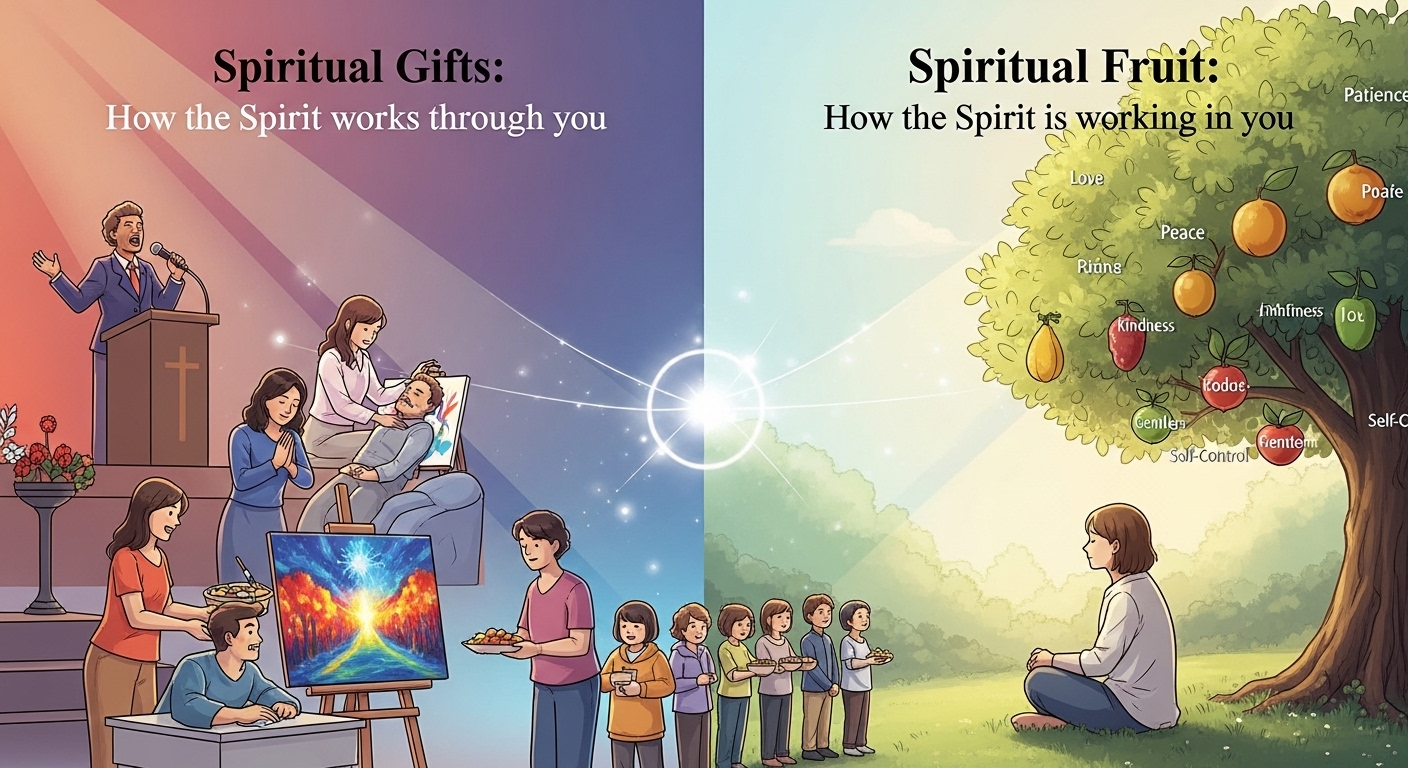
Here’s the simple thesis you’ll hold as you read: spiritual gifts show how the Spirit works through you; spiritual fruit shows how the Spirit is working in you. Gifts equip you for service; fruit shapes your inner life into the likeness of Christ. Both matter, but they are not the same thing. Let’s define both biblically and gently shepherd your understanding so you can move from performance-based spirituality to Christ-centered growth.
What Are Spiritual Gifts? (Biblical Definition)
When you read Paul’s letters, he is careful to explain that spiritual gifts are given by the Holy Spirit to believers for a purpose. In passages like 1 Corinthians 12, Paul describes a variety of spiritual gifts and highlights that the same Spirit distributes them as He wills. In Romans 12:6–8 Paul lists gifts such as prophecy, serving, teaching, encouraging, contributing, leading, and showing mercy. Ephesians 4:11–13 describes gifts given to equip the saints for ministry and to build up the body until we reach unity and maturity in Christ.
In short, spiritual gifts are:
- Special abilities given by the Holy Spirit to you.
- Given for building up the church and serving others.
- Not earned by performance or moral achievement.
- Not definitive proof of personal holiness.
Examples include teaching, leadership, mercy, encouragement, prophecy, service, and giving. Notice the important distinction: gifts are given. They aren’t grown. You don’t work to earn them; you steward them.
What Is Spiritual Fruit?
Spiritual fruit is the moral and emotional transformation of your inner life into the character of Christ. The classic anchor for this is Galatians 5:22–23, where the apostle Paul lists the fruit of the Spirit: love, joy, peace, patience, kindness, goodness, faithfulness, gentleness, and self-control. Fruit represents the Spirit’s ongoing sanctifying work as you abide in Jesus.
Fruit is not a talent. It’s transformation. While gifts are often outward and public, fruit is inward and relational. You can sing or preach well, manage people effectively, or heal with compassion in a moment — and that same person may still struggle with anger, pride, or impatience in private. Fruit is evidence of the Spirit forming Christlikeness in you over time.
To understand how the Spirit produces this kind of character, read The 9 Fruits of the Spirit Explained (Galatians 5:22–23).
Can Someone Be Gifted but Not Mature?
Yes. This is a pastoral reality you need to face if you want maturity more than applause. The church in Corinth illustrates the point clearly. In 1 Corinthians 12 the Corinthians operated in many gifts, yet the church struggled with division, pride, immorality, and confusion about worship. Paul even calls them “infants in Christ” in 1 Corinthians 3:1–3, despite their giftedness. That contrast shows that gift does not equal godliness.
You can preach powerfully, lead dynamically, or prophesy faithfully while still lacking patience, humility, or love in daily life. It’s possible for a person’s gifting to draw attention and produce results while their character remains immature. That’s why Paul had to correct and instruct — not to deny gifts, but to insist that they be used in love and humility.
Remember: being gifted is a responsibility, not a badge of holiness.

Why Fruit Matters More Than Gifts
When you look at Scripture’s priorities, you see that God places the highest value on who you are becoming, not only what you can do. In the heart of the Corinthian discussion about gifts, Paul inserts the love chapter: 1 Corinthians 13. The chapter makes a radical claim: without love, all the most spectacular gifts are meaningless. You can speak with tongues, understand mysteries, give away your possessions, or sacrifice your body, but if you lack love, it profits you nothing.
Why does fruit matter more?
- Gifts may attract attention; fruit sustains influence. When your actions are rooted in love, your ministry builds rather than harms.
- Gifts can be used for showmanship; fruit protects gifts from being misused. Without gentleness and humility, leadership can wound rather than heal.
- Christlikeness is the goal — not spiritual performance. You’re not aiming to collect a resume of gifted acts; you’re aiming to reflect Jesus.
Paul’s pastoral argument is clear: let gifts function, but let love govern them.
The Simple Difference (Side-by-Side Comparison)
To help you see the contrast clearly, consider these practical differences:
Spiritual Gifts:
- Given instantly by the Spirit.
- Primarily for ministry and building the church.
- Often public-facing and visible.
- Vary by believer (different gifts to different people).
- Can exist without maturity.
Spiritual Fruit:
- Grown over time as you follow Christ.
- Designed for Christlikeness and internal transformation.
- Often unseen, revealed in relationships and private places.
- The same for all believers (fruit list is consistent).
- Evidence of maturity.
This isn’t a perfect dichotomy (the Spirit can work both ways), but it helps you reorient priorities: gifts equip you; fruit shapes you.

How to Know What’s Growing in You
Self-examination is pastoral, not punitive. If you want to know whether fruit or mere giftedness characterizes your walk, ask simple, honest questions and listen to trusted friends and the Holy Spirit.
Ask yourself:
- Do I get defensive when corrected, or do I receive instruction with humility?
- Is my love for people increasing, or is it primarily for those who affirm me?
- Do people experience peace and encouragement around me, or tension and comparison?
- Am I more patient than I was two years ago?
- Do I delight in others’ success as God’s work, or do I compare and compete?
Shift the question from “What can I do?” to “Who am I becoming?” If your answers show increasing Christlikeness — more patience, deeper love, growing self-control — then the Spirit is at work. If you’re gifted but your relational life shows little growth, that’s a prompt to return to the basics of abiding and repentance.
You may also appreciate Spiritual Maturity: Biblical Markers That Show You’re Growing in Christ.
Gifts Are Good — They’re Just Not the Goal
You don’t need to choose between affirming gifts and prioritizing fruit. Gifts are from God, necessary for the life of the church, and beautiful in their diversity. Scripture affirms gifts and assigns them an essential role in ministry. But the pastoral correction is steady: gifts are tools, not trophies.
Affirmation you can hold:
- Gifts are given by grace and are needed for the body.
- Gifts are beautiful and bring glory to God when used rightly.
- Fruit protects gifts and sustains calling.
Warning to receive:
- Without fruit, gifts can harm: leaders can wield influence selfishly, meetings can become platforms for pride, and ministries can cause relational damage. Character sustains calling; an impressive gift without love is unstable ground.
Treat your gifts as stewardship. Let your fruit be the proof that stewardship is faithful.
Pursue Christ — The Source of Both
Everything returns to the vine. In John 15 Jesus invites you to “abide” in Him. Abiding is not mere busyness; it’s sustained union with Christ. When you abide:
- The Spirit produces fruit in your life.
- The Spirit empowers your gifts for service.
- You are not called to chase either fruit or gifts; you are called to stay connected to Jesus.
Abiding looks like prayer, Scripture-saturated life, sacramental rhythms (if your tradition keeps them), confession, and consistent repentance. As you remain in Christ, the results — both visible gifts and invisible fruit — follow as a byproduct of union with Him. The goal is to be a branch that blooms because it is rooted, not a branch that performs to be affirmed.
If you want to explore this further, read What Does It Mean to Walk in the Spirit? (Galatians 5 Explained).
If You Feel Behind Spiritually
You may be honest with yourself: you don’t know your gifts, you feel less impressive, or you compare yourself to charismatic leaders. That feeling is common in a culture that elevates visible success.
Here’s what to remember:
- Growth is often slow and unseen. Fruit can be quiet. If love is growing — if you forgive more easily, listen better, and seek others’ good — you are growing.
- Maturity is measured by surrender, not stage presence. A humble heart that obeys is more spiritually mature than a gifted ministry with unchecked pride.
- Gifts can emerge later and can change. God’s timing is wise; you don’t fail Him by being patient.
If you feel behind, don’t sprint to prove yourself. Return to Jesus, practice small obedience, steward your relationships well, and invite trusted believers to speak into your life. Your progress will likely be deeper than you think.

Frequently Asked Questions
Are spiritual gifts proof of maturity?
- No. While gifts indicate the Spirit’s work in equipping you for ministry, they are not proof of holiness. Paul’s correction to the Corinthians shows that gifts can coexist with immature behavior (see 1 Corinthians 12 and 1 Corinthians 3:1–3). Maturity is shown by growing Christlike character and love.
Can someone lose spiritual gifts?
- Scripture doesn’t teach that God capriciously removes spiritual gifts as punishment in a definitive way. However, the manifestation, exercise, or recognition of a gift can change over time as God leads, as contexts shift, or as the believer’s life changes. Paul’s teaching in Ephesians 4:11–13 indicates gifts are given for a purpose, and those purposes can be fulfilled as the body grows toward maturity.
Which is more important: fruit or gifts?
- Fruit. Paul places love at the center of the conversation about gifts in 1 Corinthians 13. Without love, gifting is empty. Fruit sustains and sanctifies gifts.
Do all Christians have spiritual gifts?
- Yes, Scripture affirms that the Spirit distributes manifestations to each believer for the common good (1 Corinthians 12:7). Gifts may differ in kind and intensity, but each believer is given something by the Spirit to contribute to the body.
Why do gifted leaders sometimes fall?
- Human hearts are vulnerable. Even gifted servants can be tempted by pride, selfish ambition, or moral failure. Scripture’s warnings are sober and pastoral: “So, if you think you are standing firm, be careful that you don’t fall!” (1 Corinthians 10:12). Gifts without humility and accountability can lead to a fall; regular repentance and accountability are protective.
Closing Encouragement
You live in a world that is easily impressed by gifts — by charisma, eloquence, and measurable results. Heaven, however, is shaped by fruit: the quiet, consistent work of the Spirit forming Jesus’ character in you. That work may not make headlines, but it sustains discipleship, heals relationships, and honors God.
If you’re tempted to measure spirituality by stage presence or program success, gently re-center on the Fruits Pillar. Let character be your primary evidence of spiritual life. Steward gifts well, but let fruit guard and sanctify your influence. The goal isn’t to be more gifted; it’s to be more like Jesus.
Prayer for Growing in True Spiritual Maturity
Lord Jesus, you are the vine and we are the branches. Help us to abide in you. Produce your fruit in us: deepen our love, grow our patience, quiet our pride, and steady our faithfulness. Teach us to steward the gifts you’ve given with humility, to serve without seeking applause, and to love without calculation. Where we’ve chased performance, forgive us and return us to simple, faithful dependence on you. Make us people of character, not only capability, and grant us the grace to become what you have called us to be. Amen.
Sponsored recommendation

Acknowledgment: All Bible verses referenced in this article were accessed via Bible Gateway (or Bible Hub).
“Want to explore more? Check out our latest post on Why Jesus? and discover the life-changing truth of the Gospel!”