


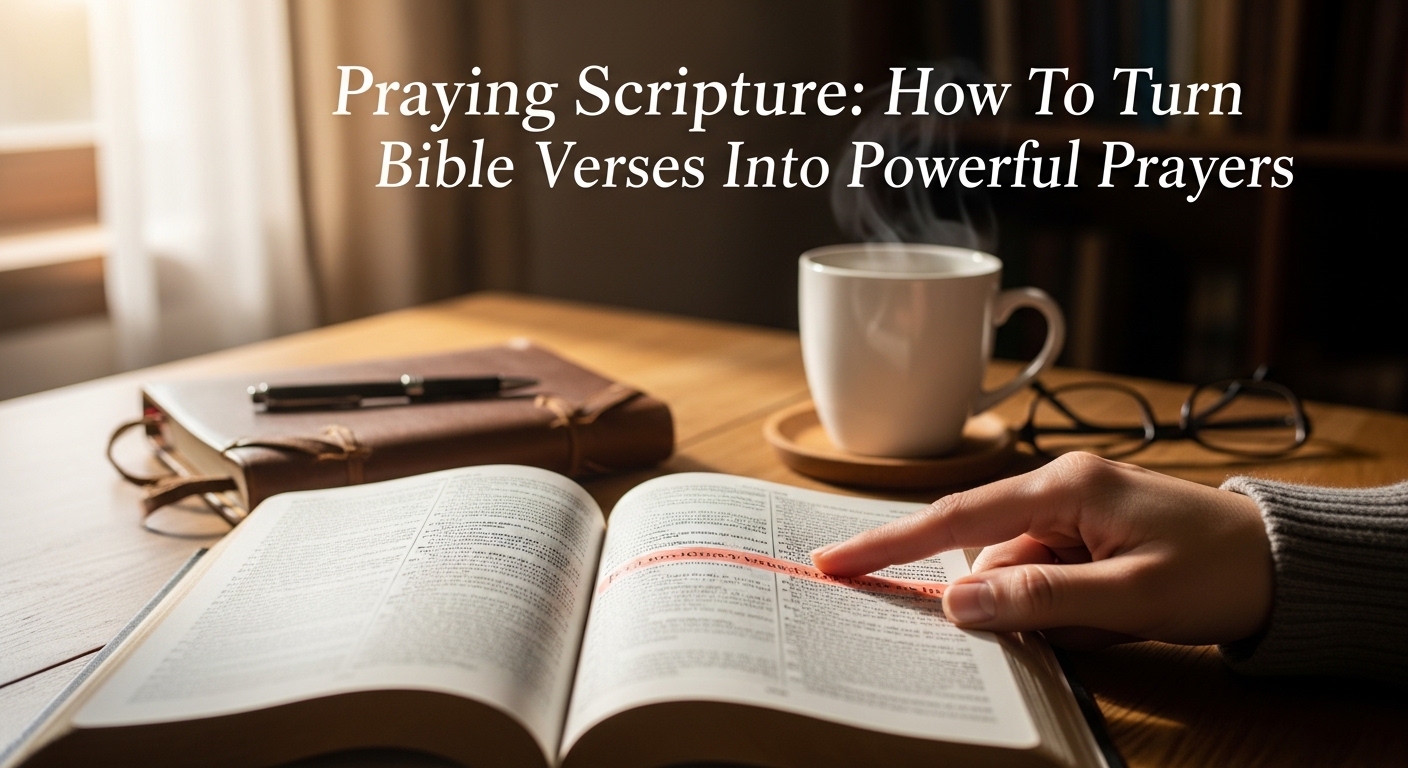
You’re in a season where words feel thin or scarce. Maybe you’re navigating fear that wakes you in the night, grief that reshapes your routine, or a decision that looms larger than you feel equipped for. You want your prayers to be real, to land honestly before God, and to carry the weight of Scripture—not because the right words alone save you, but because God’s Word shapes and steadies the heart that prays.
You’re not failing at prayer; you’re human. Prayer can feel confusing, scattered, or distant when your circumstances press in. That struggle is valid, and it’s exactly why praying Scripture can help you move from anxious fragments to steady, God-centered conversation. In this piece you’ll find a clear, usable process to turn Bible verses into prayers that feel powerful, personal, and aligned with God’s will—plus sample prayers, immediate steps, and resources to grow this practice into a habit.
By the end, you’ll have practical ways to lift specific verses into your voice, breathe Scripture back to God, and make promises in the Bible your own as you pray. This is about more than memorization; it’s about letting Scripture reorient how you speak to God, how you listen, and how your faith grows in the hard places.
Why This Moment Requires Prayer
When your world shifts—through fear, grief, confusion, decisions, or crisis—prayer is not optional, it’s essential. You need a way to name your fear and to carry it to Someone bigger than your worries. You need a place to pour your grief that both acknowledges the loss and trusts God’s presence in it. When confusion clouds your next steps, prayer helps you peel back the noise and listen for God’s voice. For hard decisions, prayer aligns your heart with God’s priorities instead of your own anxieties. And in crisis, prayer steadies you, keeps you connected to truth, and opens you to God’s comfort and provision.
Each of these situations can feel overwhelming on its own, and they often overlap. Fear amplifies confusion. Grief complicates decision-making. That’s why you don’t need a perfectly formed theological treatise to pray—you need a practical way to enter God’s presence and use Scripture to give language to your longings, doubts, and hopes. Scripture-infused prayer gives you the theological backbone and the emotional honesty to approach God effectively and with faith.
What Scripture Shows Us
Scripture repeatedly invites you to bring your real life to God and promises that He hears, meets, and works for you. A few passages capture this clearly:
- Philippians 4:6-7 tells you not to be anxious but to present your requests to God with thanksgiving. The promise is peace that guards your heart and mind. This applies when anxiety feels like the default setting; Scripture gives you a pattern—bring worry to God in prayer and expect His peace.
- Psalm 46:1 declares that God is your refuge and strength, an ever-present help in trouble. When you feel small in the face of crisis, this verse anchors you to God’s active presence and help.
- Romans 8:28 reassures you that God works for the good of those who love Him. In seasons of loss or confusion, this doesn’t erase pain, but it frames suffering within God’s redemptive purposes.
These verses give both a posture and a promise: come to God honestly, and expect Him to meet you. They show you that Scripture doesn’t distance you from emotions—it informs and directs them toward God.
How to Pray in This Situation
You need a usable structure—not abstract advice—to turn Scripture into prayer the moment you’re struggling. Below is a step-by-step method you can use immediately, plus a shorter breath-prayer option when words feel scarce.
Step-by-step method: Turn a verse into a prayer
- Choose a verse that matches your situation.
- Pick a short passage that speaks clearly to your heart (e.g., promises of peace, presence, provision, or guidance). Keep it simple and specific so you can hold it in your mind and mouth.
- Read the verse slowly and aloud.
- Let the words land. Notice any phrase that tugs at you—this becomes the heart of your prayer.
- Personalize the wording.
- Turn the verse into first-person phrases you can pray to God. Replace the general subject with “I” or “we” and insert your current concern. For example, if the verse promises God’s presence, pray: “Lord, be with me in this meeting tonight; I need You.”
- Add a short confession or honesty.
- If fear, doubt, or anger is present, name it. Scripture-informed prayer doesn’t hide your rawness; it brings it into God’s light.
- Declare the verse as a prayer of faith.
- Speak the promise back to God as an expression of trust. Ask for the Holy Spirit to make it true in your life.
- Close with thanksgiving and surrender.
- Thank God for His word and His work. Surrender the outcome to His wisdom, repeating a phrase like, “I trust You, Lord,” or “Your will, not mine.”
This method moves you from reading Scripture to claiming Scripture, from passive reception to active prayer. It’s simple, repeatable, and suited to crises or routine needs.

Breath-prayer model: When words run out
When you’re too drained for longer prayers, use a breath prayer. Pair a short Scripture phrase with each inhale and exhale:
- Inhale: “God, be my peace” (drawing on Philippians 4:6-7)
- Exhale: “I rest in You”
Repeat this rhythm for several minutes. Breath prayers help you internalize Scripture and stabilize your heart when stress makes language hard.
Quick outline for urgent moments
If you’re in an urgent emotional moment, use this 3-line prayer outline:
- Name the situation: “Lord, I am afraid because…”
- Claim a Scripture promise: “You say You are my refuge (Psalm 46:1). Be my refuge now.”
- Give thanks and release the outcome: “Thank You. I trust You.”
This compact formula gives you theological content, emotional honesty, and an act of surrender in under a minute.
How to Turn Specific Verses Into Prayers (Examples)
You’ll grow fastest by doing this with concrete examples. Below are short, practical conversions of Scripture into prayers for common situations.
Example 1 — Anxiety and fear (Philippians 4:6-7)
Verse: Philippians 4:6-7
Turn it into prayer: “Lord, I am anxious about [name the concern]. I bring this worry to You now and thank You for the ways You care. Please give me Your peace that guards my heart and mind in Christ Jesus. Help me not to be ruled by fear but to live in Your calm.”
Why it works: You’re following the verse’s command (don’t be anxious) and receiving its promise (peace that guards). You add honesty (I am anxious) and thanksgiving, which Scripture pairs together.
Example 2 — Grief and loss (Psalm 34:18)
Verse: Psalm 34:18
Turn it into prayer: “God, my heart is broken. You are near to the brokenhearted and save those crushed in spirit. Be near now. Hold the parts of me that feel torn. Comfort me in this pain and give me the courage to grieve honestly.”
Why it works: You bring raw emotion before God and claim His nearness, which the psalm promises. It’s both truthful and hope-filled.
Example 3 — Decision-making (James 1:5)
Verse: James 1:5
Turn it into prayer: “Father, I need wisdom about [specific decision]. You promise to give wisdom generously to those who ask. I ask now. Guide my mind and open doors or close them according to Your wisdom. Help me hear Your voice clearly.”
Why it works: You’re requesting what the text invites—wisdom—and you’re specifying the decision, which helps God shape your request and your heart.
Example 4 — Uncertainty and fear of the future (Isaiah 41:10)
Verse: Isaiah 41:10
Turn it into prayer: “Lord, I’m afraid about what’s next. You said not to fear because You are with me. Uphold me with Your righteous hand. Give me strength and help me to trust You day by day.”
Why it works: You claim God’s command and promise, and you ask Him to meet you where fear is real.
Use these patterns with other verses—take a promise, personalize it, add honesty, and declare it back to God.

A Sample Prayer You Can Use
Use this prayer as a template when you need words. It’s written in first person and is short, honest, and specific.
Lord, I’m weary and uncertain about [name your struggle]. I bring this to You because You promised to be near to the brokenhearted Psalm 34:18 and to give peace when I am anxious Philippians 4:6-7. Please meet me now. Calm my heart, give me wisdom for the next steps, and help me trust You with outcomes I can’t control. Thank You that You are working for my good even when I can’t see it Romans 8:28. In Jesus’ name, Amen.
This compact prayer models the method: name the pain, claim Scripture, ask specifically, thank God, and close in faith.
Growing Beyond This Moment
Praying Scripture is not only a crisis tool—it’s a pathway to long-term spiritual growth. When you consistently lean on Scripture to shape your prayers, your theology, emotions, and daily decisions begin to align with God’s truth. Here are concrete ways to grow from immediate help to lasting spiritual maturity.
- Build a daily rhythm. Set a consistent time—morning, midday, or night—to read a short passage and turn one line into prayer. Over weeks this trains your imagination to pray God’s language naturally.
- Keep a prayer-scripture journal. Write the verse, then write your prayer based on it. Track answers, changes in emotion, and patterns in God’s faithfulness. This journal will become a map of spiritual growth and evidence of God’s work.
- Learn to memorize one promise a week. Small, bite-sized memory work makes it easier to recall Scripture in the moment of need and to pray it without your Bible in front of you.
- Practice confession and surrender regularly. Scripture-prayer is powerful when mixed with honest confession and repeated acts of surrender. Use verses like 1 John 1:9 to frame confession and Romans 12:1-2 for surrender.
- Join a small group or prayer partner. Praying Scripture in community strengthens you—others can model ways to personalize verses and help hold you accountable to regular prayer life.
- Study the context of beloved verses. Understanding historical and theological context prevents proof-texting and helps you pray biblically robust prayers that honor the original meaning.
Growth is incremental. The goal isn’t performance but formation: letting Scripture shape your heart so your prayers become more aligned with God’s character and purposes.

Strengthening Your Prayer Life Biblically
For a deeper biblical foundation on building a consistent and powerful prayer life, read Prayer Practices: A Biblical Guide to Deepening Your Prayer Life. That resource dives into the biblical theology of prayer, practical rhythms, and historical practices that have helped Christians grow steady in prayer for centuries.
Using Scripture in prayer is more than a technique; it aligns you with God’s will. When you pray God’s Word, you’re not trying to manipulate outcomes—you’re asking God to make His truth present in your life. That alignment brings peace, clarity, and power that persist beyond single moments.
Read Next
If this encouraged you, continue here:
These links will help you build both immediate and long-term practices for a robust prayer life rooted in Scripture.
Practical Tips to Keep This Practice Fresh
You’ll fall into patterns that can dull the practice if you’re not intentional. Here are gentle, practical tips to keep Scripture-prayer lively and true.
- Vary the verses. Rotate between Psalms, Gospels, Epistles, and wisdom literature so you don’t script your prayers to one emotional tone.
- Use different forms: declarations, petitions, thanksgiving, confession, and intercession. Scripture provides examples of each.
- Incorporate music or silence. Sometimes singing a verse-based chorus or sitting in quiet after praying a verse helps you notice God’s presence.
- Pray aloud when possible. Speaking Scripture to God out loud helps your body and voice join your heart in worship.
- Reclaim the Lord’s Prayer as a structural template (Matthew 6:9-13). You can weave personal Scripture promises into its framework.
These small adjustments keep Scripture prayer from becoming rote and help it stay a living conversation.
Common Objections and Honest Responses
You may wonder whether praying Scripture is manipulative, repetitive, or somehow reduces spontaneity. These are fair concerns.
- Is it manipulative? No—praying Scripture is not trying to bend God’s will. It’s aligning your heart with God’s revealed will and asking Him to live out His promises in your life.
- Does it replace honesty? Not at all. Scripture prayer requires honesty and confession; it gives language for your reality and frames it in God’s truth.
- Will it make prayer rote? It can if you only recite verses like a script. Prevent rote by personalizing the words, adding confession, and remembering that prayer is relational, not transactional.
Prayer is both personal conversation and faithful obedience. Scripture serves as the map and the words to say when you’re lost or exhausted.
How This Strengthens Faith Over Time
When you consistently pray Scripture, you retrain your imagination to see life through God’s promises and character. You begin to expect God to act because you’ve seen His faithfulness recorded in Scripture and remembered in your journal. That expectation fuels courage, steadies your heart in unknowns, and changes how you make decisions. Over time, Scripture-informed prayer shapes you into a person whose instincts turn to God first, not last.
You’ll also notice a practical shift: your emotional life stabilizes, your discernment sharpens, and your ability to pray for others becomes more precise as you learn to pair specific needs with Scriptural promises.
Suggested Practices for the Next 30 Days
If you want to make tangible progress, try this 30-day practice plan:
- Week 1: Choose one verse for each day. Read it, personalize it, and journal one short prayer based on it.
- Week 2: Memorize two short promises (e.g., Philippians 4:6-7 and Psalm 46:1). Use them as breath prayers.
- Week 3: Pair Scripture-prayer with confession—choose verses that invite repentance and practice honest confession in prayer.
- Week 4: Pray Scripture with a partner once a week—share verses and prayers and report back on what you noticed.
Small, consistent steps build long-term fruit.
Final Encouragement
You don’t need to have everything figured out to pray meaningfully. Start with one verse, one breath, one honest sentence. Let Scripture teach you how to bring your whole life before God. Over time, you’ll find your prayers becoming steadier, richer, and more aligned with God’s heart. Remember: praying Scripture isn’t about perfect technique; it’s about faithful relationship—using God’s own words to shape your voice and trust.
📖 Continue Growing in Your Faith
If you want to deepen your prayer life and grow stronger in God’s Word, here’s where to go next:
👉 How to Pray According to the Bible
Build a solid biblical foundation for confident, Scripture-centered prayer.
👉 The Prayer of the Lord: A Model for Everyday Life
Discover how Jesus’ model prayer (Matthew 6:9–13) shapes the way we approach God.
👉 How to Build a Prayer Routine That Feels Real and Personal
Turn what you’re learning into a daily habit that strengthens your walk with Christ.
 Recommended Christian Reading
Jesus and the Woman Caught in Adultery — Grace and Mercy Over Judgment
A powerful retelling of Gospel of John 8:1–11, exploring forgiveness, mercy, and Christ’s compassion.
If you’re reflecting on spiritual growth and obedience, this story will remind you that transformation begins with grace.


Sponsored recommendation

Acknowledgment: All Bible verses referenced in this article were accessed via Bible Gateway (or Bible Hub).
“Want to explore more? Check out our latest post on Why Jesus? and discover the life-changing truth of the Gospel!”