

What Are Seraphim In The Bible? (Isaiah 6:1-7)

Introduction
Have you ever read a Bible passage that felt like standing in a thunderstorm of holiness? Isaiah 6 is one of those moments — a sudden, electrifying encounter with God’s glory. In that vision, you meet strange, radiant creatures called seraphim. If you’ve wondered who they are, why they’re on fire, and what Isaiah’s experience means for your life, you’re in the right place. This article walks you through Isaiah 6:1–7, explains the role of the seraphim, and helps you apply the vision’s lessons to your worship, courage, and daily pursuit of holiness. You’ll get clear explanations, practical steps, and reflective questions that invite you to respond personally to the presence of God.

📖 The Bible Foundation
Isaiah 6:1-7 (NIV):
1 In the year that King Uzziah died, I saw the Lord, high and exalted, seated on a throne; and the train of his robe filled the temple.
2 Above him were seraphim, each with six wings: With two wings they covered their faces, with two they covered their feet, and with two they were flying.
3 And they were calling to one another: “Holy, holy, holy is the Lord Almighty; the whole earth is full of his glory.”
4 At the sound of their voices, the doorposts and thresholds shook, and the temple was filled with smoke.
5 “Woe to me!” I cried. “I am ruined! For I am a man of unclean lips, and I live among a people of unclean lips, and my eyes have seen the King, the Lord Almighty.”
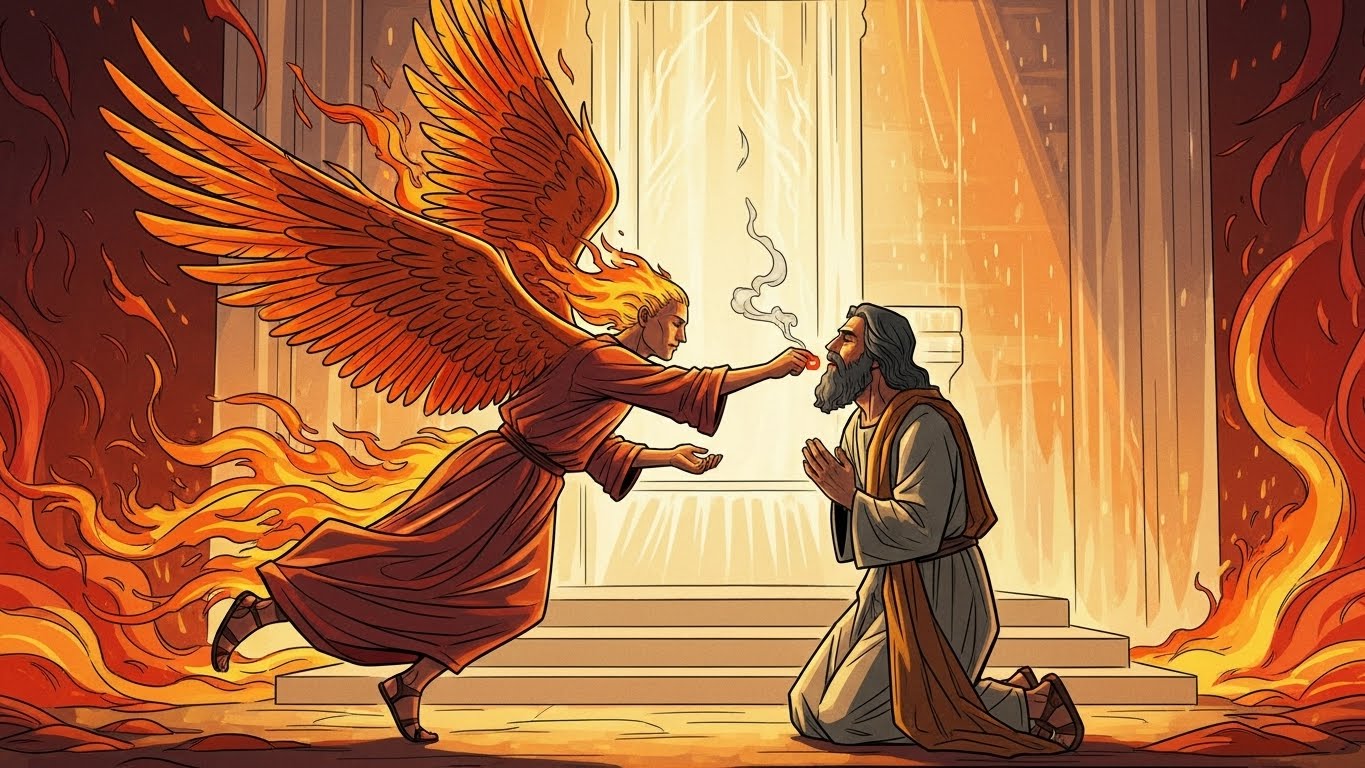
6 Then one of the seraphim flew to me with a live coal in his hand, which he had taken with tongs from the altar.
7 With it, he touched my mouth and said, “See, this has touched your lips; your guilt is taken away and your sin atoned for.”
In plain words: Isaiah sees God on a throne, notices heavenly beings called seraphim praising God and proclaiming His holiness, feels his own sinfulness, and is purified by a seraph touching his lips with a live coal from the altar. This passage sets the stage for Isaiah’s prophetic commissioning. It’s a powerful picture of God’s majesty, human sinfulness, and divine cleansing.
🧠 Understanding the Core Truth
The core truth of Isaiah 6 is the breathtaking gap between God’s holiness and human sin, and how God bridges that gap by purifying and sending people. The seraphim are central to expressing God’s holiness: they vocalize it, embody it, and participate in Isaiah’s cleansing. The word “seraphim” comes from Hebrew, likely meaning “burning ones” — suggesting both brightness and purifying fire. Their six wings symbolize both reverence (covering face and feet) and active service (flying). When they cry “Holy, holy, holy,” they aren’t just repeating a word; they’re declaring God’s absolute otherness — His transcendence, purity, and worthiness of worship. For you, the heart of the scene is this: encountering God’s holiness reveals your need for cleansing, and God provides that cleansing so you can be sent.

🌊 Going Deeper — The Hidden Meaning
There’s a deeper meaning tucked into the fiery details. First, the seraph touching Isaiah’s lips signals more than ritual purity — it shows that God’s holiness doesn’t leave you condemned; it heals. The coal comes from the altar, linking the act to worship and sacrifice — in other words, purification is tied to God’s atoning work. Second, the threefold “Holy” amplifies God’s perfection and completeness. In ancient Near Eastern thought, tripling a word intensifies it; so “Holy, holy, holy” is the highest possible declaration.
Think of Peter’s story in Luke 5:1-11: Peter realizes his sinfulness after seeing Jesus, is humbled, and then is assured and sent to fish for people. That pattern — see God, see self, be cleansed, be sent — is a biblical rhythm. Isaiah’s vision is a template: the seraphim voice God’s holiness, awaken Isaiah’s conscience, and enact purification, preparing him for mission. The seraphim, therefore, aren’t distant showpieces — they’re participants in God’s restorative work.

💡 Modern Connection — Relevance Today
You might think, “This is ancient and strange — what does it mean for my Monday morning?” Isaiah’s vision translates directly to modern life. When you encounter God’s holiness — through worship, Scripture, or prayer — two things usually happen: you’re reminded of your limitations, and you’re offered transformation. The seraphim’s presence teaches you to approach God with awe, not casual familiarity. The live coal shows that worship and repentance are linked; spiritual renewal often follows honest confession and contact with God’s presence. In practical terms, moments of genuine worship should lead you not to spiritual pride but to renewal and service — readying you for whatever God asks next.
❤️ Practical Application — Living the Message
Here are simple, practical ways to live out Isaiah’s lesson about seraphim and God’s holiness:
- Make space for awe: Schedule unplugged time of worship and Scripture reading where you deliberately wait to encounter God, not just check a box.
- Practice honest confession: When God’s holiness exposes sin, be quick to confess. Use a short prayer like, “Lord, I see my failure. Cleanse me.”
- Seek symbolic acts: Just as the coal touched Isaiah’s lips, use physical symbols — kneeling, laying hands, communion — to internalize God’s cleansing.
- Get sent: After renewal, ask how God wants you to serve. Holiness transforms into mission.
- Remember God’s grace: The vision ends with forgiveness. Don’t let the awareness of sin shatter you; let it lead you to God’s healing.
These aren’t complicated rituals; they’re small habits that help you stay aware of God’s otherness and your constant need for His grace.
🌿 Faith Reflection Box
Reflective question: When was the last time you genuinely felt God’s holiness and allowed it to change you? Pause and consider what that encounter asked you to confess, and what next step it invited you to take.
Key Takeaways:
- Encountering God’s holiness reveals both your brokenness and God’s mercy.
- The seraphim model reverent worship and active participation in God’s cleansing work.
- Worship should lead to transformation and mission.
- Confession and tangible symbols help you experience God’s forgiveness.
- God’s holiness isn’t distant — it heals and sends you.
👉 Q&A
Q1: Are seraphim just a type of angel, and how are they different from cherubim?
Answer: Seraphim are heavenly beings described in Isaiah 6 and are often classified with angels, but they have unique features and roles. The term “seraph” likely means “burning ones,” emphasizing purifying fire and worship. Cherubim, on the other hand, appear in Genesis and Ezekiel, often portrayed as guardians (e.g., cherubim guard Eden and appear on the Ark’s mercy seat). Cherubim emphasize protection and God’s throne presence; seraphim emphasize worship and purification. Both point to God’s holiness and presence, but their imagery and responsibilities differ. See Isaiah 6:2–3 and Ezekiel 1 for contrast.
Scripture: Isaiah 6:2-3, Ezekiel 1.
See also: God Is Holy – (Isaiah 6:3)
Q2: Why do the seraphim cry “Holy, holy, holy,” and what does it mean for your worship?
Answer: The triple declaration “Holy, holy, holy” intensifies God’s utter separateness and perfection. In Hebrew, repeating a word amplifies it; saying “holy” three times proclaims God as supremely holy. For your worship, it’s a call to approach God with reverence that recognizes His total otherness, purity, and glory. This doesn’t push you away; it draws you near in humility. When you pray or worship, the seraphim’s cry invites you to lift your eyes from everyday things and see God’s greatness, which in turn humbles and purifies your heart. Let this shape how you prepare for worship and confession.
Scripture: Isaiah 6:3, Revelation 4:8.
Q3: What does Isaiah’s cleansing mean for your sense of unworthiness and calling?
Answer: Isaiah’s cry, “Woe to me! I am ruined!” mirrors how awareness of God’s holiness reveals personal sin. But the seraph’s coal touching Isaiah’s lips shows that God doesn’t leave you in that state; He cleanses. For your life, this means that honest recognition of sin is the pathway to grace, not to despair. After cleansing, Isaiah is sent to prophesy. So your experience of unworthiness can become the foundation for a mission: God refines you and then uses you. If you feel unfit, remember Isaiah’s story — confession, cleansing, and commissioning are the biblical pattern.
Scripture: Isaiah 6:5–7, Luke 5:8–10.
See also: Attributes of God
🙏 Conclusion & Reflection
Isaiah’s vision of the seraphim is more than an ancient mural — it’s a living invitation. You’re invited to stand in awe, to let God’s holiness expose your need, and to receive cleansing that equips you for mission. The seraphim remind you that God’s glory is both overwhelming and healing. As you go into your week, ask God to give you more moments of holy awe, honest confession, and renewed purpose.
A short prayer: Lord, let me see Your glory with reverence. Reveal what needs cleansing in me, and touch my lips with Your grace so I may be forgiven and sent in Your name. Amen.
More Inspiration Awaits — Read These Next
 For deeper insight into Isaiah 40:31 and how it renews your strength in both faith and daily life
For practical lessons on compassion and neighborliness from the Good Samaritan
For a clear explanation of what we can learn from the Parable of the Good Samaritan
For meaningful insights from the Parable of the Pearl and its hidden treasures
For a deeper look at the Rich Man and Lazarus and what it reveals about the afterlife
For guidance on the Parable of the Ten Virgins and preparing for God’s Kingdom
For clarity on the Parable of the Lamp and how it calls us to shine our light
For insights from the Parable of the Wedding Feast and the meaning behind the invited guests

 Jesus and the Woman Caught in Adultery – Grace and Mercy Over Judgement
A powerful retelling of John 8:1-11. This book brings to life the depth of forgiveness, mercy, and God’s unwavering love. Check it now on Amazon 


 “Every great message deserves a home online.”


Don’t let your calling stay hidden. Start a Christian blog or website using Hostinger — with 99.9% uptime, a free domain, and SSL, your voice can shine for God’s glory anytime, anywhere. Begin today. Try it RISK-FREE! 

 “Your body is God’s temple — care for it with purpose.”


Renew your energy and restore balance naturally. Mitolyn helps support a healthy metabolism, giving you the vitality to live out God’s calling with strength and confidence.
Unlock Your Metabolic Power!  Burn More Calories & Feel Great With Mitolyn.
Start Today.  Check Price Now.
As a ClickBank & Amazon Affiliate, I earn from qualifying purchases.
 Acknowledgment: All Bible verses referenced in this article were accessed via Bible Gateway (or Bible Hub).
Want to explore more? Dive into our new post on Why Jesus? and experience the life-changing truth of the Gospel!