


Taking Thoughts Captive: What It Really Means
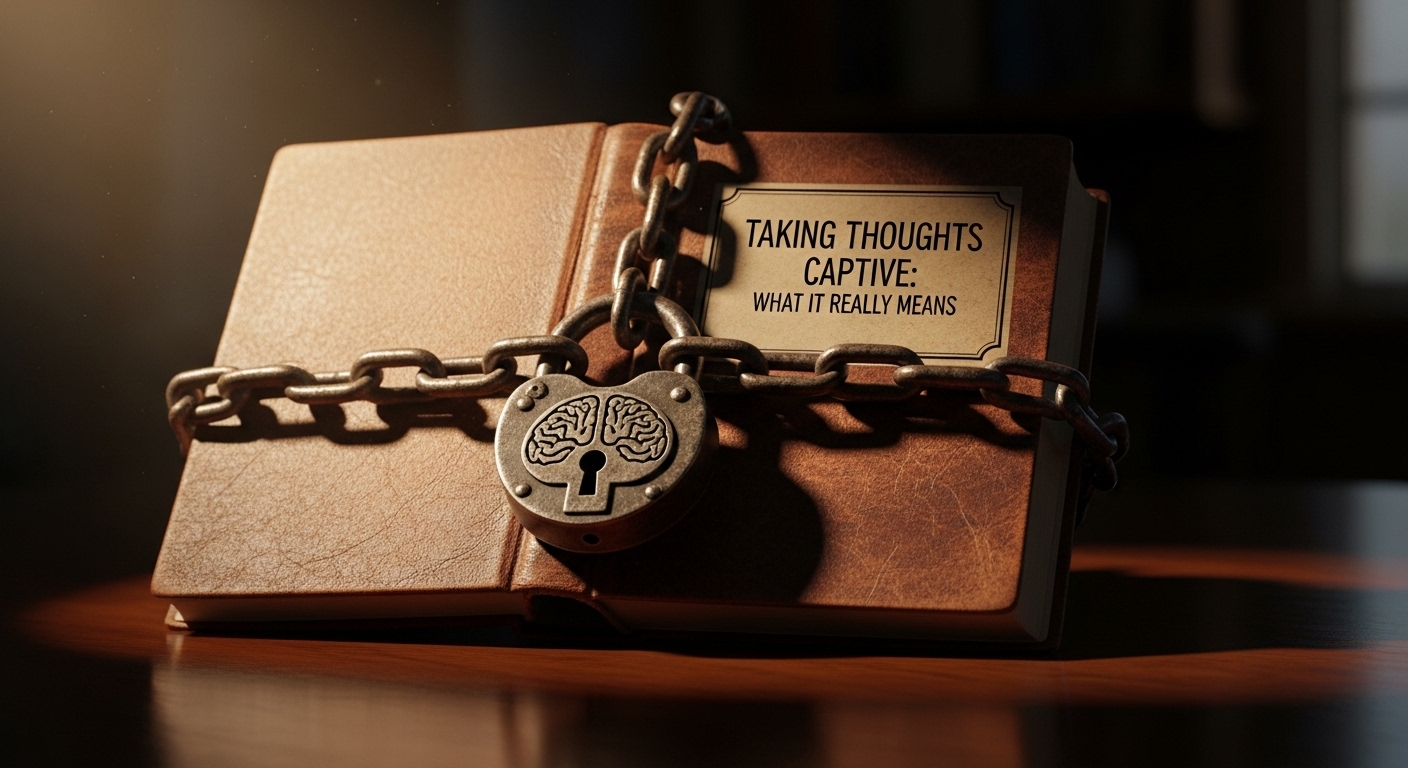
You’re tired. The thoughts that come and stay drain your energy, replay old fears, and make your spirit feel small even after you’ve prayed. You might wonder if you’re doing faith “wrong” because the worry keeps coming back. You’re not the only one who’s lost sleep over the same anxious ideas despite sincere prayers and Scripture memorized. God is not surprised by your struggle, and He is present to help you move through it.
Many believers discover that anxiety can return even after prayer, and that doesn’t mean your faith is failing. It often means you’re learning new spiritual and mental habits slowly. In this article you’ll find both the biblical clarity behind the command to “take every thought captive” and practical, small ways to practice that command today. For a fuller biblical foundation on how God brings peace and stability to your inner life, see Renewing the Mind: A Biblical Plan for Mental Calm.

Intro
You feel exposed when intrusive thoughts return. They make you question your identity in Christ, your competence, and sometimes your salvation. That uncomfortable loop of “I prayed, so why do I still feel this?” is painfully familiar to many.
You are not isolated in this—countless believers wrestle with the same replaying worries and intrusive images. You’re walking a well-trod path that others have navigated, and there are spiritual resources and practical tools that can help.
God invites you into a patient, steady process of renewal that includes His commands, His promises, and His Spirit working in you. The aim here is to clarify what “taking thoughts captive” actually looks like and to give you practical steps that fit your daily life.
Why This Feels So Hard
When you’re trapped in anxious thinking, it’s not just a matter of willpower. There are real reasons why the process feels heavy and slow.
First, mental exhaustion weakens your ability to respond intentionally. When you’re tired, your mind defaults to familiar grooves—negative ruminations, catastrophizing, and rehearsing past pain. Your capacity to notice a harmful thought and choose a different one shrinks when you’re depleted.
Second, you might be cycling through the same thoughts because they’ve been rehearsed for years. These loops are like well-worn paths in your brain; the neurons there are primed to fire the same way again and again. Breaking them requires repeated, gentle rerouting—not an overnight fix.
Third, you may fear losing control. Letting go of a thought feels risky when the thought is trying to protect you (even if it’s wrong). You worry that if you dismiss “what if” scenarios, you’ll be unprepared or irresponsible. That fear keeps the thought alive.
If that describes you, know that the struggle is understandable and common. You’re not stubborn or spiritually weak for needing time and help to change your mental patterns. You’re learning new spiritual muscle.

What Scripture Shows Us to Do
Scripture gives both command and direction—clear actions you can take and promises to lean on as you change your inner life.
Start with the often-quoted instruction in 2 Corinthians: “We take captive every thought to make it obedient to Christ.” Read the verse and sit with it: this is a proactive, deliberate practice—not suppressing or pretending a thought isn’t there, but confronting and evaluating it. See 2 Corinthians 10:5
Paul’s other commands connect to this work: Romans tells you not to be conformed to this world but to be transformed by a renewal of your mind—renewal that is both spiritual and practical. See Romans 12:2
You also have an invitation in Philippians to bring everything to God in prayer and a promise that His peace can guard your heart and mind. That peace doesn’t always erase feeling, but it reorders your inner life so that fear doesn’t rule you. See Philippians 4:6-7
Isaiah holds the promise that God will keep in perfect peace those whose minds are steadfast because they trust in Him—an encouragement to tether your thoughts to God’s truth. See Isaiah 26:3
Finally, David’s invitation—“Search me, God, and know my heart”—models honest prayer as part of mental and spiritual evaluation. See Psalm 139:23-24
Taken together, these passages show you a rhythm: notice your thoughts, bring them before God, measure them against Scripture, and choose obedience to Christ rather than automatic reaction.
A Simple Way to Practice Faith Right Now
You don’t need a perfect theology or an hour of quiet to start. Small, repeatable practices will give you a foothold in daily faithfulness.
Begin with a three-step micro-routine you can do anywhere: breathe + pray + refocus.
- Breathe: Pause and take three slow breaths. Slowing your breath calms your nervous system enough to create space for a decision rather than a reflex. Even five deep breaths can reduce the intensity of an intrusive thought.
- Pray a short surrender statement: Say, “Lord, I give you this thought” or “I surrender this worry to you.” This short prayer acknowledges that you’re handing the thought to God rather than letting it carry you away.
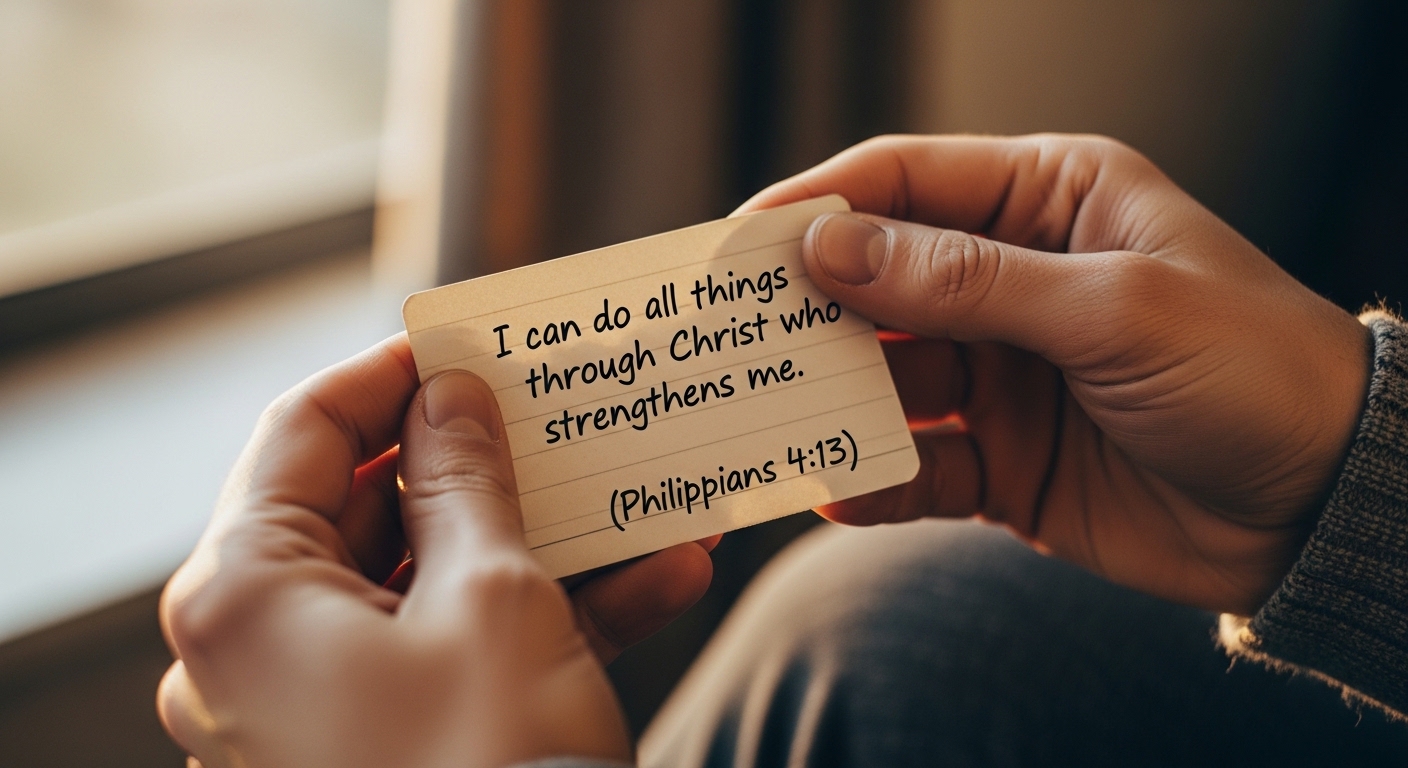
- Refocus on a short truth verse: Choose a 10–15 word verse you can hold in your mind. For example, you might use Isaiah 26:3 linked above, or a comforting line from Psalm 46. Slowly repeat it for 30 seconds and notice how your inner tone shifts.
Another sticky practice is verse meditation. Pick a short verse that directly counters your recurring worry. If you’re stuck in “What if I fail?” a verse about God’s presence or strength can be your corrective. Read it aloud, write it on a sticky note, and rehearse it at the first hint of the old thought. The repetition isn’t legalism; it’s spiritual retraining.
Practice a gratitude pivot when your mind locks on worst-case scenarios. Name three small facts that are true right now—something you see, hear, or feel. Gratitude doesn’t deny hardship, but it prevents your imagination from spiraling unchecked.
Finally, use a surrender statement combined with a physical action. You might literally place your hand over your heart and whisper, “This is not mine; it’s yours, Lord.” The body and voice together help the mind make a new association.
Do these practices in bite-sized ways so they become accessible habits, not burdens you avoid.
Where Real Change Slowly Happens
Real change is slow because it involves retraining your patterns at emotional, mental, and spiritual levels. Expect progress rather than perfection, and learn to celebrate small wins.
First, understand the process is cumulative. The first few times you challenge a thought you’ll notice some success and some backslide. That’s normal. Every time you practice taking a thought captive, you strengthen a new neural pathway and a spiritual habit.
Second, make daily, consistent steps non-negotiable. This isn’t a one-off training event—it’s a lifestyle of reorienting your thinking. Ten short practices throughout the day beat one long, infrequent attempt.
Third, let grace be your framework. You are not trying to earn God’s love by silencing every anxious thought. The goal is to live more freely under Christ’s lordship, letting truth shape you gradually. When you stumble, return to confession and recommitment without shame.
Fourth, seek community and counsel. Real change often happens in relationships: a trusted friend who reminds you of truth, a pastor who gives perspective, or a therapist who teaches practical cognitive tools. Faith and therapy can work together; they aren’t antagonists but partners in your healing.
Finally, keep track of growth. Journaling small wins—“I noticed a thought and replaced it with a truth verse today”—creates evidence you can look back on when the recovery feels invisible.

Learn the Bigger Picture of Mental Health & Faith
Understanding “taking thoughts captive” isn’t just a technique; it sits inside a wider theology of spiritual formation and mental health. The Christian story assumes that you are a whole person—mind, body, and soul—and that renewal includes psychological insights alongside biblical truth.
Cognitive patterns are real and sometimes require clinical help, medication, or therapy. That doesn’t make your faith less real—many believers find that professional care and spiritual disciplines together bring long-term stability. You’re invited to steward the means God provides for your wellbeing.
For a fuller biblical foundation on how God brings peace and stability to your inner life, explore the longer treatment in Renewing the Mind: A Biblical Plan for Mental Calm. This pillar resource unpacks theology, offers study guides, and connects spiritual practices with practical mental-health strategies.
If you’d like more immediate, practical articles that build on this micro, especially for moments when your mind won’t slow down at night and anxious thoughts keep circling, or when you’re ready to go deeper into replacing fearful thinking with biblical truth through intentional mental training, these sibling resources will help you move from understanding thought captivity to actually living it out.
Other Biblical Stories That Give Hope
You don’t have to invent an approach—Scripture is full of people who processed hard thoughts and emotions in ways that honored God and led to growth.
David: The psalms show that David was brutally honest with God about fear, guilt, and envy, and he repeatedly invited God’s examination and cleansing. See Psalm 51:10 for David’s plea to be renewed.
Joseph: He endured betrayal, false accusation, and long seasons of waiting. Joseph processed repeated negative interpretations of his life and ultimately trusted that God was present in the story (see Genesis 50:20). Read Joseph’s story beginning in Genesis 37. His endurance shows how reframing suffering within God’s purposes reshapes thinking.
Job: Job’s laments are full of raw thoughts and questions. He took them to God honestly and, through the process, God met him not by erasing questions but by reorienting his view of God. Job’s story encourages you to bring hard questions to God instead of stuffing them. See Job 1-2 and later chapters.
Each of these characters gives you permission to be real, to ask hard questions, and to rely on God’s long, shaping work.
How to Spot a Thought That Needs to Be Taken Captive
You gain power when you can quickly recognize which thoughts deserve your attention and which you can dismiss. Not every stray thought is a spiritual emergency; some are simply noise. But certain kinds of thoughts need to be addressed:
- Thoughts that predict calamity without evidence (catastrophizing).
- Thoughts that replay past hurts in ways that fuel present fear.
- Thoughts that call your identity in Christ into question.
- Thoughts that push you toward behaviors that harm your relationships or health.
When you notice these, label them. Saying to yourself “That’s a catastrophic thought” gives you distance and authority to choose differently. The act of naming is a spiritual and cognitive tool that allows you to take the thought captive.
Practical Examples of Thought Replacement
You’ve heard that you should replace bad thoughts with truth—here’s how to do it with concrete examples.
If your thought is: “I’m going to fail and everyone will think I’m stupid,” replace with a truth like: “I don’t know the outcome, but God is with me and I can take one step.” Back this up with a short verse: Romans 8:28 says God works for the good of those who love Him. See Romans 8:28.
If your thought is: “I don’t belong,” replace with: “I am chosen and loved by God” and anchor that with a verse such as Ephesians 1:4-5
If your thought is: “What if something terrible happens?” practice an evidence check: ask yourself, “What is the evidence this will happen right now?” Often you’ll find there’s currently no evidence. Then remind yourself of God’s presence—try Isaiah 41:10.
You can create a small list of ready-made replacement thoughts with verses and keep it on your phone or a card. Rehearse them so they come to mind quickly when the old pattern arises.
When to Get Extra Help
Taking thoughts captive is a spiritual practice and sometimes a clinical one. If your thoughts are persistent, intrusive to the degree that you can’t function, or you have symptoms that might be clinical anxiety, depression, or OCD, seeking professional care is wise. Faith-informed counselors can offer cognitive-behavioral tools that complement your spiritual practices.
Therapy can give you techniques like thought records, exposure response prevention, and behavioral experiments—all of which work well with prayer, Scripture meditation, and community support. Asking for help is a courageous, faithful step.
A Short Prayer for This Moment
Use this prayer as a template; say it aloud or silently. Let the words form a bridge between your honest emotion and God’s steady presence.
Lord Jesus, my thoughts feel heavy and loud. I invite You into each one. Search me, and show me what is true and what is fear. Help me to take captive the lies and to hold fast to Your truth. Give me the courage to speak the truth aloud, the patience to practice small habits, and the grace to step forward when I stumble. Guard my heart and mind with Your peace. Amen. (See Psalm 139:23-24 and Philippians 4:6-7.
Final Encouragement
You’re learning a skill that combines spiritual obedience with psychological wisdom. It will be slow at times, and that’s okay. Keep showing up with small practices: name the thought, pray briefly, anchor to truth, and take one faithful step.
Remember, this is not about perfection—it’s about movement toward Christ and a calmer inner life. When you slip, receive God’s grace and return to the disciplines that sustain you. You are not alone in this journey. Many have walked it before you, and many resources are available to help.
Sponsored recommendation

Acknowledgment: All Bible verses referenced in this article were accessed via Bible Gateway (or Bible Hub).
“Want to explore more? Check out our latest post on Why Jesus? and discover the life-changing truth of the Gospel!”