



Introduction
You sit down with the intention to pray—but you don’t start. Not because you don’t believe in prayer, but because something inside resists the beginning.
It might be exhaustion. It might be distraction. Or it might just be that quiet internal weight that says, “Not now.”
This is not spiritual emptiness. It is not distance from God. It is something more subtle: the struggle to begin.
And that distinction matters.

Problem Focus: The struggle to initiate prayer
This article is about one specific experience:
You want to pray, but you can’t seem to start.
Your faith is not gone. Your relationship with God is not broken. The issue is activation, not connection.
This shows up as:
- delaying prayer repeatedly
- feeling mentally “stuck” before starting
- avoiding prayer even though you intend to do it
- waiting for motivation that never arrives
This is a will + habit friction problem, not a spiritual dryness problem.
Biblical grounding for faithful action
Scripture consistently emphasizes obedience even when emotion is absent:
- Colossians 3:23 — Work heartily as for the Lord
- Luke 18:1 — Always pray and do not give up
- Proverbs 3:5 — Trust beyond your understanding
These verses highlight a simple truth:
Faith often begins with action, not feeling.

Practical steps: How to START praying when you don’t feel like it
1. Use the “Start Small Rule” (2-minute entry point)
Do not aim for a full prayer session.
Instead:
- Set a 2-minute timer
- Say one sentence
- End if needed
Example:
“God, I’m here. Help me start.”
The goal is not depth — it is entry.
2. Remove the decision barrier
Don’t ask:
“How should I pray?”
Ask:
“What is my first sentence?”
Prayer begins when the first sentence exists.
3. Use “pre-written starting lines”
Prepare simple starters like:
- “God, I don’t feel like starting, but I will.”
- “Help me be present for a moment.”
- “I’m here even though I feel stuck.”
You are reducing friction, not deepening theology.
4. Link prayer to an action trigger
Attach prayer to something automatic:
- after brushing teeth
- before opening phone
- when sitting in a specific chair
This builds behavioral consistency, not emotional dependence.
5. Don’t evaluate how it feels
This is critical:
You are not measuring emotional response — you are building initiation discipline.
Even a “dry start” counts fully.
Reframe
Not feeling like starting prayer does not mean something is wrong spiritually.
It often means:
- your mind is overloaded
- your habits are weakly anchored
- your initiation threshold is too high
God is not requiring intensity at the start — only presence.
🙏 Short Prayer
Lord, I bring my honest struggle—my tiredness, my resistance, my lack of words. Meet me in these small steps. Help me to pray, even two minutes at a time. Restore desire through faithfulness, and let my actions open the door to renewed conversation with You. Amen.
Continuing Prayer Even When Motivation Is Low
If prayer has started to feel difficult, dry, or emotionally draining, these related topics may encourage you:
- Why Is Prayer So Hard Sometimes? — understanding why prayer feels difficult at times
- Why God Feels Silent Even When You Pray — learning how to trust God during silent seasons
These articles remind you that difficult prayer seasons are common and spiritually meaningful.
Conclusion
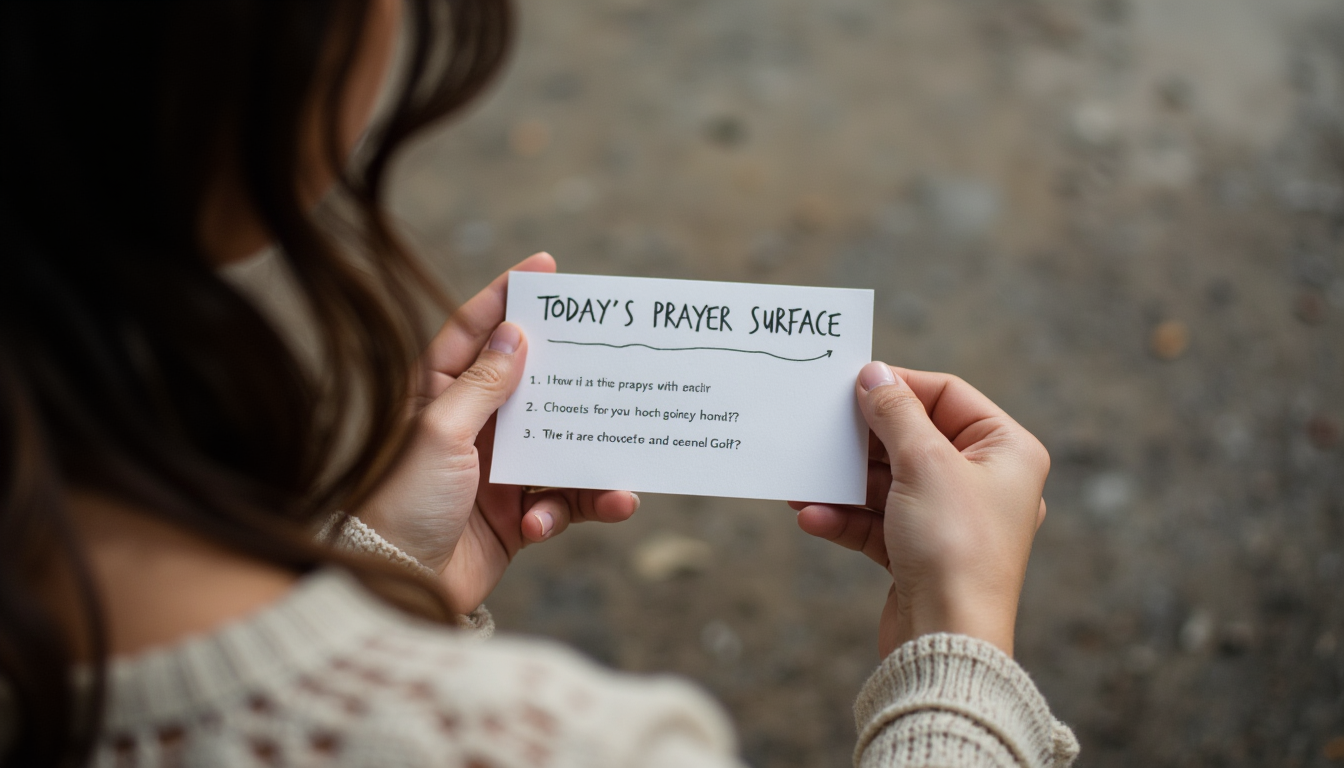
You don’t need to wait for a surge of feeling to pray. When you don’t feel like praying, choose a tiny faithful step: two-minute prayers, movement, verb-based focus, a prayer surface, or acting in service. These practices aren’t a substitute for heartfelt devotion; they’re ways to show up when your heart lags behind. Trust that God honors the faithful motion of your will and meets you in the small things. Keep returning, keep practicing, and let simple obedience grow into renewed desire.