

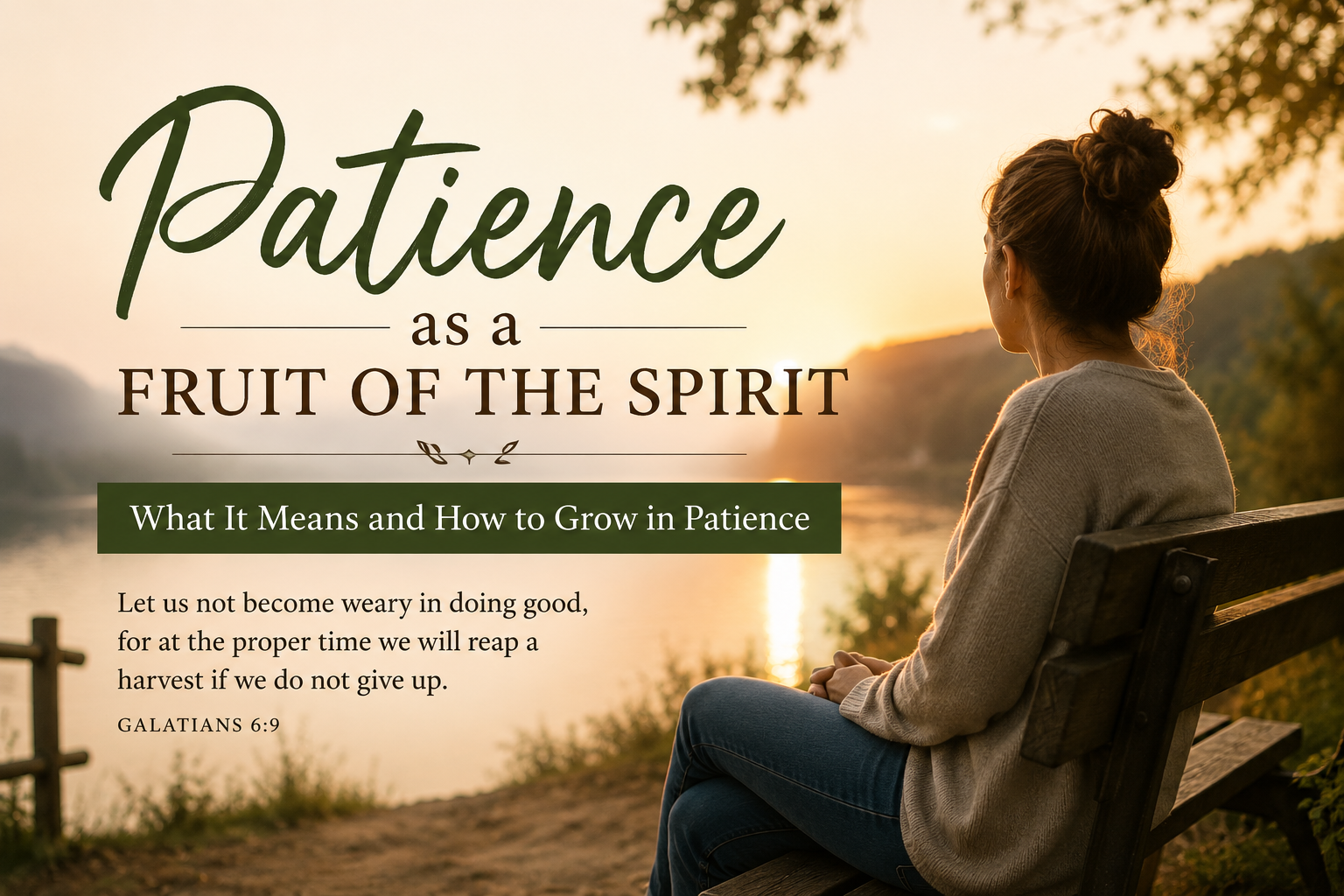
Waiting is hard.
We wait for prayers to be answered. We wait for circumstances to change. We wait for healing in relationships, direction for the future, financial provision, or an opportunity we have been hoping for.
And sometimes the hardest kind of patience has nothing to do with waiting for something.
It has to do with people.
Someone disappoints you again. A family member tests your patience. A coworker is difficult. Someone says something hurtful. Your plans are interrupted, and suddenly you discover how quickly frustration can rise inside you.
The Bible teaches that patience is more than staying calm because everything is going well. Patience is part of the fruit the Holy Spirit develops in the life of a believer.
In Galatians 5:22–23, Paul includes forbearance—often translated as patience—among the qualities produced by the Spirit.
So biblical patience is not simply having a naturally relaxed personality. It is learning to trust God while you wait, endure difficulty without giving up, and respond to people with grace when your natural reaction might be frustration.
What Does Patience as a Fruit of the Spirit Mean?
Patience as a fruit of the Spirit is the Spirit-produced ability to endure delays, difficulties, and difficult people without quickly giving in to anger, bitterness, or despair.
That does not mean a patient Christian never feels frustrated.
It means frustration does not have to control the response.
Think about the difference.
You may feel irritated when someone keeps you waiting, but you can choose not to speak harshly.
You may feel discouraged because a prayer has not been answered the way you hoped, but you can continue trusting God.
You may be hurt by another person’s behavior, but you can resist the urge to retaliate.
That is where patience becomes visible.
It is not merely something you feel. It changes the way you wait, speak, react, forgive, and persevere.

Patience Is Produced by the Holy Spirit
The context of Galatians 5 is important.
Paul contrasts living according to the desires of the flesh with walking by the Spirit. Immediately before describing the fruit of the Spirit, he lists behaviors such as hatred, discord, jealousy, selfish ambition, and fits of rage (Galatians 5:16–23).
Then comes the contrast:
the fruit of the Spirit.
In other words, Christian patience is not primarily a self-improvement project.
You can certainly develop better habits. You can learn to pause before speaking. You can manage your schedule so you are less stressed. Those things can help.
But spiritual fruit grows from a deeper source: the Holy Spirit working within you as you walk with Him.
That means the prayer of an impatient believer is not simply:
“God, make annoying people stop annoying me.”
A better prayer is:
“Holy Spirit, change the way I respond when my patience is tested.”
Sometimes God changes the situation.
Sometimes He changes us while we are in the situation.
Patience Means Trusting God While You Wait
One of the clearest places patience appears in the Christian life is waiting.
Waiting can make us feel as though nothing is happening.
But Scripture repeatedly shows people waiting for God’s purposes to unfold.
Abraham waited years for the son God had promised.
Joseph experienced betrayal, slavery, false accusation, and imprisonment before seeing how God would use his circumstances.
David was anointed to become king long before he actually became king.
None of their waiting seasons were meaningless.
This does not mean every delay in our lives carries a hidden promise that we will eventually receive exactly what we want. Scripture does not give us permission to turn our personal desires into guarantees from God.
Instead, biblical patience says:
“I may not know what God will do, but I can trust Him while I wait.”
That distinction matters.
Patience does not demand that God follow our timetable.
Patience learns to remain faithful when His timetable is different from ours.
Psalm 27:14 encourages God’s people to wait for the Lord and remain strong.
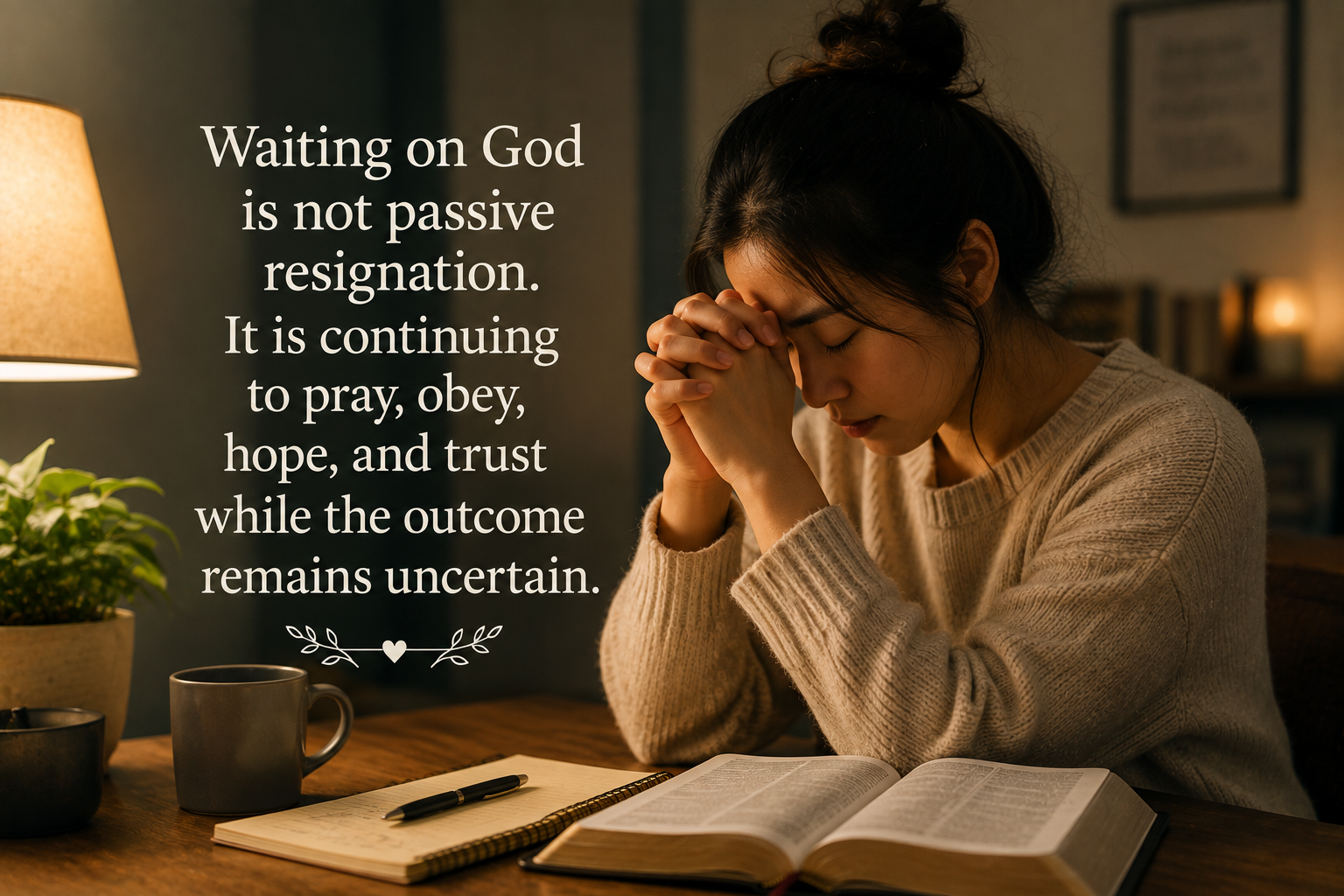
Waiting on God is therefore not passive resignation. It is continuing to pray, obey, hope, and trust while the outcome remains uncertain.
Patience With People Can Be Harder Than Patience With Circumstances
It is one thing to wait patiently for a delayed flight.
It is another thing to remain patient with a person who has disappointed you repeatedly.
Scripture connects patience directly with relationships.
Colossians 3:12–13 tells believers to clothe themselves with compassion, kindness, humility, gentleness, and patience, and then connects those qualities with bearing with and forgiving one another.
Ephesians 4:2 similarly connects patience with bearing with one another in love.
That makes patience intensely practical.
It appears when:
- your child asks the same question again;
- your spouse does something that frustrates you;
- someone at church sees an issue differently;
- a coworker works more slowly than you would like;
- someone misunderstands what you said;
- a friend disappoints you.
Patience gives another person room to be imperfect without immediately treating that imperfection as a personal attack.
After all, we also need other people to be patient with us.

Patience Does Not Mean Allowing Wrong Behavior
There is an important misunderstanding to avoid.
Being patient does not mean you must tolerate abuse, ignore serious wrongdoing, remain silent about harmful behavior, or refuse to establish healthy boundaries.
Patience and wisdom belong together.
Jesus was patient and compassionate, yet He also confronted wrongdoing. The apostles taught forgiveness while still addressing sin and harmful conduct.
You can therefore be patient with someone while saying:
“What happened was not right.”
You can forgive someone and still establish a boundary.
You can respond without hatred while seeking appropriate help.
Biblical patience is not weakness. It is refusing to let anger, revenge, or impulsiveness decide how you respond.
What Patience Looks Like in Everyday Life
Patience often grows in ordinary moments rather than dramatic ones.
Imagine that you are already late and the person in front of you is moving painfully slowly.
Your first reaction might be:
“Come on!”
Nothing catastrophic has happened. Yet that tiny inconvenience reveals something happening inside your heart.
Or perhaps someone sends you a message that sounds disrespectful.
Your fingers immediately begin typing a response.
This is where patience can look remarkably simple:
Don’t send it yet.
Pause.
Pray.
Read the message again.
Ask whether you understood it correctly.
Then respond in a way you will not regret tomorrow.
A Spirit-led response may take only thirty seconds longer than an impulsive one.
But those thirty seconds can completely change a conversation.
Patience Is Not the Same as Passivity
Some people hear the word patience and imagine doing nothing.
Biblical patience is different.
You can patiently wait while still taking responsible action.
If you are looking for work, patience does not mean submitting one application and sitting at home waiting for the phone to ring.
You can pray, prepare your résumé, apply for jobs, develop your skills, and speak with people who might help.
Patience means you do what is faithfully yours to do while trusting God with what you cannot control.
The same principle applies elsewhere.
Pray for reconciliation—and be willing to initiate a gracious conversation.
Pray for spiritual growth—and spend time in Scripture.
Pray for wisdom—and seek wise counsel.
Patience does not replace obedience.
It keeps us faithful while results take time.

Why Does God Sometimes Allow Us to Wait?
We cannot know God’s specific reason behind every delay.
It would be wrong to pretend that we do.
But Scripture does show that difficult seasons can produce spiritual maturity.
Romans 5:3–5 connects suffering with perseverance, character, and hope.
James 1:2–4 similarly teaches that the testing of faith develops perseverance and maturity.
Waiting exposes what immediate comfort can hide.
It can reveal:
- how much we want control;
- how quickly we become angry;
- whether we trust God only when life moves according to our plans;
- whether our hope depends entirely on circumstances.
Those discoveries can be uncomfortable.
But they can also become opportunities for growth.
A delay may become a classroom where God teaches us to depend on Him more deeply.
How to Grow in Patience as a Christian
You cannot manufacture the fruit of the Spirit through willpower alone. But you can cooperate with the Holy Spirit as He changes you.
Here are several practical ways to do that.
1. Identify What Usually Makes You Impatient
Pay attention to your patterns.
What makes your patience disappear fastest?
Traffic?
Waiting?
Being interrupted?
Certain people?
Unanswered prayers?
Technology that does not work?
Plans changing unexpectedly?
You cannot address a pattern you refuse to notice.
Ask God to show you where impatience most often controls your reactions.
2. Create Space Between the Feeling and the Response
You do not have to respond to every emotion immediately.
When irritation rises, practice a simple habit:
Pause before reacting.
Take a breath.
Pray silently.
Ask yourself:
“Will what I am about to say help this situation or make it worse?”
James 1:19–20 teaches believers to be quick to listen, slow to speak, and slow to become angry.
That short pause can give you room to choose a Spirit-led response instead of an impulsive one.
3. Remember How Patient God Has Been With You
We often want grace for ourselves and immediate correction for everyone else.
Remember your own story.
How many times has God corrected you?
How often have you repeated the same mistake?
How long has He been shaping your character?
Remembering God’s patience with us makes it harder to demand perfection from others.
2 Peter 3:9 points to the Lord’s patience in the context of His desire for people to come to repentance.
God’s patience should shape the patience we extend to others.
4. Stop Trying to Control Every Outcome
Impatience often grows from our desire for control.
We want the answer now.
We want the person to change now.
We want the problem fixed now.
But much of life lies outside our control.
Ask yourself:
“What is my responsibility here, and what must I entrust to God?”
Do what God has given you to do faithfully.
Then release the outcome to Him.
5. Pray Specifically for Patience
Instead of praying only for difficult circumstances to disappear, ask God to develop patience within you.
For example:
“Lord, help me respond gently to this person today.”
“Help me trust You while I wait.”
“Holy Spirit, stop me before I speak out of frustration.”
Specific prayers make us more aware of the specific places where God is changing us.
6. Practice Patience in Small Things
Character develops through repeated choices.
A long line at the grocery store can become practice.
Traffic can become practice.
A slow computer can become practice.
An interruption can become practice.
Instead of thinking:
“This is wasting my time,”
try asking:
“How can I honor God in these next few minutes?”
Small frustrations provide frequent opportunities to practice the character we hope to demonstrate when larger trials come.
7. Keep Walking With the Holy Spirit
Ultimately, patience grows the same way the rest of the fruit grows: through life with God.
Read Scripture.
Pray honestly.
Obey what God shows you.
Confess impatience when you fail.
Ask forgiveness when your frustration hurts someone.
Then continue walking with the Spirit.
Galatians does not tell believers merely to admire spiritual fruit. Paul tells them to walk by the Spirit and to keep in step with the Spirit (Galatians 5:16, 25).
Patience grows as our lives become increasingly surrendered to Him.
What If I Keep Losing My Patience?
Growth is rarely instant.
You may pray for patience in the morning and lose your temper before lunch.
That does not mean you should give up.
When you fail, acknowledge it.
If you spoke harshly to someone, apologize.
If you acted selfishly, confess it to God.
Then ask:
What triggered my reaction?
What could I do differently next time?
Spiritual maturity is not pretending that failure never happens.
It includes becoming quicker to recognize sin, quicker to repent, and increasingly willing to let the Holy Spirit change established patterns.
Over time, you may notice something encouraging.
The situation that once caused an immediate angry reaction now causes you to pause.
The delay that once ruined your entire day becomes manageable.
The difficult person you once avoided becomes someone you can treat with grace.
Those changes may seem small.
But small changes repeated over time can be evidence of genuine spiritual growth.
A Simple Example of Spirit-Led Patience
Suppose someone promises to meet you at 2:00 p.m.
At 2:15, they have not arrived.
At 2:30, there is still no message.
Your irritation grows.
You could immediately assume:
“They don’t respect my time.”
Then they arrive and explain that an unexpected problem happened on the way.
Now imagine two responses.
The first response begins with accusation.
The second begins with a question:
“What happened? Are you okay?”
The circumstances are identical.
The difference is the response.
Patience gives us enough space to learn the whole story before allowing frustration to write one for us.
That principle can save friendships, marriages, workplace relationships, and church relationships from unnecessary conflict.
Patience Points Us Toward Jesus
Jesus showed extraordinary patience with imperfect people.
His disciples misunderstood Him repeatedly. They argued about status. Peter made confident promises and later denied knowing Him.
Yet Jesus continued teaching, correcting, loving, and restoring them.
Peter’s story did not end with his failure.
After the resurrection, Jesus restored him and entrusted him with responsibility (John 21:15–19).
That should encourage us.
Jesus is not asking us to show others a kind of patience we have never received ourselves.
We live every day because of His grace.
And as the Holy Spirit makes us more like Christ, that grace increasingly shapes the way we treat other people.
A Prayer for Patience
Father, thank You for being patient with me. I confess that I often become frustrated when people, circumstances, and timing do not go the way I want. Please forgive me for the times I have responded with anger, harsh words, or a demanding attitude.
Holy Spirit, grow patience in me. Teach me to trust You when I have to wait. Help me respond with grace when people disappoint me. Give me wisdom to know when to wait, when to act, and when healthy boundaries are necessary.
When frustration rises, remind me to pause before I speak. Help me surrender what I cannot control and remain faithful in what You have given me to do. Make my responses increasingly reflect the character of Jesus.
In Jesus’ name, amen.
Frequently Asked Questions About Patience as a Fruit of the Spirit
Is patience really a fruit of the Spirit?
Yes. Galatians 5:22–23 includes the quality translated “forbearance” in the NIV and “patience” in several other English translations. It describes patient endurance and restraint as part of the character produced by the Holy Spirit in believers.
Does patience mean doing nothing?
No. Biblical patience is not inactivity. You can take wise, responsible action while patiently trusting God with the outcome.
How can I become more patient with difficult people?
Begin by recognizing your triggers, pausing before reacting, praying for the person, remembering God’s patience with you, and asking the Holy Spirit to control your response. Colossians 3:12–13 connects patience with bearing with and forgiving one another.
Why does God make us wait?
Scripture does not give us the specific reason for every delay. However, it does show that trials and waiting can develop perseverance, character, maturity, and deeper trust in God.
Can I be patient and still set boundaries?
Yes. Patience does not require accepting abuse or harmful behavior. Christians can respond without revenge or uncontrolled anger while still speaking truth, establishing appropriate boundaries, and seeking help when necessary.
Keep Growing in the Fruit of the Spirit
Patience is not about becoming someone who is never bothered by anything.
It is about becoming someone whose frustrations no longer control every response.
As you walk with the Holy Spirit, He can teach you to wait without losing hope, endure without giving up, and deal with imperfect people with the same kind of grace you continually receive from God.
Patience grows slowly—which is fitting for patience.
And every time you choose trust instead of panic, grace instead of irritation, and faithfulness instead of giving up, you are learning what it means to live a Spirit-led life.
👉 See how all nine qualities fit together and how the Holy Spirit develops them in the life of a believer.
Read The 9 Fruits of the Spirit Explained
👉 Understand the meaning of the fruit of the Spirit in Galatians 5 and why spiritual fruit comes from the Holy Spirit rather than human effort alone.
Read What Is the Fruit of the Spirit?
👉 Discover practical biblical ways to depend on the Holy Spirit in your thoughts, decisions, relationships, and everyday Christian life.
Read How to Walk in the Holy Spirit Daily
Read Next in This Series
Continue with Kindness as a Fruit of the Spirit: What It Means and How to Grow in Kindness to see how the Holy Spirit turns compassion into practical ways of treating others with care.