


We all know what it feels like to want something we know is not good for us.
We know we should stay calm, but anger rises.
We know we should stop scrolling and go to sleep, but we keep reaching for the phone.
We know we should not say what is on our mind, but the words come out anyway.
We know we should resist temptation, but part of us wants immediate satisfaction more than long-term obedience.
This struggle is one reason self-control matters so much in the Christian life.
In Galatians 5:22–23, Paul writes:
“But the fruit of the Spirit is love, joy, peace, patience, kindness, goodness, faith, gentleness, and self-control.”
Self-control is the final quality Paul names, but it affects nearly every area of life.
It influences what we say when we are angry.
It affects how we respond to temptation.
It shapes how we use our time and money.
It influences our eating, entertainment, habits, relationships, sexuality, work, thoughts, and use of technology.
But biblical self-control is more than trying harder to behave.
Self-control as a fruit of the Spirit is the Holy Spirit developing in us the ability to bring our desires, emotions, thoughts, words, and actions under God’s authority rather than allowing our impulses to control us.
That does not mean Christians never struggle.
It means we increasingly learn that every desire does not have to become a decision.
Every emotion does not have to become an action.
Every thought does not have to be entertained.
And every temptation does not have to be obeyed.

What Is Self-Control as a Fruit of the Spirit?
Self-control is the ability to govern ourselves rather than being governed by uncontrolled desires and impulses.
The Bible does not teach that physical desires, emotions, or pleasure are automatically sinful.
God created us with emotions.
He created food to be enjoyed.
Rest is good.
Marriage and sexuality within God’s design are good.
Possessions can be used for good purposes.
Technology can accomplish good things.
The problem begins when something that should have an appropriate place in our lives begins controlling us.
Self-control asks:
Who is in charge of this part of my life?
Can I stop when I should stop?
Can I say no when obedience requires no?
Can I wait when wisdom says wait?
Can I remain quiet when speaking would cause unnecessary harm?
Can I walk away when temptation tells me to stay?
Can I choose what honors God even when another choice feels easier?
Biblical self-control is not about becoming emotionless.
It is about refusing to let our emotions, appetites, or impulses become our master.
Self-Control Is More Than Willpower
People often think of self-control as having strong willpower.
Willpower certainly has a place in making responsible decisions.
But the Fruit of the Spirit points us toward something deeper.
Paul does not call self-control the fruit of human determination.
He calls it part of the fruit of the Spirit.
Christian self-control grows through our relationship with God and the transforming work of the Holy Spirit.
We still make real choices.
We still establish boundaries.
We still develop habits.
We still walk away from temptation.
But we do these things while depending on God’s power rather than assuming that determination alone will transform our hearts.
This distinction matters because willpower can sometimes control outward behavior while leaving inward desires untouched.
The Holy Spirit works deeper.
He changes what we love.
He changes what we value.
He exposes destructive desires.
He teaches us wisdom.
He reminds us of truth.
He strengthens us to obey.
Over time, He develops a life increasingly governed by God’s purposes rather than immediate impulses.
Why Does God Want Us to Practice Self-Control?
God’s commands are not designed to remove everything enjoyable from life.
His boundaries protect what is valuable.
Think about a river.
Water flowing within its banks can bring life to fields, communities, animals, and people.
But when the river overflows its boundaries, the same water can become destructive.
Many human desires work similarly.
Food is good, but uncontrolled appetite can become harmful.
Money is useful, but uncontrolled desire for wealth can become greed.
Rest is necessary, but uncontrolled comfort can become laziness.
Sexual desire has a God-given purpose, but outside God’s boundaries it can become destructive.
Anger can alert us that something is wrong, but uncontrolled anger can wound people deeply.
Technology can connect and educate us, but uncontrolled use can consume our attention.
Self-control helps keep good things in their proper place and sinful desires from ruling us.
God’s boundaries are therefore not merely restrictions.
They help lead us toward freedom.
A Person Without Self-Control Is Vulnerable
Proverbs 25:28 gives a memorable picture:
“Like a city that is broken down and without walls is a man whose spirit is without restraint.”
In the ancient world, city walls provided protection.
A city without walls was vulnerable to attack.
Anything could enter.
The writer uses that picture to describe a person without restraint.
When we refuse to control our impulses, we become vulnerable.
One angry moment can damage a relationship built over years.
One uncontrolled purchase can create financial problems.
One careless message can damage a reputation.
One decision made during temptation can create consequences far beyond the moment.
One habit that begins casually can eventually become difficult to escape.
Self-control builds protective boundaries around our lives.
It helps us recognize that temporary desires can create lasting consequences.

Jesus Demonstrated Perfect Self-Control
Jesus is our greatest example of Spirit-led self-control.
One of the clearest examples appears when Satan tempted Him in the wilderness.
After fasting for forty days, Jesus was hungry.
Satan tempted Him to turn stones into bread.
Hunger itself was not sinful.
Eating bread was not sinful.
The temptation involved using His power outside the Father’s will and yielding to Satan’s challenge.
Jesus refused.
When Satan offered Him the kingdoms of the world in exchange for worship, Jesus refused again.
When Satan tempted Him to prove Himself dramatically by throwing Himself from the temple, Jesus refused.
Jesus answered temptation with God’s Word and remained obedient to the Father.
Matthew 4:10 records Jesus saying:
“Get behind me, Satan! For it is written, ‘You shall worship the Lord your God, and you shall serve him only.’”
Jesus did not allow hunger, opportunity, power, or pressure to determine His obedience.
His commitment to the Father remained greater than the temptation of the moment.
Biblical Example: Joseph Ran from Temptation
Joseph provides another powerful example.
While serving in Potiphar’s household, Joseph repeatedly faced sexual temptation from Potiphar’s wife.
Joseph understood that giving in would not simply be a private decision.
It would be a sin against God.
In Genesis 39:9, Joseph asked:
“How then can I do this great wickedness, and sin against God?”
Eventually, Potiphar’s wife grabbed Joseph’s garment and tried to pressure him into sleeping with her.
Joseph did not remain there to test how strong his resistance was.
He ran.
That is an important lesson about self-control.
Sometimes self-control means standing firm.
Sometimes it means leaving immediately.
Spiritual maturity does not mean placing ourselves unnecessarily close to temptation to prove how strong we are.
Sometimes the wisest response is:
Close the browser.
Leave the room.
End the conversation.
Delete the app.
Call someone you trust.
Change the environment.
Walk away.
Joseph’s strength was demonstrated not by staying near temptation but by fleeing from it.
Self-Control Begins Before the Moment of Temptation
We often think we will make the right decision when temptation arrives.
But many victories or failures begin much earlier.
Imagine someone who repeatedly spends money impulsively.
If that person waits until an advertisement appears before deciding whether to exercise self-control, the battle has already become harder.
A better approach may include creating a budget, removing stored payment information, unsubscribing from promotional messages, and establishing a waiting period before unnecessary purchases.
The same principle applies elsewhere.
If certain social media accounts repeatedly trigger anger, envy, lust, or unhealthy comparison, self-control may begin by changing what you follow.
If you regularly say things you regret when angry, self-control may involve deciding beforehand that you will not respond to serious conflict until you have calmed down.
If staying awake late every night is harming your health and responsibilities, self-control may include placing your phone outside the bedroom.
Wise boundaries reduce unnecessary battles.
Self-control is not only resisting temptation when it appears. It is also arranging our lives wisely before temptation arrives.

Self-Control and Gentleness Work Together
Self-control follows gentleness in Paul’s list, and the two qualities naturally complement one another.
Gentleness teaches us to use strength carefully when dealing with others.
Self-control helps govern the emotions and impulses within us.
Suppose someone insults you.
Gentleness affects the way you respond to that person.
Self-control helps prevent your anger from deciding what happens next.
Someone sends you a hurtful message.
Your first reaction may be to send something equally hurtful.
Self-control says:
Wait.
Gentleness asks:
How can I respond without unnecessarily wounding this person?
Together, these qualities help us respond in a way that reflects Christ rather than simply reacting.
Paul Compared Self-Control to Athletic Training
The apostle Paul used the picture of an athlete to explain disciplined Christian living.
In 1 Corinthians 9:25, he writes:
“Every man who strives in the games exercises self-control in all things.”
Athletes understand something important.
A goal often requires saying no to things that interfere with that goal.
Training requires discipline.
Practice happens when you feel motivated and when you do not.
An athlete may choose sleep instead of staying out late.
Training instead of comfort.
Healthy food instead of whatever feels easiest.
Repetition instead of entertainment.
These choices are not made because rest, food, or entertainment are automatically wrong.
They are made because the athlete values a greater goal.
Christian self-control works similarly.
We learn to ask:
What do I want most?
Do I want the satisfaction of this moment more than obedience to God?
Do I want to win this argument more than I want to reflect Christ?
Do I want another purchase more than financial wisdom?
Do I want another hour online more than the rest my body needs?
Do I want temporary pleasure more than spiritual integrity?
Self-control becomes easier to understand when we stop viewing it only as saying no.
Often we are saying no to something smaller because we are saying yes to something greater.
Self-Control Does Not Mean Suppressing Every Emotion
Biblical self-control does not require pretending emotions do not exist.
Jesus experienced sorrow.
He wept.
He experienced anguish.
He expressed righteous anger.
He showed compassion.
The Psalms contain grief, fear, frustration, joy, confusion, and hope.
God is not asking us to become emotionally numb.
Instead, self-control means our emotions inform us without automatically controlling us.
You can feel angry without becoming abusive.
You can feel afraid without allowing fear to make every decision.
You can feel attracted to someone without acting outside God’s boundaries.
You can feel disappointed without becoming bitter.
You can feel tempted without giving in.
You can feel impatient without treating people harshly.
An emotion can be real without becoming your master.
Why Do We Struggle with Self-Control?
Self-control is difficult because immediate gratification is powerful.
We often prefer something enjoyable now over something better later.
That struggle appears everywhere.
We want financial stability, but buying something now feels satisfying.
We want better health, but unhealthy habits offer immediate comfort.
We want peaceful relationships, but winning the argument feels satisfying.
We want spiritual growth, but entertainment feels easier than prayer or Scripture.
We want sexual purity, but temptation promises immediate pleasure.
We want rest, but another hour online feels harmless.
We want freedom from a destructive habit, but returning to it provides temporary relief.
This is why self-control involves more than knowing what is right.
Most of us already know many things we should or should not do.
The deeper question is whether we will choose what is right when another desire feels stronger in the moment.
How to Grow in Self-Control
Self-control grows through dependence on the Holy Spirit combined with intentional choices.
1. Identify Where You Most Often Lose Control
Do not begin with vague goals such as:
“I need more discipline.”
Be specific.
Is your struggle anger?
Spending?
Food?
Pornography?
Gossip?
Social media?
Alcohol?
Entertainment?
Procrastination?
Your words?
Something else?
Specific problems allow specific responses.
Ask God to reveal the areas where your desires are controlling you rather than serving you.
2. Bring the Struggle Into the Light
Hidden struggles often grow stronger.
Confess sin honestly to God.
When appropriate, talk with a mature Christian you trust.
Accountability can interrupt the secrecy that allows destructive habits to grow.
You do not need to announce every private struggle publicly.
But isolation often makes temptation more powerful.
3. Remove Unnecessary Temptation
Do not confuse access to temptation with spiritual freedom.
If something repeatedly causes you to stumble, creating distance may be wise.
Jesus used strong language about dealing seriously with sin.
Self-control sometimes means recognizing that a particular boundary is necessary precisely because we know our weaknesses.
4. Replace Bad Habits Instead of Only Removing Them
Simply saying “I will stop” often leaves an empty space.
Replace destructive habits with healthier ones.
Replace late-night scrolling with reading.
Replace impulsive shopping with a planned savings goal.
Replace angry responses with a habit of pausing and praying.
Replace gossip with encouraging conversation.
Replace unhealthy isolation with Christian community.
The goal is not merely an emptier life.
It is a better-directed life.
5. Practice Small Acts of Discipline
Self-control develops through repeated choices.
Keep a small commitment.
Get up when you said you would.
Finish an important task before entertainment.
Wait before buying something unnecessary.
Put the phone down during a conversation.
Stop eating when you have had enough.
Pause before answering when irritated.
Small acts of discipline train us to understand that our impulses do not have absolute authority.
6. Fill Your Mind with God’s Word
Jesus responded to temptation with Scripture.
God’s Word reminds us what is true when temptation makes something destructive appear attractive.
Psalm 119:11 says:
“I have hidden your word in my heart, that I might not sin against you.”
Knowing Scripture does not automatically eliminate temptation.
But truth gives us something solid to stand on when our feelings are pulling in another direction.
7. Pray Before the Crisis
Do not wait until temptation becomes overwhelming before asking God for help.
Pray regularly about areas of weakness.
Ask the Holy Spirit to strengthen you before difficult situations arrive.
Jesus taught His disciples to pray:
“Bring us not into temptation, but deliver us from the evil one.”
Prayer acknowledges something essential:
We need God’s help.
8. Learn to Delay Gratification
Not everything you want needs to happen immediately.
Practice waiting.
Before an unnecessary purchase, wait twenty-four hours.
Before responding while angry, wait until you are calm.
Before reaching automatically for your phone, finish the task in front of you.
Learning to wait weakens the assumption that every desire requires immediate satisfaction.
9. Remember the Greater Goal
Self-control becomes more meaningful when connected to purpose.
You are not merely refusing temptation.
You are protecting something.
Your relationship with God.
Your marriage.
Your family.
Your health.
Your finances.
Your integrity.
Your witness.
Your peace.
Your future.
Remember what matters more than the temporary desire.
Self-Control in Our Words
One of the most practical places to exercise self-control is our speech.
James 1:19 says:
“Let every man be swift to hear, slow to speak, and slow to anger.”
Many conflicts would look different if we practiced those three instructions.
Listen quickly.
Speak slowly.
Become angry slowly.
Before speaking, ask:
Is it true?
Is it necessary?
Is this the right time?
Will the way I say it help?
Once words leave our mouths, we cannot completely retrieve them.
Self-control gives wisdom time to catch up with emotion.

Self-Control in a Digital World
Technology has created opportunities previous generations never faced.
Entertainment is available continuously.
Notifications compete for attention.
Social media can consume hours without us noticing.
Online shopping allows purchases within seconds.
Sexually explicit material can be accessed privately.
Arguments can be joined instantly.
None of this means technology itself is evil.
But technology makes self-control increasingly important.
Ask yourself:
Do I reach for my phone automatically whenever I feel bored?
Can I sit quietly without needing a screen?
Do I lose sleep because I keep scrolling?
Does social media regularly produce envy, anger, lust, or anxiety?
Do I neglect people physically present because I am focused on people online?
Would I be uncomfortable if someone saw my browsing habits?
The answer may not always be deleting technology.
Sometimes it means controlling how technology is allowed to enter our lives.
Use limits.
Turn off unnecessary notifications.
Create screen-free times.
Keep devices away from situations where they create temptation.
Technology should serve us.
We should not become servants of technology.
Self-Control After Failure
What happens when you fail?
Maybe you lose your temper.
Return to an old habit.
Overspend.
Waste hours.
Give in to temptation.
Say something you regret.
Failure can produce two dangerous reactions.
The first is minimizing sin:
“It doesn’t matter.”
The second is hopelessness:
“I will never change.”
Neither response leads to healthy growth.
Instead:
Confess what happened.
Receive God’s forgiveness.
Identify what contributed to the failure.
Make necessary changes.
Seek accountability if needed.
Then continue walking with God.
1 John 1:9 reminds believers:
“If we confess our sins, he is faithful and righteous to forgive us the sins and to cleanse us from all unrighteousness.”
Spiritual growth does not mean never stumbling.
It means we stop making peace with the things that keep pulling us away from God.
We return.
We learn.
We keep growing.
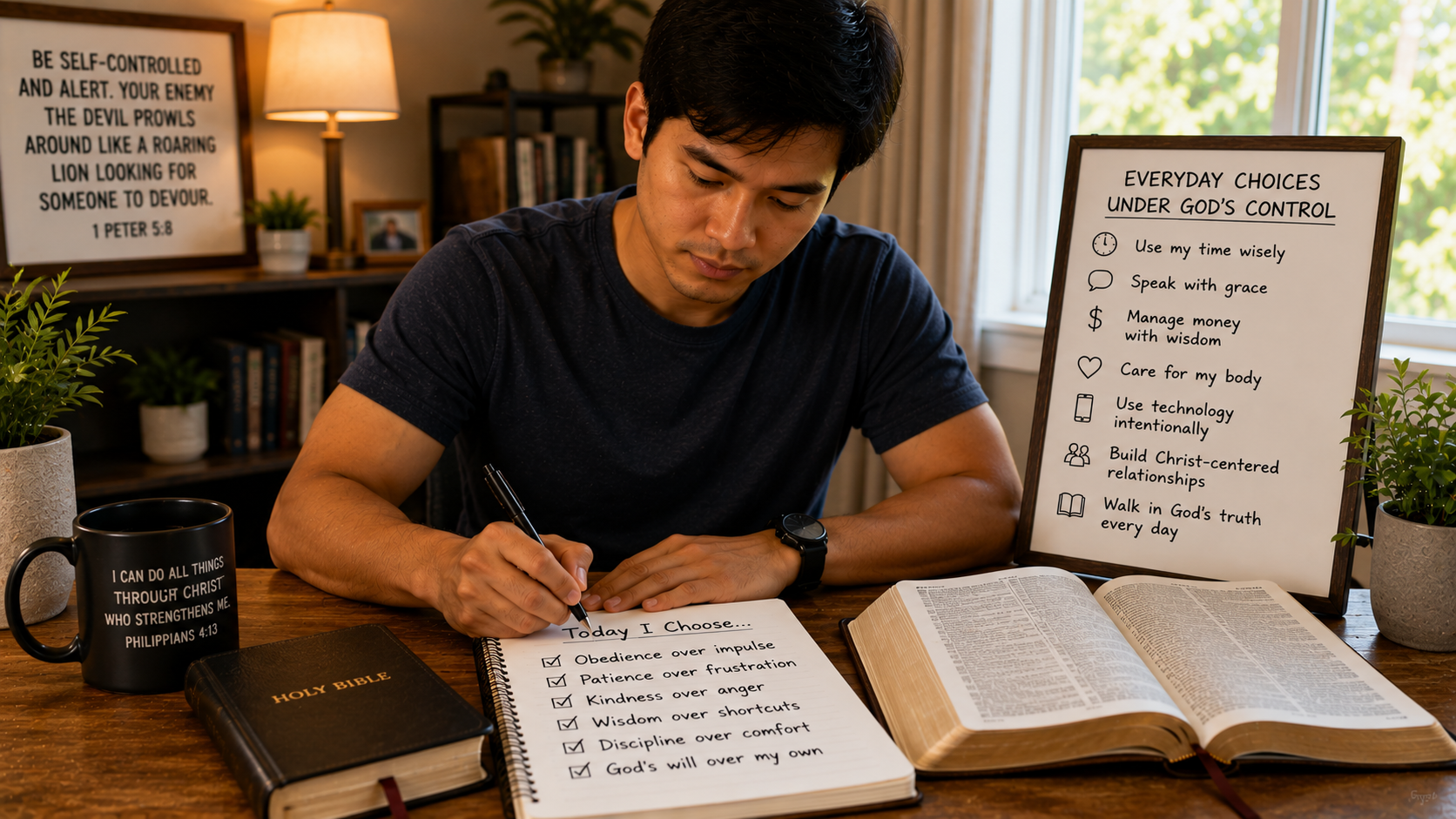
What Does Self-Control Look Like in Everyday Life?
Self-control appears in ordinary choices.
With your words, it means refusing to say everything you feel.
With anger, it means creating space between emotion and response.
With money, it means spending according to wisdom rather than every desire.
With food, it means enjoying God’s provision without allowing appetite to rule you.
With sexuality, it means honoring God’s boundaries even when desire is strong.
With technology, it means using devices intentionally rather than compulsively.
With work, it means resisting laziness and procrastination.
With rest, it can mean stopping work when work itself has become excessive.
With entertainment, it means knowing when enough is enough.
In relationships, it means refusing manipulation, jealousy, uncontrolled anger, and destructive words.
Self-control is not confined to dramatic moments.
Much of it is built through ordinary decisions nobody else sees.
How Can You Tell If You Are Growing in Self-Control?
You may be growing when:
- You pause more often before reacting.
- Temptation does not automatically become action.
- You recognize unhealthy patterns sooner.
- You establish boundaries before problems occur.
- You become more willing to say no to yourself.
- Your emotions still affect you but control you less.
- You recover more quickly after failure.
- You ask for help instead of hiding repeated struggles.
- Your habits increasingly support your values.
- You make more decisions based on what honors God rather than what feels easiest now.
Growth may happen slowly.
Do not underestimate the spiritual significance of repeated small victories.
Every time you choose obedience over impulse, another part of your life is being placed under God’s direction.
Frequently Asked Questions About Self-Control as a Fruit of the Spirit
What does self-control mean as a fruit of the Spirit?
Self-control as a fruit of the Spirit is the Holy Spirit developing our ability to govern our desires, emotions, thoughts, words, and actions according to God’s will instead of being controlled by impulses or temptation.
Is self-control just willpower?
No. Willpower can help us make disciplined choices, but biblical self-control is produced through the Holy Spirit’s transforming work. Christians still make intentional decisions and establish boundaries, but they depend on God’s power rather than human determination alone.
Why is self-control important for Christians?
Self-control helps believers resist temptation, use God’s gifts wisely, protect relationships, develop healthy habits, and live consistently with their faith. Without restraint, desires and emotions can begin controlling areas of life that should be submitted to God.
What is a biblical example of self-control?
Jesus resisting Satan’s temptations in Matthew 4 is the greatest example. Joseph fleeing from Potiphar’s wife in Genesis 39 also demonstrates self-control by refusing sexual temptation and choosing faithfulness to God.
How can I develop more self-control?
Identify specific areas of weakness, pray for the Holy Spirit’s help, fill your mind with Scripture, establish wise boundaries, remove unnecessary temptation, practice small acts of discipline, develop accountability, and remember what you value more than temporary gratification.
A Prayer for Growing in Self-Control
Father, thank You for loving me and for giving me Your Holy Spirit.
You know every area where I struggle.
You know the desires, habits, thoughts, emotions, and temptations that sometimes feel stronger than my desire to obey You.
Please develop self-control in me.
Help me recognize temptation before I am overwhelmed by it.
Give me wisdom to establish boundaries where I need them.
Teach me to pause before speaking, wait before reacting, and walk away when staying would lead me toward sin.
Help me control my use of money, food, technology, entertainment, time, and every other gift You have entrusted to me.
When my emotions are strong, remind me that I do not have to obey every feeling.
When temptation promises immediate satisfaction, help me remember what matters more.
When I fail, keep me from hiding or giving up.
Lead me quickly back to confession, forgiveness, wisdom, and obedience.
Make my private choices increasingly consistent with the faith I profess publicly.
May every part of my life come more fully under Your authority.
In Jesus’ name, amen.
Self-Control Is Freedom to Choose What Matters Most
The world often describes freedom as being able to do whatever we want.
Scripture gives us a deeper picture.
If we cannot say no to a desire, that desire may already be controlling us.
Real freedom is not simply having options.
It is having the ability to choose what is good even when another option feels more attractive.
Through the Holy Spirit, we learn that our impulses are not our master.
Anger does not have to control our words.
Temptation does not have to control our actions.
Technology does not have to control our attention.
Money does not have to control our priorities.
Appetite does not have to control our choices.
Fear does not have to control our decisions.
The Holy Spirit develops something better.
He teaches us to live increasingly under God’s authority.
Sometimes that means saying no.
Sometimes it means waiting.
Sometimes it means walking away.
Sometimes it means keeping quiet.
Sometimes it means asking for help.
Sometimes it means beginning again after failure.
Every one of those choices can become an act of worship.
Self-control is therefore not merely about becoming more disciplined.
It is about becoming more free to live the life God is calling us to live.
Continue Growing in the Fruit of the Spirit
Self-control completes Paul’s list in Galatians 5:22–23, but it does not complete the Holy Spirit’s work in us.
The nine qualities belong together.
Love teaches us to seek the good of others.
Joy gives us a deeper gladness rooted in God.
Peace steadies us in uncertain circumstances.
Patience helps us endure without giving up.
Kindness moves us to treat others with compassion.
Goodness leads us to choose what is morally right.
Faithfulness makes us trustworthy and steadfast.
Gentleness teaches us to place our strength under God’s control.
Self-control helps bring our desires, emotions, words, habits, and choices under His authority.
Together, these qualities form a picture of Christlike character.
🍇 The 9 Fruits of the Spirit Explained
Return to the complete guide to see how all nine qualities work together and how the Holy Spirit develops them in Christian life.
Read The 9 Fruits of the Spirit Explained
🌿 Gentleness as a Fruit of the Spirit
Gentleness teaches us that biblical strength does not need to be harsh. It is strength surrendered to God and expressed with humility, wisdom, and compassion.
Read Gentleness as a Fruit of the Spirit
🌱 Explore the Complete Fruit of the Spirit Series
Continue through Love, Joy, Peace, Patience, Kindness, Goodness, Faithfulness, Gentleness, and Self-Control to explore how the Holy Spirit transforms every part of Christian character.
And remember:
The goal is not to manufacture nine qualities through sheer effort.
The goal is to walk closely with Christ and allow His Spirit to make us increasingly like Him.