

Romans 5:3-5 – From Struggle To Strength

Introduction
Have you ever wondered how your struggles could ever make sense — not just as random pain, but as something that shapes you for good? You’re not alone. Life brings seasons that bruise and seasons that refine, and Romans 5:3-5 speaks right into that reality. This short passage tells you a surprising truth: suffering, when seen through God’s lens, isn’t wasted. Instead, it can produce endurance, build character, and root you more deeply in hope.
In this article, you’ll explore how Romans 5:3-5 connects your present hurts to an inheritance of hope, how that truth works in everyday life, and practical ways you can live it out. You’ll come away with clear steps to grow your faith in hard times and a prayer to anchor your heart. Let’s step into the Scripture together and see how struggle can become strength.
🕮 The Bible Foundation
Bible Verse: Romans 5:3-5 (NIV)
Read it on Bible Gateway: Romans 5:3-5
“Not only so, but we also glory in our sufferings, because we know that suffering produces perseverance; perseverance, character; and character, hope. And hope does not put us to shame, because God’s love has been poured out into our hearts through the Holy Spirit, who has been given to us.” — Romans 5:3-5 (NIV)
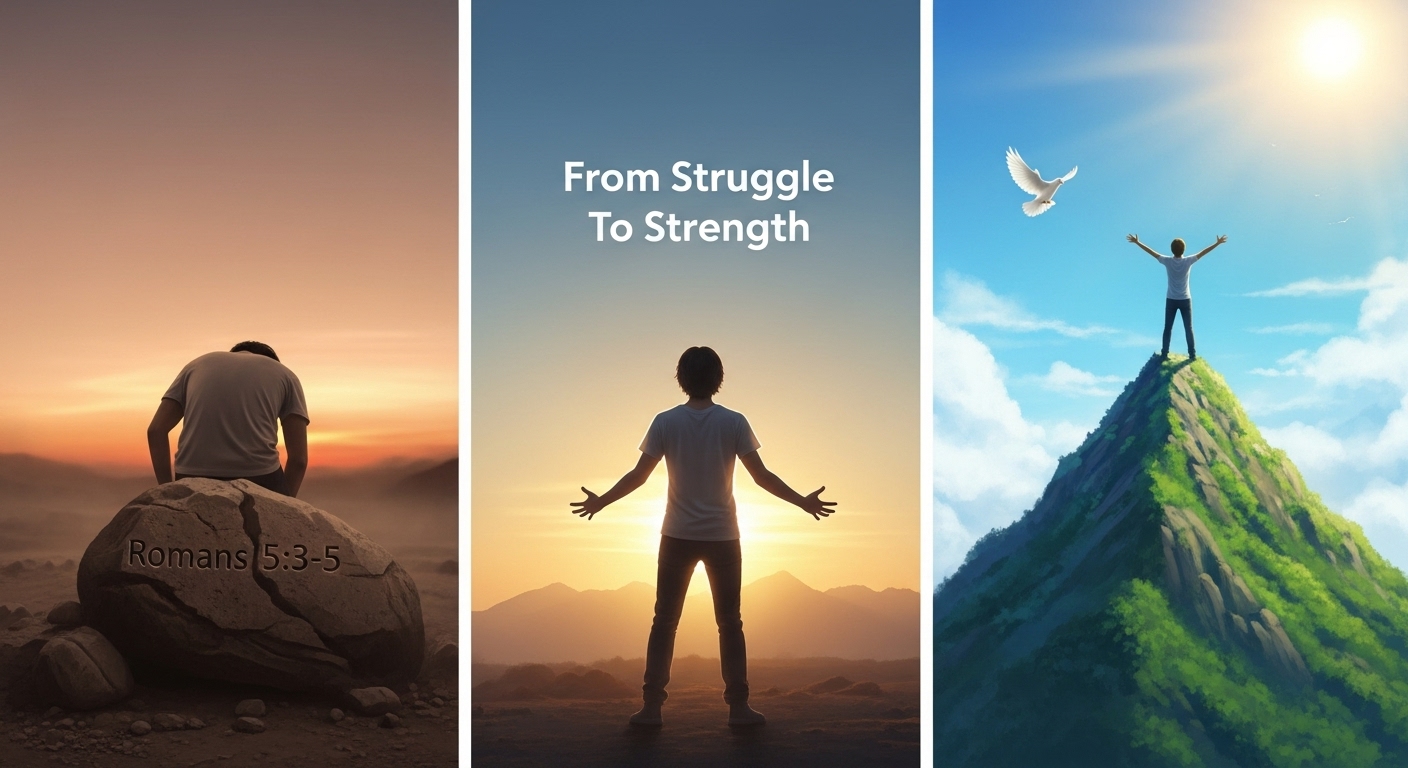
This passage sits in a chapter where Paul explains the good news of salvation through Christ — how you’re declared righteous by faith and how suffering fits into that story. Paul isn’t saying you should enjoy pain for pain’s sake. Instead, he’s giving a framework: suffering leads to perseverance; perseverance shapes character; character fuels hope. And this hope is secure because it’s grounded in God’s love poured into you by the Holy Spirit.
To make it even clearer, you can compare Paul’s thought with James 1:2-4: “Consider it pure joy, my brothers and sisters, whenever you face trials of many kinds…” — which also points to trials producing maturity and completeness. Both writers invite you to see suffering not as a detour but as a formative stage in your faith journey. Read James 1:2-4 (NIV) for that additional perspective.
Understanding the Core Truth
In simple terms, Romans 5:3-5 teaches this: your difficulties can have purpose. When you endure pain with faith, it works like a refining process. Think about metals: they’re heated to remove impurities and then become stronger. God uses hardship to strengthen your inner life so you can reflect Christ more clearly.
Paul’s sequence is practical and psychological: suffering → perseverance (endurance) → character → hope. Each step builds on the last, like rungs on a ladder. You don’t skip steps. Perseverance is not passive resignation; it’s an active, habitual trust in God amid trials. Character is the inner moral and spiritual quality developed through that endurance. Hope is the confident expectation of God’s final goodness, rooted not in circumstances but in God’s demonstrated love through Christ and the indwelling Spirit.
This matters to you because it provides meaning in hard times. When you face setbacks — job loss, illness, relationship pain — Romans 5:3-5 offers a lens that turns confusion into training. Knowing the process helps you cooperate with God instead of resisting or despairing.
Going Deeper — The Hidden Meaning

Beyond the sequence, there’s an emotional and theological depth here. Paul isn’t promoting a prosperity theology where pain equals immediate reward. He’s describing a transformation. The “glory” he mentions isn’t a celebration of hardship; it’s a posture of trust that sees God’s hand in the refining work of suffering.
Consider Joseph’s story (Genesis 37–50). He endured betrayal, slavery, and imprisonment. Through those trials, his character was shaped, and he emerged positioned to save many. Joseph didn’t always see the purpose, but later he recognized God’s sovereign plan: “You meant evil against me, but God meant it for good” (Genesis 50:20). Paul invites you to hold a similar long view.
Another layer is the role of the Holy Spirit. Paul doesn’t leave hope as abstract. He anchors it in God’s love poured into your heart through the Spirit. That means hope isn’t wishful thinking; it’s relational and personal. God’s love is the source and guarantee of the hope that suffering produces. So, even when circumstances feel chaotic, you have an internal witness: the Spirit’s presence and love confirming that you belong to God.
Modern Connection — Relevance Today
How does an ancient letter to Rome speak into your modern life? Quite directly. Your culture often treats struggle as failure or something to be avoided at all costs. Social media amplifies polished success, making you feel isolated in your hardship. Romans 5:3-5 offers a counter-cultural posture: suffering is a context where faith is formed.
If you’re in a difficult season — grief, financial strain, workplace pressure — this passage reframes your experience. Instead of asking “Why me?” as an accusation, you can ask, “What is God doing in me through this?” That question moves you from victim to participant. It encourages you to seek endurance, practice spiritual disciplines, and stay anchored in community.
In practical terms, this might mean showing up to worship even when you don’t feel like it, choosing forgiveness over bitterness, or actively praying for growth rather than only relief. Your endurance can be contagious; when others see you trusting God through hard times, their hope is strengthened, too. In this way, your struggle becomes part of the broader story of the Church’s witness.
Practical Application — Living the Message

You don’t have to wait to feel stronger before you act. Here are simple, doable steps you can start today to turn struggle into strength:
- Name the struggle and pray about it. Be honest with God — He already knows. Honest prayer builds perseverance by keeping you connected to the Source of hope.
- Keep faithful habits. Daily Scripture reading, brief prayers throughout the day, and weekly worship are scaffolds for endurance. Habits don’t remove pain, but they keep you anchored.
- Seek community. Share your burden with a trusted friend, small group, or pastor. Perseverance often grows in the presence of compassionate others.
- Reframe setbacks as training. Ask God what character trait you’re being groomed to learn — patience, humility, compassion — and take small steps to practice it.
- Affirm God’s past faithfulness. Remind yourself of times God has sustained you. Memory fuels hope.
Try a short practice today: write down one difficulty and then jot three ways God might use it to shape you (endurance, empathy for others, renewed dependence). Pray that you’d see the formative work God is doing.
🌿 Faith Reflection Box
Pause for a moment and ask yourself: Which struggle am I resisting that God might be using to grow me? How can I choose to trust rather than merely endure?
Key Takeaways:
- Suffering can produce endurance that builds godly character.
- The Holy Spirit anchors your hope with God’s love.
- Practical faith looks like prayer, habit, community, and intentional reframing.
- Your struggles can be a witness and a ministry when you let God shape you through them.
Q&A
Q1: Does Romans 5:3-5 mean I should look for suffering to grow?
Answer: No — Paul isn’t encouraging you to seek pain. The passage acknowledges that suffering will come, but it teaches how God can use that suffering for growth when you respond with faith. You’re invited to embrace God’s transformative work within the trial, not to manufacture trials for the sake of growth. Growth can happen in many ways: through disciplined spiritual practices, relationships, and even joys. But when suffering arrives, this passage gives you a roadmap to respond in hope, trusting the Spirit’s presence. See Romans 5:3-5 and James 1:2-4 for related encouragement.
Related: Faith And Perseverance
Q2: How can I tell if my response to suffering is building character or just keeping me stuck?
Answer: Pay attention to fruit. If you notice increased patience, empathy, humility, and dependence on God, your suffering is likely shaping character. If you find bitterness, isolation, or denial dominating, you might be stuck. The difference often shows in your relationships and spiritual practices: are you leaning into prayer and community, or withdrawing and blaming? Ask a trusted friend or mentor to help you see blind spots. Remember, the Spirit’s work is gradual; small transformations matter. See Galatians 5:22-23 for the Spirit’s fruit and how character grows.
Q3: What hope does Paul mean when he says ‘hope does not put us to shame’?
Answer: Paul refers to a confident expectation based on God’s proven love. Because Jesus bore sin and the Spirit is given to you, your hope isn’t hopeful wishfulness; it’s grounded in God’s action on your behalf. “Not put us to shame” means that God will not fail you in the ultimate sense — your trust in Him aligns with reality. Our present pain may remain, but ultimate vindication and renewal are sure. This hope sustains you in the meantime and shapes how you live today. See Romans 8:24-25 and Romans 5:3-5.
See also: God’s Promises That Strengthen You in Weakness
Conclusion & Reflection
You don’t have to pretend that pain is easy. But you can let God work in your pain. Romans 5:3-5 gives you a hopeful pattern: suffering can produce endurance; endurance builds character; character fuels hope — a hope that’s anchored in God’s love through the Holy Spirit. When you cooperate with that process through prayer, habit, and community, you’ll find your faith maturing in ways that are both practical and eternal.
A simple prayer you can use now: Lord, in this difficult season, help me to endure with faith. Shape my character to reflect you. Fill me with your Spirit so my hope rests in your love. Amen.

More Inspiration Awaits — Read These Next
👉 For deeper insight into Isaiah 40:31 and how it renews your strength in both faith and daily life
👉 For practical lessons on compassion and neighborliness from the Good Samaritan
👉 For a clear explanation of what we can learn from the Parable of the Good Samaritan
👉 For meaningful insights from the Parable of the Pearl and its hidden treasures
👉 For a deeper look at the Rich Man and Lazarus and what it reveals about the afterlife
👉 For guidance on the Parable of the Ten Virgins and preparing for God’s Kingdom
👉 For clarity on the Parable of the Lamp and how it calls us to shine our light
👉 For insights from the Parable of the Wedding Feast and the meaning behind the invited guests

📘 Jesus and the Woman Caught in Adultery – Grace and Mercy Over Judgement
A powerful retelling of John 8:1-11. This book brings to life the depth of forgiveness, mercy, and God’s unwavering love.
👉 Check it now on Amazon 🛒💥

🔥 “Every great message deserves a home online.” 🌍💬🏡
Don’t let your calling stay hidden. Start a Christian blog or website using Hostinger — with 99.9% uptime, a free domain, and SSL, your voice can shine for God’s glory anytime, anywhere.
💥 Begin today. 🛒 Try it RISK-FREE! ✅

✝️ “Your body is God’s temple — care for it with purpose.” 💪💖🏛️
Renew your energy and restore balance naturally. Mitolyn helps support a healthy metabolism, giving you the vitality to live out God’s calling with strength and confidence.
🔥 Unlock Your Metabolic Power! ⚡Burn More Calories & Feel Great With Mitolyn. 💪
👉 Start Today. 🚀 Check Price Now. 🛒💰
💰 As a ClickBank & Amazon Affiliate, I earn from qualifying purchases.
📖 Acknowledgment: All Bible verses referenced in this article were accessed via Bible Gateway (or Bible Hub).
🚀 Want to explore more? 👉 Dive into our new post on Why Jesus? and experience the 🔥 life-changing truth of the Gospel!