

You’re in a season where prayer feels both urgent and a little awkward — urgent because fear, grief, or a big decision presses on your chest, and awkward because you don’t always know where to begin. You’ve tried praying before: sometimes it felt powerful, sometimes like you were reading from a script. Right now you need something simple, steady, and trustworthy — a way to orient your heart and speak honestly with God without the pressure of performance.
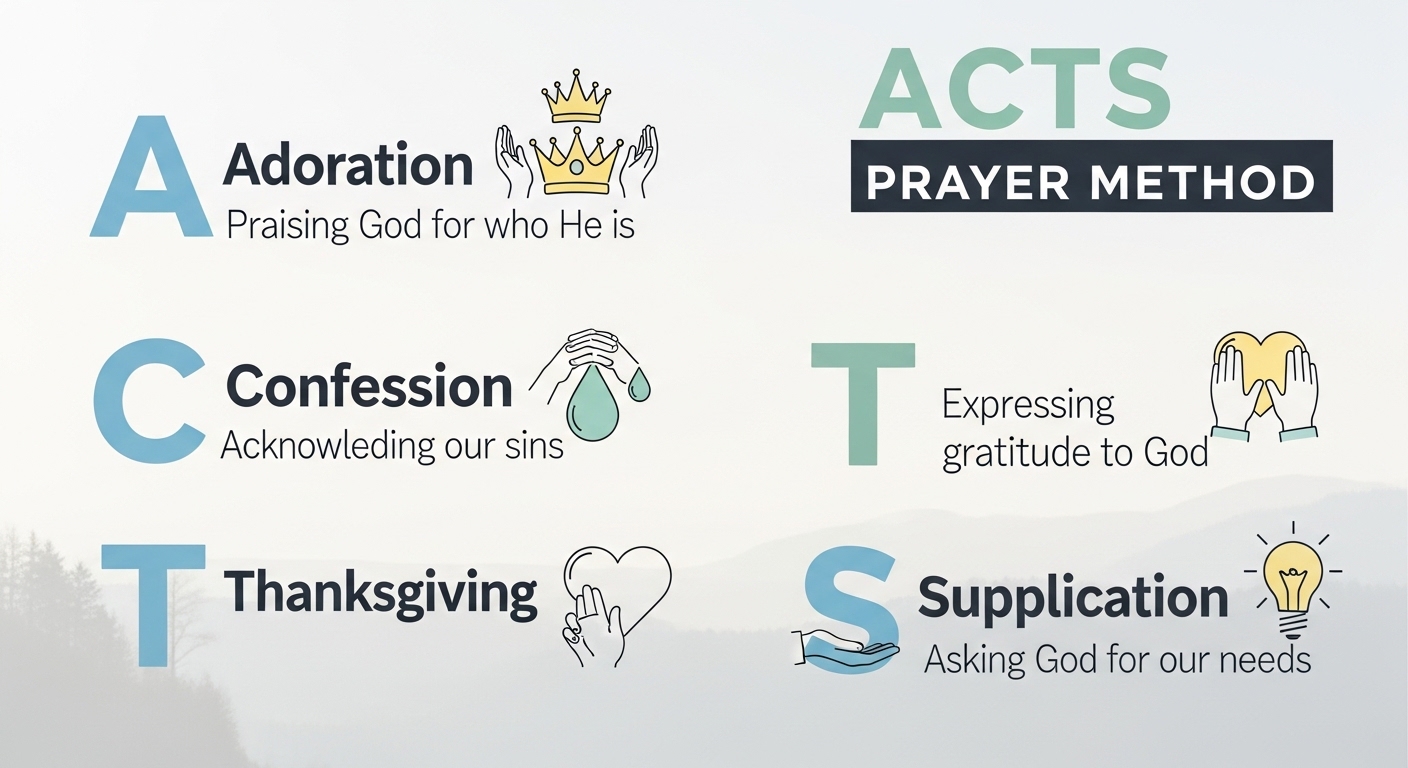
You’re not failing at prayer; you’re learning how to pray in real life. The ACTS method gives you that reliable structure: Adoration, Confession, Thanksgiving, Supplication. It’s not a formula to manipulate God, but a roadmap that helps you come before God in an ordered, humble, and intimate way. In the next sections you’ll get situational reasons to pray, scriptural grounding, a short step-by-step you can use immediately, a sample prayer to lift up, and practical next steps that help this moment become growth for the long haul.
By the end you’ll have a usable pattern you can return to whenever life gets heavy — something that trains your heart to worship, admit your need, remember God’s goodness, and bring your real requests with confidence.
Why This Moment Requires Prayer
You face moments that demand prayer because spiritual reality and everyday reality collide. When fear grips you, prayer steadies your heart; when grief settles in, prayer holds space for honest sorrow; when confusion clouds your mind, prayer clears perspective for decisions; and when crisis hits, prayer connects you to help beyond your own resources. Prayer is the breath of your relationship with God — and seasons of high emotion make that breathing both more urgent and more difficult.
If fear is your current companion, you need prayer because it redirects your gaze from the size of the problem to the character of God. If grief has made the future feel thin, you need prayer because God is present even in what feels absent. If decision-making has become paralyzing, you need prayer because it helps you surface values and wise counsel, not just desires. In a crisis, prayer invites the One above time and complication to work — not always by changing circumstances first, but by changing and strengthening you within them.
This is situational: your prayer in fear will look different from your prayer in grief, and the ACTS method adapts to those differences. You’ll learn how to use each component — adoration to steady your view, confession to clear the relational board, thanksgiving to remember what’s already true, and supplication to bring urgent needs — so your prayer becomes both honest and anchored.

What Scripture Shows Us
Scripture gives both example and promise for the rhythm of prayer. A few passages illuminate different parts of the ACTS pattern and why it works for the season you’re in.
- Adoration: You’re invited to bow out of reverence. Psalm 95:6 points the posture: Psalm 95:6 — “Come, let us bow down in worship, let us kneel before the Lord our Maker.” This verse shows that the first move is orientation — recognizing who God is before you ask anything of Him. That posture reshapes your expectations and calms your anxiety.
- Confession: Honesty with God clears the pathways in your heart. 1 John 1:9 says, “If we confess our sins, he is faithful and just and will forgive us our sins and purify us from all unrighteousness.” Confession isn’t just admitting moral failures; it’s removing the friction between you and God so you can walk freely in relationship.
- Supplication + Thanksgiving: Bring requests and gratitude together. Philippians 4:6 encourages you: “Do not be anxious about anything, but in every situation, by prayer and petition, with thanksgiving, present your requests to God.” Scripture models making requests alongside thankfulness, a pairing that reduces anxiety and anchors hope in God’s past faithfulness.
These verses are short and approachable. Use them as touchstones: adoration to reorient, confession to clear the way, and thanksgiving + supplication to bring your real needs with a heart that remembers God’s care.
How to Pray in This Situation
You want something practical you can use right away. Here’s a 4-step guided method that maps to ACTS and fits into a short quiet moment or a longer time of prayer. Each step includes a quick example you can pray or adapt.
Step 1 — Adoration: Ground Your Heart (1–3 minutes)
Start by praising God for who He is. This isn’t empty praise; it’s specific. Name attributes that matter to your situation: sovereignty in a crisis, comfort in grief, wisdom for decisions, faithfulness in fear.
Example: “God, You are my refuge and strength. You hold the nations and you hold my small world. You are faithful.”
Why it helps: You shift from problem-focus to Person-focus. Adoration centers your heart and reduces frantic energy.
Step 2 — Confession: Clear the Space (1–2 minutes)
Say what’s true about you: your doubts, resentments, wrong choices, or attitudes that block trust. Be brief and honest.
Example: “Forgive me for clinging to control. Forgive me for impatience and for thinking I must fix everything.”
Why it helps: Confession removes the layers that keep you from receiving. It’s like cleaning a window so light can come through.
Step 3 — Thanksgiving: Remember and Recalibrate (1–3 minutes)
Name recent ways God has been good, even small ones. Gratitude trains your memory and reorients your perspective toward grace.
Example: “Thank you for the friend who listened yesterday, for the meal that arrived, for a quiet hour of peace. Thank you that You never leave me.”
Why it helps: Gratitude balances urgency with recognition; it reminds your heart of God’s track record and builds trust.
Step 4 — Supplication: Bring Needs and Requests (2–5 minutes)
Bring specific requests for you, others, and the situation. Be concrete: not only “help,” but describe what help looks like. Include intercession for others and ask for wisdom, provision, or healing as needed.
Example: “Please bring clarity about this job decision. Open doors that need opening; close doors that would harm. Comfort those who mourn in our family. Provide financially for what we can’t cover.”
Why it helps: You move from general anxiety to focused conversation. Specific requests are easier to pray for repeatedly and to look back on when you see answers.
These four steps can take as little as five minutes or stretch into a longer conversation. If your attention drifts, use a breath prayer: breathe in a short adoration phrase (“Lord, my refuge”), breathe out a petition (“give me peace”). The ACTS order helps you avoid the two common pitfalls: starting with a shopping list (supplication only) or staying only in corporate clichés without personal honesty. Use ACTS as a flexible rehearsal for your heart — not a rigid checklist.
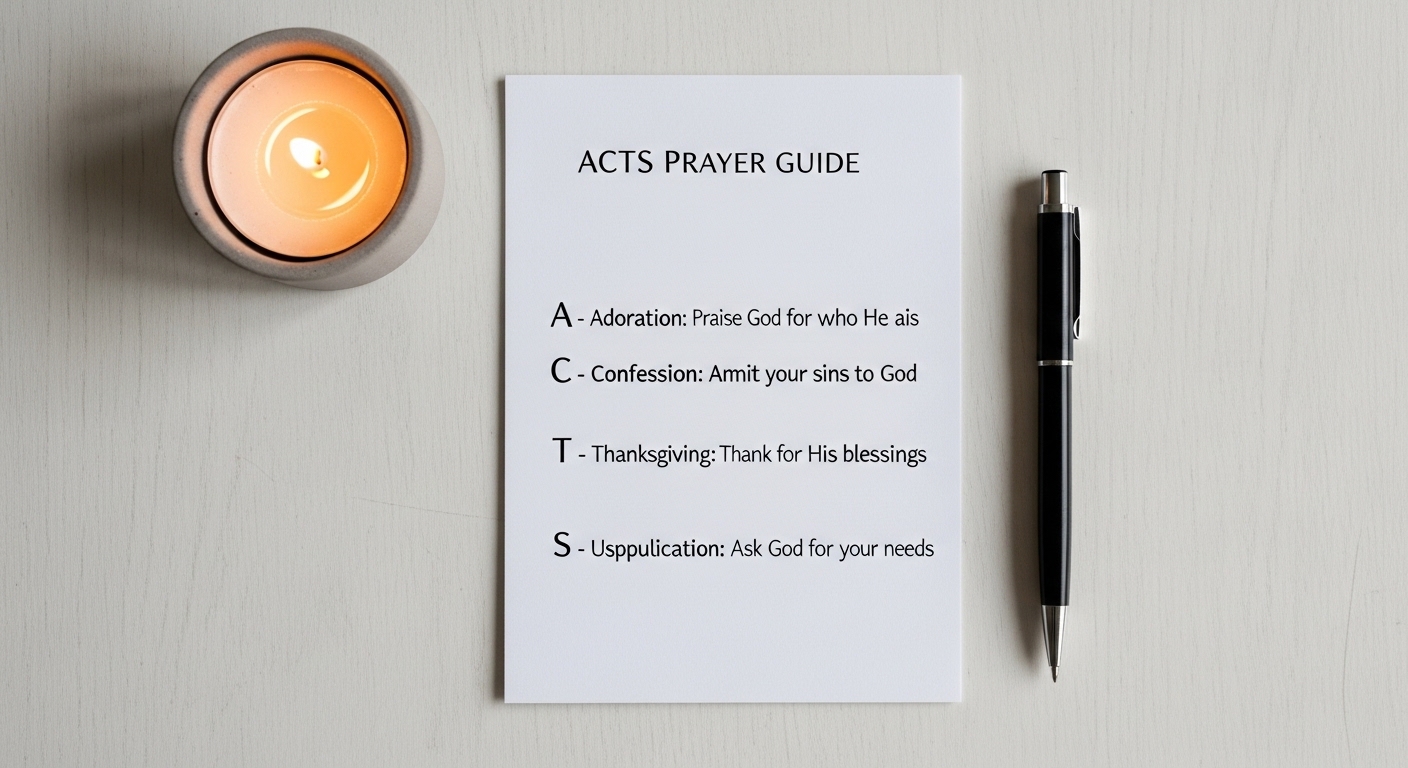
A Short Prayer Outline (If You Prefer One Page)
If you like a compact template to carry or pin:
- Address God and adore (1 sentence).
- Confess one thing (one sentence).
- Name two things you’re grateful for (two items).
- Ask three specific things (one for you, one for relationships, one for others).
- Close in trust (“I wait on You,” “In Jesus’ name, amen”).
Tips to Keep It Unmechanical
Stay conversational. Change the adjectives you use in adoration. Vary the length of silence between steps. Occasionally reverse the order if you’re in a season where confession needs to come first — ACTS is a guide, not a legalistic rule. The structure is training wheels; the goal is intimacy, not performance.
A Sample Prayer You Can Use
(First person; short, honest, specific)
God, you are my shelter and my steady hand. I praise you for your faithfulness and for holding me when life feels uncertain. I confess I’ve clung to worry and tried to solve things in my own strength — forgive me for that. Thank you for the friends who have shown up, for the small signs of hope this week, and for your presence in the night. Please give me wisdom about the choice before me; make the path clear and grant me peace about the outcome. Provide for our needs in ways only you can. I trust you and rest in your timing. In Jesus’ name, amen.
Growing Beyond This Moment
This moment is a training ground. The ACTS method is not just for crisis — it’s a rhythm that grows a steady prayer life. You can use the same four movements in daily, weekly, and seasonal patterns to deepen intimacy with God rather than simply reacting to situations.
- Consistency: Make a small, achievable plan — five to ten minutes every morning or evening — and stick with it. Consistency compounds; five minutes daily over months shifts your prayer muscles and your affections.
- Deeper Study: Couple ACTS with Scripture reading. Let a Bible verse inform each section: use a verse of praise for adoration, a verse of repentance for confession, a verse of gratitude for thanksgiving, and a promise to plead in supplication. Over time, Scripture supplies the language your heart needs.
- Surrender: Practice abandoning outcomes. Prayer changes you, not always circumstances. Learn to place requests in God’s hands and say, even in the asking, “Thy will be done.” That surrender is an act of worship and a practical way to reduce persistent anxiety.
- Accountability and Community: Share the method with a trusted friend and pray together sometimes. You’ll be surprised how shared prayer normalizes honesty and deepens spiritual growth.
- Journaling: Keep a short prayer log. Note requests, dates, and any answers you see. Looking back builds faith and helps you learn how God answers over days and months.
Remember, growth isn’t linear. You’ll have seasons of dryness and seasons of bloom. Return to ACTS as your familiar road when you don’t know what else to do.

Learn More About Strengthening Your Prayer Life
For a deeper biblical foundation on building a consistent and powerful prayer life, read Prayer Practices: A Biblical Guide to Deepening Your Prayer Life. That pillar article explains the biblical purpose of prayer, and the ACTS method fits inside that larger framework by offering a practical, teachable pattern to implement the theology you’ll find there.
Also explore character studies and examples of prayer in Scripture for real-life models. For instance, consider how David’s honesty in the psalms or Daniel’s disciplined prayers give texture to ACTS in practice. You’ll find helpful character reflections in the resources linked below.
Read Next
If you want to keep going, these are good next reads that expand on the skills you’ve started:
-
Prayer Practices: A Biblical Guide to Deepening Your Prayer Life
-
Praying Scripture: How to Turn Bible Verses Into Powerful Prayers
-
Lessons From The Life Of David: Faith, Failure, And God’s Grace
Final Encouragement
You don’t have to get prayer perfect. The ACTS method teaches you to show up: to worship, to be honest, to remember good things, and to ask. Return to the pattern again and again, and you’ll find your prayers becoming less frantic and more like conversation: honest, steady, and transformative.
👉 10 Practical Ways to Live in Obedience to God Daily
Apply what you reflect on.
👉 Train for Godliness: What It Means and How to Grow Spiritually
Strengthen spiritual discipline intentionally.
👉 Spiritual Maturity: Biblical Markers That Show You’re Growing in Christ
Measure your growth biblically.
 Recommended Christian Reading
Jesus and the Woman Caught in Adultery — Grace and Mercy Over Judgment
A powerful retelling of Gospel of John 8:1–11, exploring forgiveness, mercy, and Christ’s compassion.
If you’re reflecting on spiritual growth and obedience, this story will remind you that transformation begins with grace.


Sponsored recommendation

Acknowledgment: All Bible verses referenced in this article were accessed via Bible Gateway (or Bible Hub).
“Want to explore more? Check out our latest post on Why Jesus? and discover the life-changing truth of the Gospel!”