

Explore the complex role of the Philistines in the Old Testament. Analyzing their opposition to Israel reveals lessons on faith, resilience, and God’s divine plan.
The Philistines and Their Role in the Old Testament Narrative
The Philistines – The Enemies of God in the Old Testament
Introduction
Have you ever wondered who the Philistines were and why they consistently found themselves at odds with the Israelites throughout the Old Testament? This ancient people are best known for their frequent skirmishes with the Israelites and their role in many of the Bible’s most dramatic narratives. But apart from this adversarial nature, who were the Philistines? Throughout the Old Testament, they emerge time and again, not just as mere enemies, but as a significant force that challenged and shaped the Israelites’ journey. Join us as we delve into their origins, their impact, and the valuable lessons their story imparts to us today.
Who Were the Philistines?
Identity
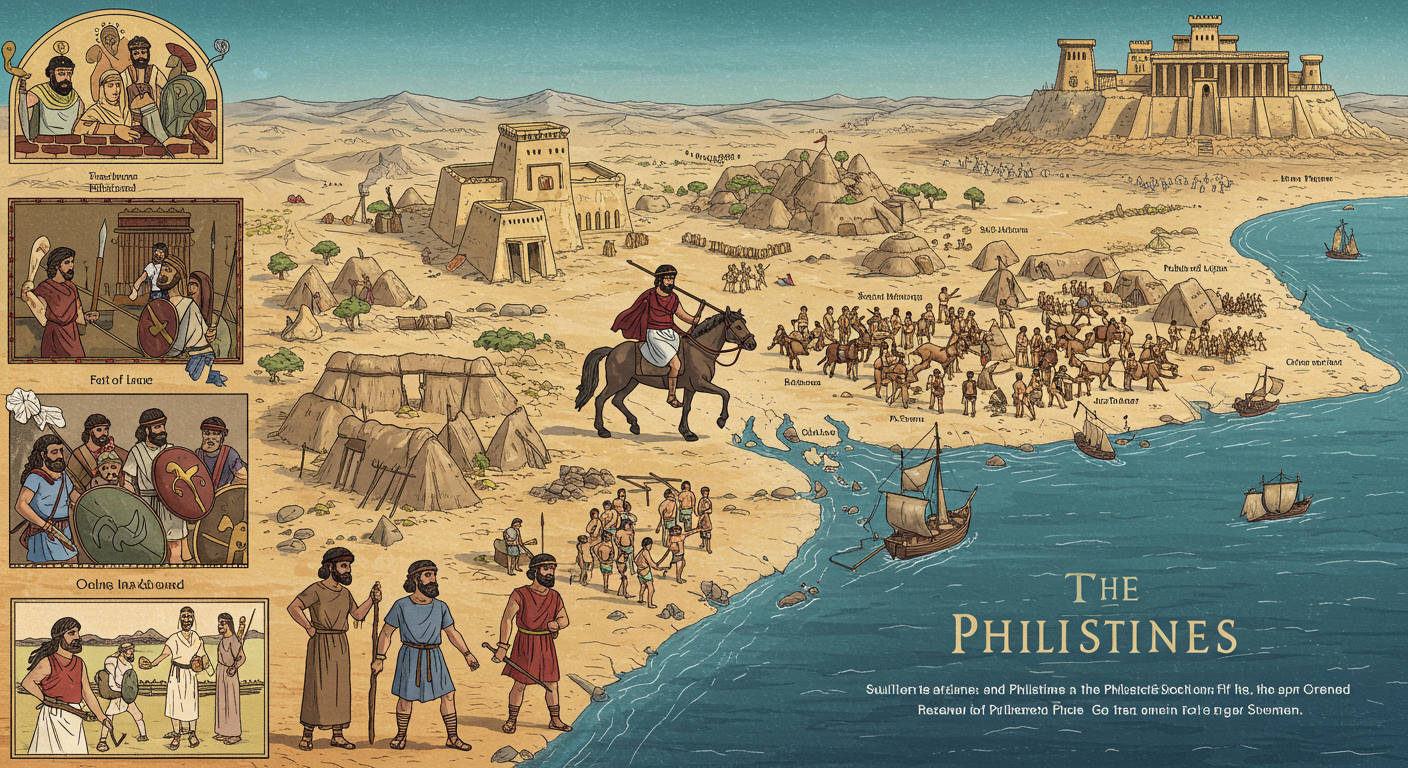
The Philistines were an ancient people whose presence looms large in the Old Testament. Predominantly known as fierce warriors, they were part of the ‘Sea Peoples,’ a confederation of naval raiders around the 12th century BC. Settling in the coastal region of Canaan, they established five main city-states: Gaza, Ashkelon, Ashdod, Ekron, and Gath. Their society was sophisticated, known for advanced weaponry and urban centers—suggesting a keen adaptation to the land they inhabited.
Biblical Context
In biblical narratives, the Philistines emerge in the period of the Judges, continuing through the days of King David. They were a thorn in Israel’s side during this tumultuous time. With a powerful and organized military, they exerted control over parts of Israel, often subjugating them and pressing them into conflict. Their repeated confrontations with key figures like Samson, Saul, and David underline their role and provide a backdrop for many Old Testament events. Notably, their importance in biblical narratives isn’t just as adversaries, but as significant influencers and provocateurs that advanced God’s overarching plan for His people.
The Philistines’ Opposition to God
Motivation
The Philistines’ opposition to God and His people was driven by a mixture of territorial ambition and cultural superiority. Unlike the Israelites, whose identity was centered around their covenant with God, the Philistine identity was rooted in conquest and assertion of dominance. Their war-like nature and political strength made them formidable challenges to Israel’s claim on the Promised Land. This clash of cultures and beliefs set the stage for their numerous encounters with God’s chosen people.
Key Actions
The Philistines are famously known for their oppressive rule, as seen when they captured the Ark of the Covenant (1 Samuel 4:10-11). This act wasn’t just a military victory; it was a spiritual affront to the Israelites, who saw the Ark as the embodiment of God’s presence. Years later, the Philistine giant Goliath dared Israel’s armies in the valley of Elah, taunting King Saul’s army (1 Samuel 17:41-44). It was a defining moment illustrating the Philistines’ deep disrespect for the God of Israel.
Conflict with God’s Will
The Philistine’s actions consistently collided with God’s intentions for His people. Through their attempts to control and influence Israel, the Philistines unknowingly played a role in highlighting Israel’s reliance on God. Their presence forced Israel to decide repeatedly—to either succumb to foreign pressures or to stand firm in their faith and divine purpose. These moments of conflict were not just military encounters but pivotal points that tested and reaffirmed the Israelites’ covenant with God.
The Consequences of Their Opposition
Divine Judgment
The Philistines, for all their might, were not beyond the reach of God’s judgment. The capture of the Ark led to severe consequences for them, resulting in the devastation of their lands by plagues (1 Samuel 5:6-12). Furthermore, the eventual downfall of Goliath at the hands of a young David demonstrated the limits of their worldly power and highlighted divine intervention as a cornerstone of Israel’s deliverance.
Biblical Teachings
The interactions of the Israelites with the Philistines teach us profound lessons about divine justice and resilience in faith. The downfall of proud giants and the retrieval of the sacred Ark emphasizes that no matter how dire the situation, God’s will ultimately prevails. The narratives are not just historical recounts; they echo the timeless truth that humility before God and steadfastness in belief are paramount to overcoming life’s great battles.
The Philistines in the Larger Biblical Narrative
Connection to Other Figures
Throughout the Old Testament, the Philistines play pivotal roles in the lives of many biblical figures. For instance, Samson’s battles with the Philistines, chronicled in the Book of Judges, portrayed a cycle of betrayal and redemption that underscored Israel’s struggle with external adversaries and internal failings (Judges 16:23-30). Moreover, Saul’s engagement with them heavily influenced his reign, marking the dramatic transition of Israel from a fragmented group into a united kingdom under David. These interactions demonstrate the Philistines’ lingering impact on Israelite history and leadership.
God’s Redemptive Plan
Interestingly, the Philistines’ constant antagonism was woven into the larger tapestry of God’s redemptive plan. While they were adversaries to the Israelites, their actions often pushed the latter towards seeking God’s guidance. David’s faith-fueled victory over Goliath, for example, was instrumental in establishing his God-ordained kingship, which led to Israel’s golden age and foreshadowed the coming of the Messiah. These stories reaffirm that even adversity is purposefully used by God to fulfill his divine plan.
Lessons We Can Learn from the Philistines
Spiritual Insights
There is much to glean from the stories of the Philistines’ interaction with Israel. The Philistines’ strength serves as a reminder of the futility of power that does not acknowledge God. Their ultimate inability to conquer Israel testifies to the truth that temporary victories mean little against the backdrop of divine purpose. For modern readers, these narratives call for a deeper reliance on faith, especially when faced with seemingly insurmountable earthly challenges.
Warnings
From the tales of the Philistines, we learn the danger of aligning solely with worldly strength and ambition. Their pride and overconfidence in their military capabilities became their downfall, a cautionary tale about the perils of self-reliance and the neglect of spiritual humility. The stories encourage us to avoid the same pitfalls by keeping our focus and faith intact, even in the face of formidable opposition.
Application
For contemporary believers, the story of the Philistines and their opposition to Israel is emblematic of the ongoing struggle between worldly temptations and spiritual integrity. As these Old Testament tales unravel, they invite us to apply lessons of resilience, humility, and trust in God’s overarching plan for our lives. By turning to Scripture in our own battles, we learn to stand steadfast in our faith, embracing the promise that divine purpose will always triumph.
Conclusion
In the grand narrative of the Old Testament, the Philistines emerge as fierce opponents, yet also as unwitting catalysts for divine action. Their key characteristics of pride, aggression, and cultural superiority clashed directly with God’s plans but ultimately played a role in strengthening and guiding Israel’s spiritual journey. As we reflect on their stories, we are urged not only to marvel at the historic confrontations but also to draw lessons that fortify our faith.
Let these ancient accounts inspire us to act with humility, trust in God’s destiny for each of us, and remain faithful amidst our challenges. How might we learn from the resilience of Israel and the consequences faced by her foes? In what ways can we view our trials as parts of a larger, divine plan?.
Acknowledgment: All Bible verses referenced in this article were accessed via Bible Gateway (or Bible Hub).