

What Is The Difference Between Pre-tribulation And Post-tribulation Rapture? (1 Thessalonians 4:16-17, Matthew 24:29-31)

Introduction
Have you ever wondered what will happen when the Bible speaks about Christ’s return? Maybe you’ve heard phrases like “the rapture,” “the tribulation,” or “the great gathering,” and you’re not sure how they fit together. You’re not alone—this topic stirs a lot of curiosity and a fair bit of debate. It matters because how you understand end-times events can shape your hope, readiness, and how you live today.
In this article, you’ll get a clear, Scripture-centered look at the two main views: pre-tribulation and post-tribulation rapture. We’ll root our discussion in two key passages—1 Thessalonians 4:16-17 and Matthew 24:29-31—and walk through what each position teaches, why Christians disagree, and how this affects your faith and daily life. You don’t need to be a scholar to follow along. This will be conversational, practical, and faith-filled.

📖 The Bible Foundation
James 1:2–4 — Bible Foundation Verse
James 1:2–4 (NIV) “Consider it pure joy, my brothers and sisters, whenever you face trials of many kinds, because you know that the testing of your faith produces perseverance. Let perseverance finish its work so that you may be mature and complete, not lacking anything.”

The New Testament often frames hardship and hope together. James encourages you to view trials as spiritual refining, not meaningless suffering. This matters when you think about the rapture and the tribulation because the core of Christian faith is trust in God through trials, not simply the avoidance of them. Whether you expect to be taken up before a time of great difficulty or believe God will carry you through it, Scripture calls you to maturity and faithfulness in the present moment.
👉 “Debates about the timing of the rapture ultimately point us toward our eternal hope—where God’s people will finally live out the joyful purpose He intended forever.”
➡️ Learn more in What Will We Do in Heaven? (Revelation 22:3-5, Isaiah 65:21-23)
Key Verses About the Rapture and Return
- 1 Thessalonians 4:16-17 (NIV) “For the Lord himself will come down from heaven, with a loud command, with the voice of the archangel and with the trumpet call of God, and the dead in Christ will rise first. After that, we who are still alive and are left will be caught up together with them in the clouds to meet the Lord in the air. And so we will be with the Lord forever.”
- Matthew 24:29–31 (NIV) “Immediately after the distress of those days, the sun will be darkened, and the moon will not give its light; the stars will fall from the sky, and the heavenly bodies will be shaken.’ Then will appear the sign of the Son of Man in heaven. And then all the peoples of the earth will mourn. They will see the Son of Man coming on the clouds of heaven with power and great glory. And he will send his angels with a loud trumpet call, and they will gather his elect from the four winds, from one end of the heavens to the other.”
These two passages are central to the debate. 1 Thessalonians gives a comforting picture of believers being caught up to meet Christ. Matthew gives a dramatic scene tied to cosmic disturbances and the Son of Man coming with power and angels gathering the elect. The puzzle is how to reconcile “caught up before hardship” vs. “gathered after distress.”
🧠 Understanding the Core Truth
At the heart of both views is the same central truth: Jesus will return, and believers will be gathered to him. That is your core assurance. The difference is timing and interpretation.
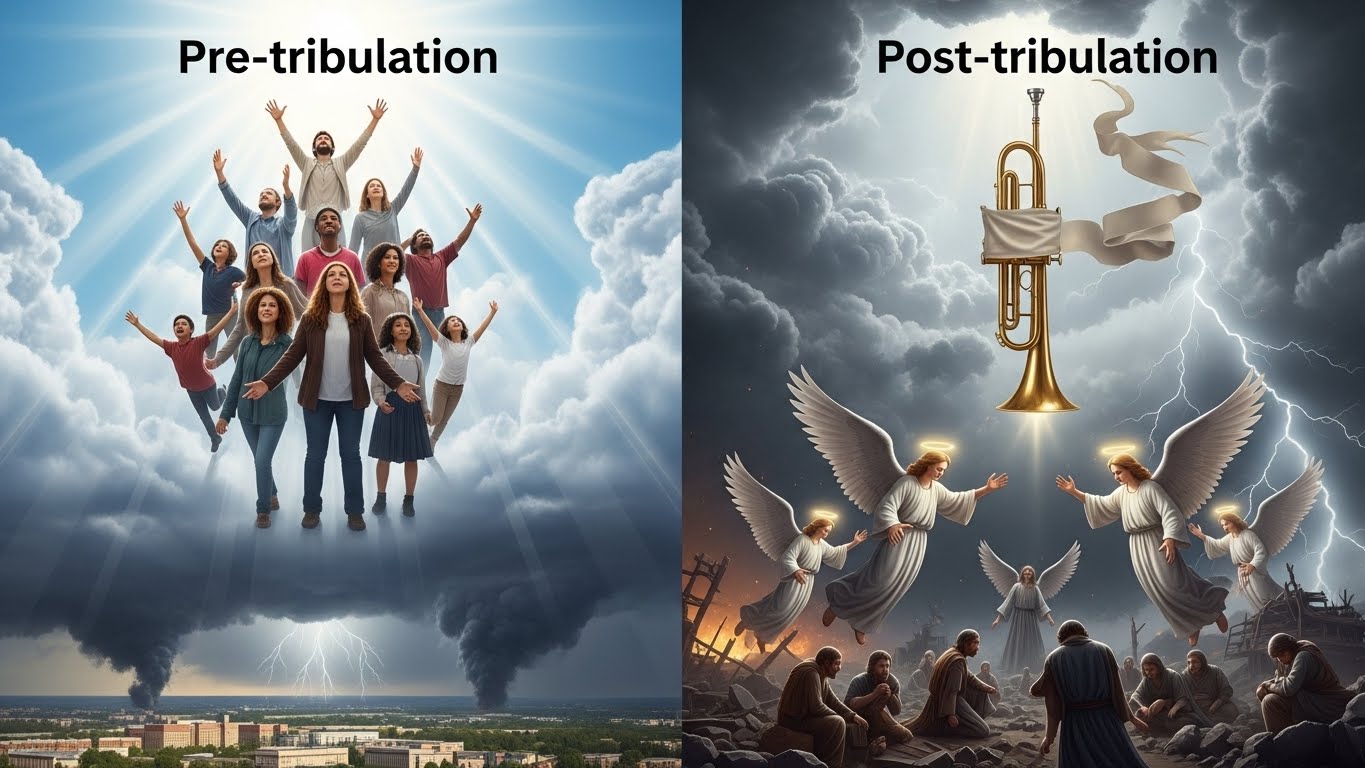
- Pre-tribulation rapture: This view teaches that believers will be taken up (raptured) before a distinct period known as the tribulation—a time of severe trial and judgment—so they are spared the worst of it. Advocates stress comfort and the promise of God’s protection for his church.
- Post-tribulation rapture: This view says the rapture will occur after the tribulation—believers will endure the hardships and be gathered at Christ’s final visible return. Advocates stress biblical continuity: Jesus’ return is a single event culminating in final judgment and gathering.
Both positions aim to honor Scripture and the character of God. You’re not choosing between hope and trust; you’re engaging with how different passages fit together. Your primary takeaway should be that Christ’s return is certain and should shape your life now.
🌊 Going Deeper — The Hidden Meaning
Why is the timing so contested? A few deeper reasons:
- Genre and context: Matthew’s Olivet Discourse is prophetic and apocalyptic, using symbolic language about cosmic signs and the Son of Man. 1 Thessalonians is pastoral—Paul is comforting a church worried about deceased members. The literary context influences how you read timing and sequence.
- The word “rapture”: The English term “rapture” comes from the Latin rapturo (from the Vulgate’s translation of “caught up”—harpazó in Greek). That single verb can be read as part of a broader narrative (Jesus returns once) or as a distinct event separated from final judgment.
- The nature of “tribulation”: Some see the tribulation as a short, unique seven-year period (based on Daniel and Revelation timelines). Others see it as any time of severe persecution that has occurred throughout church history. Your view of prophetic imagery affects how you interpret the end-time timeline.
Relate this to real life: think of a firefighter who warns you of a coming storm. Pre-tribulation thinking says you’ll be evacuated before the worst hits. Post-tribulation thinking says you’ll stay and work through danger, trusting protection and rescue at the storm’s end. Both respond to God’s promise of care—one emphasizes removal from danger, the other endurance through it.
👉 “As we discuss Christ’s return, many also wonder what happens immediately after death and whether believers become heavenly beings in the life to come…”
➡️ Learn more in Do People Become Angels When They Die? (Hebrews 1:14)
💡 Modern Connection — Relevance Today
How does this ancient debate matter to you now? It affects three practical areas:
- Your hope and perspective on suffering: If you expect removal before intense trials, you may live with a certain expectation of immediate rescue. If you expect to endure, your faith may grow through perseverance. Either way, the Bible calls you to hope, perseverance, and holiness.
- Evangelism and urgency: If Christ’s return is imminent, you’re motivated to share the gospel now. Both views fuel evangelism—either because time is short, or because people need hope in dark times.
- Daily living and priorities: Belief in Christ’s coming changes how you spend your time. You’ll likely invest in relationships, spiritual growth, and acts of love rather than temporal gain.
You can honor both biblical truth and practical holiness regardless of which timing you lean toward. The main point is living in ready expectancy and compassionate action.

❤️ Practical Application — Living the Message
Whether you lean pre-tribulation or post-tribulation, here are practical steps you can take today:
- Cultivate perseverance: Practice spiritual disciplines—prayer, Scripture reading, fellowship—that strengthen you for trials (James 1:2–4).
- Share the gospel with compassion: Use your expectation of Christ’s return as motivation to love and share, not as a reason for passivity.
- Live holy and expectant: Let the certainty of Christ’s coming shape your daily choices—how you treat others, manage resources, and steward your time.
- Prepare spiritually, not anxiously: Preparation means faith-filled readiness—repentance, reconciliation, and service—rather than fear-based stockpiling.
These actions apply whether you believe you’ll be taken before tribulation or through it. The emphasis is on being ready and living with Kingdom priorities.
👉 “However the end unfolds, Scripture calls every believer to spiritual growth—because salvation not only saves us, it shapes us to become more like Christ.”
➡️ Learn more in What Is Sanctification and How Is It Linked to Salvation? (1 Thessalonians 4:3, John 17:17)
Faith Reflection Box
Take a pause. Ask yourself: Do I live like Christ could return today? Where am I relying on certainty about timing, instead of trusting God’s character and promises?
Key Takeaways:
- The main Christian hope is Christ’s return—timing debates don’t change that central promise.
- Scripture encourages both readiness and endurance; live in repentance and active love.
- Use your hope to fuel evangelism and compassionate service.
- Spiritual maturity comes through trials, whether you are spared or sustained through them.
- Study Scripture humbly, knowing faithful Christians can differ on timing while sharing core convictions.
👉 Q&A
Q1: If the rapture happens before the tribulation (pre-tribulation), what about the promise that believers must endure trials? Does that make God’s call to perseverance irrelevant? Answer: The call to perseverance remains central, whether you hold a pre- or post-tribulation view. Pre-tribulation teaching typically distinguishes between the church age and a future concentrated period of judgment. It doesn’t teach that believers will never face trials; Scripture clearly shows Christians experiencing hardship throughout church history (John 16:33; John 16:33 NIV). Pre-tribulational believers are often called to be faithful in their current trials and to be spiritually prepared for the Lord’s return at any moment. The promise of removal from a distinct final period of wrath is viewed as part of God’s redemptive plan, not a negation of the biblical call to endurance and maturity (James 1:2-4 NIV).
Related: What Is The Rapture? (1 Thessalonians 4:16-17)
Q2: If you believe in the post-tribulation view, how do you reconcile Matthew’s teaching about the Son of Man coming “on the clouds” with Paul’s “caught up” language in 1 Thessalonians? Answer: The post-tribulation view reads both texts as complementary descriptions of one climactic event. Matthew 24:29–31 (Matthew 24:29–31 NIV) shows cosmic signs, the Son of Man’s visible return, and the gathering of the elect; 1 Thessalonians 4:16–17 (1 Thessalonians 4:16–17 NIV) describes believers being caught up to meet the Lord—language that fits the same final return. Post-tribulation interpreters stress that Scripture often uses multiple images (trumpet call, clouds, angels) to describe the same culmination. The unity view sees these passages as harmonious: Christ appears in glory, angels gather the elect, and the redeemed are transformed and taken into his presence in the same event.
Q3: How should I care for others when end-times discussions divide people in my church? Answer: Focus on unity around central gospel truths—Christ’s death and resurrection, grace, repentance, and the call to love. End-times differences are secondary matters that historically have divided sincere believers. Practice humility, charity, and patience: listen, ask honest questions, and avoid dogmatism that harms relationships. Use Scripture to encourage and equip rather than to win arguments, and remember Jesus’ command that your love for one another will testify to the world (John 13:34-35 NIV). Discuss differences calmly, prioritize gospel ministry together, and model the patience and hope the New Testament expects.
Conclusion & Reflection
The question “What is the difference between pre-tribulation and post-tribulation rapture?” really comes down to timing and interpretation, but both views point you back to the same hope: Jesus Christ will return and gather his people. Whether you expect to be spared before a time of intense trial or to be brought through it and gathered at the end, your life is called to faithful readiness, love for others, and perseverance.
Let’s pray: Father, thank you for the promise of your Son’s return. Help us to live in hope and humility, to love others well, and to trust you in trials. Give us wisdom as we study your Word and compassion as we walk with others who may see things differently. Keep our eyes on Jesus, the author and perfecter of our faith. Amen.

 For deeper insight into Isaiah 40:31 and how it renews your strength in both faith and daily life
For practical lessons on compassion and neighborliness from the Good Samaritan
For a clear explanation of what we can learn from the Parable of the Good Samaritan
For meaningful insights from the Parable of the Pearl and its hidden treasures
For a deeper look at the Rich Man and Lazarus and what it reveals about the afterlife
For guidance on the Parable of the Ten Virgins and preparing for God’s Kingdom
For clarity on the Parable of the Lamp and how it calls us to shine our light
For insights from the Parable of the Wedding Feast and the meaning behind the invited guests
 Jesus and the Woman Caught in Adultery – Grace and Mercy Over Judgement
A powerful retelling of John 8:1-11. This book brings to life the depth of forgiveness, mercy, and God’s unwavering love. Check it now on Amazon 


 “Every great message deserves a home online.”


Don’t let your calling stay hidden. Start a Christian blog or website using Hostinger — with 99.9% uptime, a free domain, and SSL, your voice can shine for God’s glory anytime, anywhere. Begin today. Try it RISK-FREE! 

 “Your body is God’s temple — care for it with purpose.”


Renew your energy and restore balance naturally. Mitolyn helps support a healthy metabolism, giving you the vitality to live out God’s calling with strength and confidence.
Unlock Your Metabolic Power!  Burn More Calories & Feel Great With Mitolyn.
Start Today.  Check Price Now.
As a ClickBank & Amazon Affiliate, I earn from qualifying purchases.
 Acknowledgment: All Bible verses referenced in this article were accessed via Bible Gateway (or Bible Hub).
Want to explore more? Dive into our new post on Why Jesus? and experience the life-changing truth of the Gospel!