


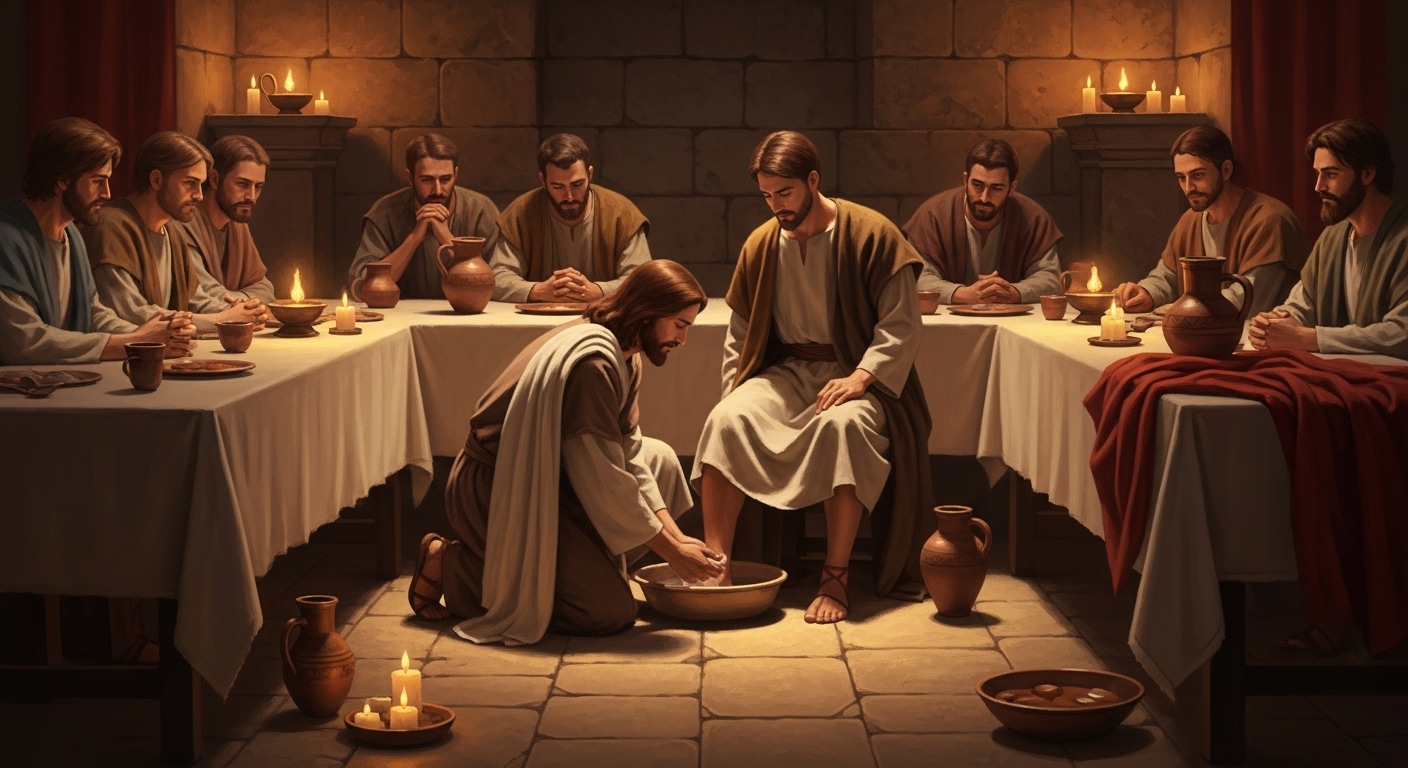
One of the most surprising and humbling scenes in the Gospels is when Jesus—Teacher, Lord, and King—kneels and washes His disciples’ feet. You might picture the drama: the Last Supper just begun, the room charged with tension, and Jesus removes his outer garment, takes a towel, and performs the role of the lowest servant. If you grew up hearing this story, you probably felt its power. If this is your first time reading it closely, you might wonder: why would the Son of God do something so shocking?
In this article you’ll walk through the cultural background, the spiritual meaning, and the practical implications of Jesus’ act. You’ll see how a single moment at the table is both a vivid sermon and a blueprint for how you’re called to live with humility, love, and service. By the end you’ll be equipped to reflect on this act in a fresh way and apply it in your relationships, leadership, and daily choices.

Introduction: The Shock and the Invitation
Jesus washing the disciples’ feet flips every expectation about status, power, and leadership. In a world that prizes honor and reputation, He models a different way. When you read this story, you’re invited not simply to admire Jesus but to be transformed by His example.
That transformation is the promise of this moment. You’ll discover why Jesus chose that particular act, what it meant for His disciples then, and what it means for you now. You’ll be invited to let His humility shape how you lead, serve, and love in your everyday life.
The Key Bible Moment
The clearest textual window into the event is found in John’s Gospel. Read the scene closely to feel its tension and tenderness.
- The specific command and model is recorded in John 13:14–15, where Jesus says, “Now that I, your Lord and Teacher, have washed your feet… you also should wash one another’s feet.” That sentence is both a summary of what has just happened and a commissioning for what will follow.
- For the full scene and context, you can read the whole passage in John 13:1–17, which frames the act in the context of Jesus’ love and the impending betrayal.
When you read John’s account, notice how the action isn’t a random demonstration. It’s deliberate, intimate, and timely—set during the Last Supper as Jesus prepares His followers for what’s coming. This is pastoral formation: an act that both teaches and transforms.
1. A Lesson in Humility
Jesus’ posture in the story is striking. He willingly takes the position of the lowest household servant, exposing his own dignity to perform a menial, dirty task. That image should challenge you—especially when you measure success by status, titles, or influence.
Jesus, being Lord and Teacher yet becoming a servant, shows you that true greatness is not measured by position; it is lived out in humility. The point is not to humiliate leaders but to reframe power. The Lord of all humbles Himself so that you might know the kingdom’s values. When you accept this as more than a story, your orientation to pride, competitiveness, and self-preservation shifts. You start valuing what Jesus valued: care, presence, and sacrificial love.
Apply this in your life by choosing humility in small daily choices. Let others go first. Admit when you’re wrong. Serve without performing. Over time, these small acts reshape your character and witness. Humility isn’t passive; it’s active, deliberate, and contagious.

2. A Model of Servant Leadership
Jesus’ act is not just about personal humility; it’s a leadership principle. He had already declared why He came: “The Son of Man did not come to be served, but to serve…” For the explicit wording, see Mark 10:45. That mission statement reframes leadership for everyone who follows Him.
When you lead—whether at home, at work, or in your community—this passage calls you to lead by serving. Servant leadership doesn’t diminish responsibility; it reorients it. You don’t lead to hoard authority or accolades. You lead to enable others, to protect the weak, and to create space for flourishing.
Practically speaking, servant leadership can look like listening actively, sharing credit, mentoring without strings attached, and prioritizing others’ needs. In conflict, you seek reconciliation before reputation. In decisions you ask who will be harmed or helped, and then choose the path that honors others. When you model humility, you invite a culture where people find freedom to grow rather than fear to perform.
3. A Symbol of Spiritual Cleansing
When Peter resists Jesus’ washing and says, “You shall never wash my feet,” Jesus responds with a deeper truth: “Unless I wash you, you have no part with Me.” See John 13:8 for that exchange. Jesus links the physical action to a spiritual reality—the need to be cleansed and restored.
Foot washing in antiquity had obvious practical value: dusty roads, sandals, and low hygiene. But Jesus uses the physical to symbolize spiritual cleansing. You can’t be a part of His life without being made clean—this is both a present reality and an ongoing dependency. When You receive Jesus, you receive forgiveness and a new standing before God; when you continue following Him, you continually allow Him to cleanse and shape you.
This symbolism should move you to regular self-examination. Do you confess your faults? Do you admit your need for cleansing? The spiritual discipline of confession, repentance, and receiving grace keeps your heart soft and responsive. The foot washing scene reminds you that following Jesus is not merely a set of beliefs but an ongoing surrender to His sanctifying presence.

4. A Call to Love One Another
Immediately after washing the disciples’ feet, Jesus issues a new commandment: “Love one another. As I have loved you, so you must love one another.” That commandment is recorded for you in John 13:34. The washing and the command go together—action and ethic unified.
This love is practical, sacrificial, patient, and costly. It’s love that bends to serve rather than expecting someone else to bend. Jesus gives you a measure: love the way He loved. That sets a high bar—love that lays down life and reputation for the good of others.
In daily life, this looks like hospitality without strings, generosity without scoring points, and patience with those who irritate you. It looks like bearing one another’s burdens and refusing to retaliate when offended. When you align your daily priorities with that command, your community begins to reflect the Jesus you say you follow.
5. An Example to Follow Daily
What makes this moment timeless is that Jesus didn’t merely teach a principle—He modeled it. You aren’t left with platitudes; you have a concrete example to imitate. This is why Jesus says you should do likewise after He washes their feet. The point is discipleship: imitation of Christ in the small and the large moments.
Living this example requires intentionality. You’ll need to ask pointed questions: Who can I serve today? Where am I protecting my status instead of choosing humility? How can my leadership reflect servant-hearted priorities? The more you turn those questions into habits—acts of service, regular confession, sacrificial time with others—the more your life will be shaped by Jesus’ example.
In practical terms, create rhythms that remind you of this posture. Commit to a monthly act of service, a weekly confession practice with a trusted friend, or a leadership covenant that prioritizes the welfare of the least visible in your context. Small disciplines compound and create significant character shifts.
Historical and Cultural Background: Why Foot Washing Wasa Big Deal
To grasp the full shock-value of the scene, you need to see how foot washing functioned culturally. In first-century Palestine, most people walked long distances on dusty roads in open sandals. Houses often had low thresholds and communal spaces where a basin and water were used to clean feet upon entering. The actual task of washing feet typically fell to the lowest household servant or a designated slave. It was not an honor task; it was necessary labor.
When you imagine Jesus performing this task, you see the reversal at play. A teacher, rabbi, and leader stoops to do what was socially beneath him. For His disciples—especially Peter and perhaps Judas—the act would have felt unsettling. Leaders washed disciples’ feet in the sense of welcoming them, but for the leader to wash disciples was to turn the social order upside down.
This background helps you appreciate the courage and clarity of Jesus’ statement. He was not being dramatic for drama’s sake. He was embodying an ethic meant to reorient social expectations and reorder how his followers valued one another.
Did Jesus Wash Judas’s Feet?
A common and provocative question is whether Jesus washed Judas’ feet too. John’s Gospel indicates that Jesus knew the identity of the betrayer as He performed the ritual (see John 13:2 and surrounding verses). Jesus’ act of washing did not depend on the recipient’s faithfulness; it was an expression of unconditional love and the openness of grace.
The inclusion of Judas in the scene teaches you that grace often precedes and invites repentance. Jesus’ love is offered even when betrayal hangs in the air. That doesn’t excuse sin, but it does reveal the scope and integrity of divine love: it offers cleansing and summons transformation even to those who later resist or reject it.
Theological Significance: More Than Clean Feet
Beyond humility, leadership, and cleansing, the event carries deeper theological signals. First, it foreshadows the atonement and cleansing work Jesus will accomplish on the cross. The towel and basin gesture toward the greater act of sacrifice that makes ultimate cleansing possible. The scene bridges teaching and action, sermon and sacrifice.
Second, the washing ties into the themes of covenant renewal and community formation. At the Last Supper Jesus institutes a new covenant symbolized by bread and wine (see Matthew 26:26–30), and the foot washing complements that act by shaping how the covenant community is to live—marked by mutual humility and love.
Third, the scene aligns with the incarnational theology of Christ—God with us who stoops. Passages like Philippians 2:5–8 echo the same motif: Christ, though in very nature God, humbled himself and became obedient to death. When you read the foot washing beside Philippians’ hymn, you see a consistent portrait of a God who lowers Himself to raise others.
These theological threads should shape your worship and your doctrine. You worship a God who serves, and that truth informs how you serve others.
Practical Applications: How You Can Live This Out
The story invites practical and concrete responses. It’s easy to admire Jesus’ humility on a spiritual level and then miss opportunities to live it out. Here are ways you can embody the lesson in everyday life without treating it as just another moral to check off.
- In family life: Do the small, unnoticed things—wash a dish without being asked, take a child to practice, listen to your spouse without trying to fix everything immediately. These acts of service create safety and cultivate intimacy over time.
- In your workplace: Use your authority to create opportunities for others, advocate for those without a voice, and be first to do what others might avoid. Serving doesn’t mean being a doormat; it means owning responsibility for others’ growth.
- In church and community: Volunteer where need is greatest, mentor younger people without expecting reciprocation, and prioritize hospitality that welcomes the awkward and the marginalized.
- In personal spiritual life: Practice regular confession, receive accountability, and be open to others washing your “feet”—people who will speak truth into your life with love.
As you practice, track small wins. Notice how others respond. You’ll find that serving often multiplies dignity rather than depleting it.

How Jesus’ Act Shapes Christian Rituals
The foot washing tradition has been preserved in various Christian communities as an act of humility and remembrance—most notably in Maundy Thursday services. “Maundy” comes from the Latin mandatum, meaning “commandment,” referencing Jesus’ command to love one another after washing the disciples’ feet.
For you, participating in or observing foot washing in worship can be a sacramental reminder: a physical symbol anchoring an inward reality. It helps you remember that holiness is practiced in ordinary acts of care. Yet you should be wary of turning symbols into legalistic hoops. The point of ritual is to recalibrate your posture, not merely to perform a rite for its own sake.
If your tradition doesn’t practice foot washing publicly, you can still adopt its spirit privately or in small groups. Let it recalibrate how you assess leadership and love.
Addressing Common Objections and Questions
You might wonder whether Jesus’ act was culturally specific and therefore irrelevant to modern contexts. That’s a valid concern. Yes, foot washing was particular to a cultural setting; but the principle—humility that serves—transcends context. You don’t need literal foot washing to practice the ethic Jesus modeled.
Others ask whether the story implies that you must always be a servant or relinquish ambition. The answer is nuanced: Jesus isn’t denigrating ambition in itself; He’s combating self-exalting ambition. Ambition channeled toward service, justice, and love becomes a powerful force for good. The test is motive: are you seeking status for its own sake, or for the welfare of others?
Another question is whether the act preaches cheap grace—are you called to accept abuse under the banner of humility? No. Humility that serves is not a license for others to exploit you. It requires wisdom, boundaries, and sometimes courage to resist injustice. Loving like Jesus often means confronting sin and injustice, not enabling it.
Reflection: How Does This Change Your Daily Choices
Take a moment to reflect on tangible ways you can live out this example. The gospel invites an embodied response: not simply believing in humility, but practicing it.
Ask yourself:
- Where are you most protective of your reputation?
- Who in your life needs a concrete act of service from you?
- What spiritual practices help you receive cleansing and remain humble?
Try a simple experiment for a week: each day do one act of service without telling anyone. Keep it small and mundane. Notice your heart. Do you seek recognition or feel genuine joy? Over time, these acts rewire your impulses and invite transformation.
The Promise: A Community Transformed by Simple Acts
When you and others choose humble service, communities change. The ripple effect of daily acts of love—washing metaphorical feet—creates cultures where trust, dignity, and generosity thrive. You may not see dramatic results overnight, but steady practice yields profound change.
Remember that Jesus’ washing was both a personal act and a public sermon. It taught a new way to belong. If you make humility a habit, you’ll contribute to a community that reflects the kingdom Jesus inaugurated.
Closing Prayer
Lord, teach me to live with humility and serve others with love. Help me follow the example of Jesus in my daily life. Cleanse my heart and guide my actions to reflect You. Amen.
 Internal Resources to Explore
 Internal Resources to Explore
If you want to explore Palm Sunday, Holy Week, and related themes more deeply, these resources will help you understand how this moment fits into the larger story of Jesus’ mission:
Main Hub
Related Articles
- Why Did Jesus Christ Ride a Donkey? (Meaning Explained)
- Palm Sunday Meaning and Bible Verses
- What Happened on Good Friday?
- The Meaning of Easter Sunday
Sponsored recommendation

Acknowledgment: All Bible verses referenced in this article were accessed via Bible Gateway (or Bible Hub).
“Want to explore more? Check out our latest post on Why Jesus? and discover the life-changing truth of the Gospel!”