

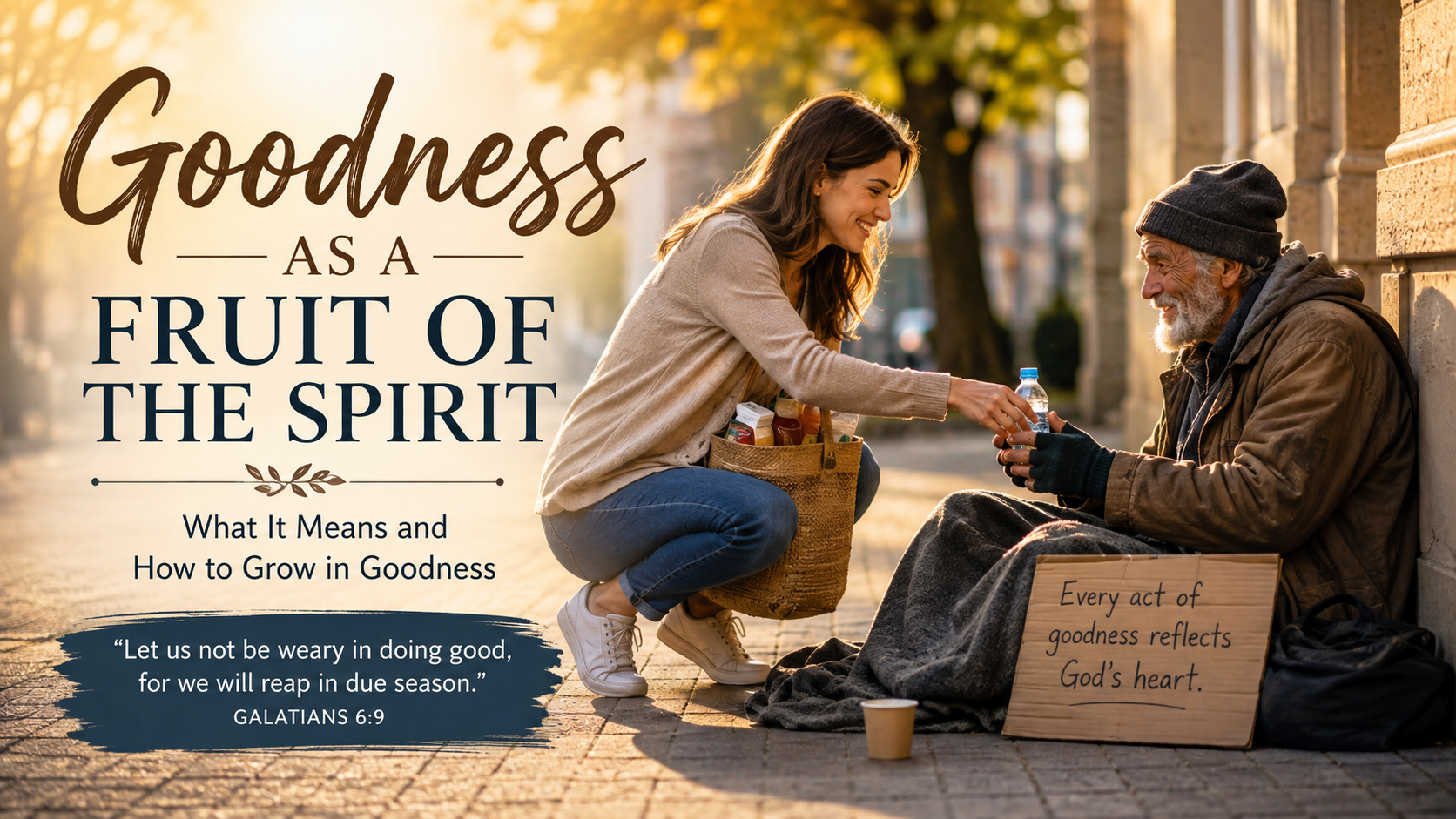
It is easy to call someone a “good person.”
Maybe they are honest, generous, dependable, or willing to help others. We often use the word good to describe anyone whose behavior we admire.
But when the Bible speaks about goodness as a fruit of the Spirit, it means something deeper than simply being nice or having a good reputation.
In Galatians 5:22–23, Paul writes:
“But the fruit of the Spirit is love, joy, peace, patience, kindness, goodness, faith, gentleness, and self-control.”
Goodness is part of the character the Holy Spirit develops in people who belong to Christ.
It affects the choices we make when nobody is watching.
It influences whether we tell the truth when lying would be easier.
It gives us courage to stand for what is right when compromise would cost less.
And it moves us to use what God has given us for the good of others.
Goodness as a fruit of the Spirit is the Holy Spirit developing in us a desire to do what is right, honorable, and pleasing to God—and helping us live that desire out in practical ways.
It is not about becoming good enough to earn God’s acceptance.
It is about God’s Spirit transforming our character after we have received His grace.

What Is Goodness as a Fruit of the Spirit?
Biblical goodness begins with God.
We cannot understand what is truly good simply by looking at popular opinion, personal preference, or whatever our culture happens to approve.
God Himself is good.
Psalm 34:8 says:
“Oh taste and see that Yahweh is good. Blessed is the man who takes refuge in him.”
Everything God does flows from His holy and righteous character.
That means biblical goodness is more than pleasant behavior. It involves a heart increasingly shaped by God’s character and a life increasingly aligned with what He calls good.
As the Holy Spirit works within us, He changes not only our outward actions but also our desires, motives, priorities, and decisions.
This is why goodness belongs in the Fruit of the Spirit. It is not merely a personality trait. It is evidence of spiritual transformation.
A naturally agreeable person can appear good when circumstances are easy.
Spirit-produced goodness goes further.
It chooses honesty when dishonesty could bring an advantage.
It chooses integrity when compromise would be convenient.
It chooses generosity when selfishness would be easier.
It chooses what honors God even when nobody else would know the difference.
Goodness Is Not the Same as Being a “Good Person”
One danger in talking about goodness is that we can begin thinking Christianity is simply about becoming nicer people.
But the gospel does not say that good behavior saves us.
Scripture teaches that salvation is God’s gift, received through faith rather than something we earn through our works.
Ephesians 2:8–10 brings these truths together.
We are saved by grace through faith, not because we have accumulated enough good deeds. Yet after saving us, God prepares us to live lives characterized by good works.
The order matters.
Good works are not the root of our salvation. They are fruit that grows from a life transformed by God.
We do not practice goodness so that God will finally love us.
We practice goodness because God has shown His love and grace toward us, and His Spirit is changing the way we live.
That protects us from two opposite errors.
The first is pride: “I do good things, so I must be better than other people.”
The second is passivity: “Since good works cannot save me, it doesn’t matter how I live.”
Neither reflects biblical Christianity.
Grace saves us, and the grace that saves us begins transforming us.
What Is the Difference Between Goodness and Kindness?
Goodness and kindness appear next to each other in Galatians 5:22, so, understandably, they can seem almost identical.
They overlap, but they emphasize different aspects of Spirit-formed character.
Kindness often emphasizes compassionate treatment of another person.
Goodness emphasizes choosing and doing what is morally right and beneficial according to God’s character.
Imagine that a friend is making a destructive decision.
Kindness may lead you to listen patiently, speak gently, and make sure your friend knows you care.
Goodness may require you to tell that friend a difficult truth instead of remaining silent simply to avoid an uncomfortable conversation.
Biblical goodness therefore does not always look soft.
Sometimes goodness comforts.
Sometimes goodness gives.
Sometimes goodness serves.
But sometimes goodness also speaks truth, refuses to participate in wrongdoing, confronts injustice, or makes a costly decision because it is right.
This is one reason goodness should not be confused with simply being agreeable.
A person can agree with everyone and still fail to do what is right.
If you want to explore the compassionate side of Spirit-produced character more deeply, read Kindness as a Fruit of the Spirit: What It Means and How to Grow in Kindness.

Goodness Begins with the Character of God
When Jesus was approached by a man who called Him “Good Teacher,” Jesus directed attention to the ultimate source of goodness:
“Why do you call me good? No one is good except one—God.”
God does not merely perform occasional good actions.
God is good.
His goodness is part of who He is.
We see His goodness in creation, His patience toward sinners, His provision, His mercy, His justice, His promises, and ultimately in His saving work through Jesus Christ.
This changes the question we ask.
Instead of merely asking, “Does this seem good to me?” we learn to ask:
“Does this reflect the character and will of God?”
That question becomes especially important when our feelings point in one direction and Scripture points in another.
Our culture can change.
Our feelings can change.
Public opinion can change.
But God’s character remains the standard by which goodness is understood.
Jesus Shows Us What Goodness Looks Like
Jesus did not merely teach people to do good. His life showed what goodness looks like in action.
He cared for people others ignored.
He welcomed children.
He touched people considered unclean.
He showed compassion to the suffering.
He fed the hungry.
He confronted hypocrisy.
He spoke truth even when it made powerful people angry.
He forgave sinners while also calling them away from sin.
And ultimately, He gave His life for others.
Acts 10:38 describes Jesus as going about doing good and healing those oppressed by the devil.
Notice that His goodness was active.
Jesus did not merely possess good intentions.
He acted.
That is an important lesson for us because it is possible to admire goodness without actually practicing it.
We can agree that generosity is good while never giving.
We can value honesty while making small exceptions when telling the truth becomes inconvenient.
We can believe that helping others matters while continually waiting for someone else to help.
Spirit-produced goodness moves from conviction into action.
Biblical Example: Barnabas Was Known for Goodness
One of the clearest New Testament examples of goodness is Barnabas.
When the gospel began spreading in Antioch, the church in Jerusalem sent Barnabas to see what was happening.
Acts 11:23–24 says that when Barnabas saw God’s grace, he was glad and encouraged the believers to remain faithful to the Lord.
Then Scripture gives us a remarkable description of his character:
“For he was a good man, and full of the Holy Spirit and of faith.”
Barnabas was not called good because he had an impressive title.
His goodness could be seen in the way he lived.
Earlier, Barnabas had sold property and given the proceeds to help others (Acts 4:36–37).
Later, when other believers were afraid of Saul because of his violent past, Barnabas was willing to stand beside him and bring him to the apostles (Acts 9:26–27).
Barnabas encouraged people.
He gave generously.
He saw potential in someone others feared.
And Acts connects his character directly with being full of the Holy Spirit.
His life gives us a picture of goodness that is both principled and practical.

Goodness Means Doing What Is Right When No One Is Watching
Some of the most important acts of goodness will never be seen by a crowd.
You may never receive recognition for them.
Nobody may congratulate you.
There may be no immediate reward.
But character is often revealed in private decisions.
Imagine receiving too much change at a store.
Nobody notices.
Do you keep it or return it?
Imagine discovering an error at work that benefits you financially.
You could probably remain silent.
Do you speak up?
Imagine hearing harmful gossip about someone who isn’t present.
Do you join the conversation, remain quietly entertained, or refuse to participate?
Imagine finding something valuable that someone has lost.
Do you ask how much you can get for it—or how you can return it?
These ordinary moments matter because goodness is not primarily about dramatic acts.
It is about becoming the kind of person who increasingly chooses what is right because your heart belongs to God.
Jesus taught this principle in Luke 16:10:
“He who is faithful in a very little is faithful also in much.”
Small decisions form patterns.
And patterns reveal character.
For a deeper look at making faithful choices in ordinary situations, see Living in Obedience to God Through Everyday Choices.
Goodness Sometimes Requires Courage
Doing good is easy when everyone agrees with you.
It becomes harder when doing what is right costs something.
Joseph experienced this when Potiphar’s wife repeatedly tried to persuade him to sleep with her.
Joseph could have rationalized the situation.
He was far from home.
His family would never know.
Potiphar might never discover it.
But Joseph understood that the decision was ultimately about God.
In Genesis 39:9, he asked:
“How then can I do this great wickedness, and sin against God?”
Then he ran.
Joseph’s choice eventually cost him his freedom when he was falsely accused and imprisoned.
Doing what was right did not immediately make his life easier.
That is important.
Biblical goodness does not guarantee immediate rewards.
Sometimes integrity costs money.
Sometimes honesty costs an opportunity.
Sometimes refusing to participate in wrongdoing makes you unpopular.
Sometimes telling the truth strains a relationship.
Sometimes obeying God means walking away from something you wanted.
Goodness asks a deeper question than, “What will benefit me right now?”
It asks:
“What is right before God?”

Goodness and Good Works Belong Together
Goodness begins in the heart, but it should eventually become visible through our actions.
Paul writes in Galatians 6:9–10:
“Let us not be weary in doing good, for we will reap in due season, if we don’t give up. So then, as we have opportunity, let’s do what is good toward all men, and especially toward those who are of the household of the faith.”
Notice the phrase “as we have opportunity.”
Opportunities to do good are often already around us.
A struggling family may need groceries.
A lonely person may need someone to listen.
A coworker may need encouragement.
A child may need patient guidance.
A neighbor may need practical help.
A church member may need prayer.
Someone who has made a mistake may need both truth and grace.
Goodness doesn’t always require money.
Sometimes the good we can give is our time.
Sometimes it is attention.
Sometimes it is courage.
Sometimes it is forgiveness.
Sometimes it is honesty.
Sometimes it is simply showing up when someone needs us.
The question is not only, “Am I a good person?”
A more useful question is:
“What good can I do with the opportunity God has placed in front of me?”
Why Is Goodness Difficult?
If goodness comes from the Holy Spirit, why do Christians still struggle to do what is right?
Because believers still experience the conflict Paul describes earlier in Galatians 5.
Galatians 5:16–17 describes the conflict between the flesh and the Spirit.
We may know what is right while still feeling the pull of selfishness.
We may know we should forgive but want revenge.
We may know we should tell the truth but fear the consequences.
We may know we should give but want to keep everything for ourselves.
We may know we should speak up but prefer comfort.
This is why the Fruit of the Spirit is not a self-improvement program.
We need more than stronger willpower.
We need transformation.
As we learn to walk in the Holy Spirit, surrender our choices to God, fill our minds with Scripture, repent when we fail, and practice obedience, the Spirit gradually changes our patterns of thought and behavior.
Growth may be slow.
But slow growth is still growth.
How to Grow in Goodness
We cannot manufacture the fruit of the Spirit by ourselves, but we can cooperate with what the Holy Spirit is doing in us.
Here are practical ways to grow.
1. Spend Time with God
Character is shaped by what continually influences us.
If we want our lives to reflect God’s goodness, we need to know God more deeply.
Spend time reading Scripture.
Pray honestly.
Think about God’s character.
Learn how Jesus treated people.
Ask the Holy Spirit to expose attitudes and habits that do not reflect Christ.
The goal is not simply to collect biblical information.
The goal is transformation.
2. Let Scripture Define What Is Good
Our feelings are real, but they are not always reliable moral guides.
Something can feel right and still be wrong.
Something can feel uncomfortable and still be right.
Romans 12:2 teaches believers to be transformed by the renewing of their minds so they can discern God’s will—what is good, well-pleasing, and perfect.
The more Scripture shapes our thinking, the better equipped we become to recognize what honors God.
3. Obey in Small Things
Don’t wait for a dramatic spiritual test before practicing goodness.
Start with today’s decisions.
Tell the truth.
Keep your promise.
Return what you borrowed.
Admit your mistake.
Treat people fairly.
Do your work faithfully.
Refuse dishonest shortcuts.
Help when you have the ability to help.
Small acts of obedience train us to choose what is right when larger tests come.
4. Look for Opportunities to Do Good
Instead of waiting until someone asks for help, learn to notice needs.
Ask yourself:
Who can I encourage today?
Is someone around me struggling?
Can I make someone’s burden lighter?
Is there something good I keep intending to do but continually postpone?
Good intentions become meaningful when they become action.
5. Choose Integrity Over Convenience
Before making a difficult decision, ask:
Would I make the same choice if Jesus were visibly standing beside me?
That simple question can expose motives quickly.
Integrity means that our private character and public character increasingly agree.
We are not one person at church and another at work.
We are not honest only when honesty is convenient.
We seek to honor God everywhere.
6. Ask the Holy Spirit for Help
Goodness is fruit of the Spirit.
That means dependence on the Spirit is essential.
Before a difficult conversation, pray.
When temptation comes, pray.
When you are unsure what is right, ask God for wisdom and search His Word.
When selfishness rises, ask the Spirit to redirect your heart.
Christian growth is not independence from God.
It is increasing dependence on Him.
7. Keep Doing Good Even When You Don’t See Results
Sometimes doing good feels unrewarded.
You help someone and receive no thanks.
You remain honest while dishonest people seem to succeed.
You serve faithfully without recognition.
You pray for someone without seeing immediate change.
This is why Galatians 6:9 tells us not to grow weary in doing good.
Our faithfulness is not wasted simply because the results are not immediate.
Keep doing what honors God.
Leave the results with Him.

What Does Goodness Look Like in Everyday Life?
Goodness often appears in ordinary situations.
At home, it can mean keeping your word, serving your family, apologizing when you are wrong, and making decisions that honor God.
At work, it can mean being honest with money, refusing deceptive practices, treating coworkers fairly, and doing quality work even when your supervisor isn’t watching.
At church, goodness can mean serving without seeking recognition, encouraging someone who feels forgotten, protecting unity, and speaking truth with love.
Online, goodness can mean refusing to spread rumors, checking facts before sharing something, avoiding cruel comments, and remembering that the person on the other side of the screen has dignity.
With money, goodness can mean generosity, honesty, responsible stewardship, and refusing to take advantage of others.
In relationships, goodness can mean forgiving, setting healthy boundaries when necessary, telling the truth with love, and wanting what is genuinely best for another person.
Goodness does not need an audience.
It needs an opportunity.
And opportunities are everywhere.
How Can You Tell If You Are Growing in Goodness?
Spiritual growth is not always dramatic.
Sometimes it appears in changed reactions and decisions that other people may never notice.
You may be growing in goodness when:
- You think more seriously about whether your choices honor God.
- You feel conviction more quickly when you do something wrong.
- You are becoming more willing to admit mistakes.
- You choose honesty even when dishonesty would benefit you.
- You notice opportunities to help people more readily.
- You care increasingly about doing what is right rather than merely looking right.
- You become less comfortable with compromise.
- You are willing to do good without receiving recognition.
- You increasingly desire God’s approval more than people’s applause.
None of these means you have reached perfection.
Fruit grows.
And growth takes time.
The important question is not whether you have already become perfectly good.
The question is whether the Holy Spirit is increasingly shaping your character toward the goodness of Christ.
Frequently Asked Questions About Goodness as a Fruit of the Spirit
What does goodness mean in the Fruit of the Spirit?
Goodness as a fruit of the Spirit is the Holy Spirit developing within believers a desire and willingness to do what is morally right, honorable, beneficial, and pleasing to God. It involves both inward character and outward action.
What is the difference between kindness and goodness in Galatians 5:22?
Kindness emphasizes compassionate and gracious treatment of others. Goodness emphasizes choosing and doing what is right according to God’s character. They overlap, but goodness may sometimes require difficult truth, correction, courage, or refusing to compromise.
Can someone be good without being a Christian?
People who are not Christians can certainly perform generous, courageous, compassionate, and morally admirable actions. The specific goodness described as fruit of the Spirit, however, refers to character produced by the Holy Spirit in the life of a believer. Christians therefore should not use the doctrine to boast about being morally superior to others.
How can I develop goodness as a Christian?
Stay close to God through Scripture and prayer, learn what God calls good, obey Him in small decisions, practice integrity, look for opportunities to help others, repent when you fail, and depend on the Holy Spirit rather than relying only on willpower.
What is a biblical example of goodness?
Barnabas is an excellent example. Acts 11:24 describes him as “a good man, and full of the Holy Spirit and of faith.” His life demonstrated generosity, encouragement, faith, and willingness to stand beside people whom others were hesitant to trust.
A Simple Prayer for Growing in Goodness
Father, thank You for Your goodness toward me.
Thank You for loving me and showing me grace that I could never earn.
Please continue changing my heart through Your Holy Spirit. Help me recognize what is right and give me courage to choose it, especially when doing what is right is difficult.
Show me where I have compromised, acted selfishly, or ignored opportunities to do good. Give me humility to repent and wisdom to make better choices.
Help me to be honest when no one is watching, generous without seeking recognition, courageous when truth needs to be spoken, and compassionate toward people who need help.
Let Your goodness become increasingly visible in the way I speak, work, give, serve, and treat others.
May my life point people toward You rather than toward myself.
In Jesus’ name, amen.
Goodness Is a Life That Reflects God’s Character
Goodness as a fruit of the Spirit is much more than being pleasant.
It is integrity when nobody is watching.
It is generosity without needing recognition.
It is choosing truth over convenience.
It is refusing compromise even when compromise would make life easier.
It is seeing an opportunity to help and acting on it.
And sometimes it is having the courage to do what is right even when doing so costs something.
We will not practice goodness perfectly.
There will be moments when selfishness wins, when fear silences us, or when we recognize afterward that we should have responded differently.
When that happens, we do not need to pretend.
We can confess our failure, receive God’s forgiveness, learn from it, and continue walking with Him.
The Christian life is not about convincing everyone that we are good people.
It is about becoming more like Christ as the Holy Spirit transforms us from within.
And as He does, goodness gradually moves from something we admire to something others can increasingly see in the way we live.
Continue Growing in the Fruit of the Spirit
Goodness is one part of the unified character the Holy Spirit develops in believers. Continue growing by exploring the other parts of the Fruit of the Spirit.
🍇 The 9 Fruits of the Spirit Explained
Discover how love, joy, peace, patience, kindness, goodness, faithfulness, gentleness, and self-control work together as evidence of a Spirit-led life.
Read The 9 Fruits of the Spirit Explained
🌿 Kindness as a Fruit of the Spirit
See how biblical kindness goes beyond simply being nice and becomes compassionate action toward others.
Read Kindness as a Fruit of the Spirit
🔥 Living in Obedience to God Through Everyday Choices
Learn how everyday decisions become opportunities to trust God and put biblical obedience into practice.
Read Living in Obedience to God Through Everyday Choices
➡️ Next: Faithfulness as a Fruit of the Spirit
Goodness teaches us to choose what is right. Faithfulness takes us further by showing what it means to remain dependable, loyal, trustworthy, and committed to God over time.
Coming next: Faithfulness as a Fruit of the Spirit: What It Means and How to Grow in Faithfulness