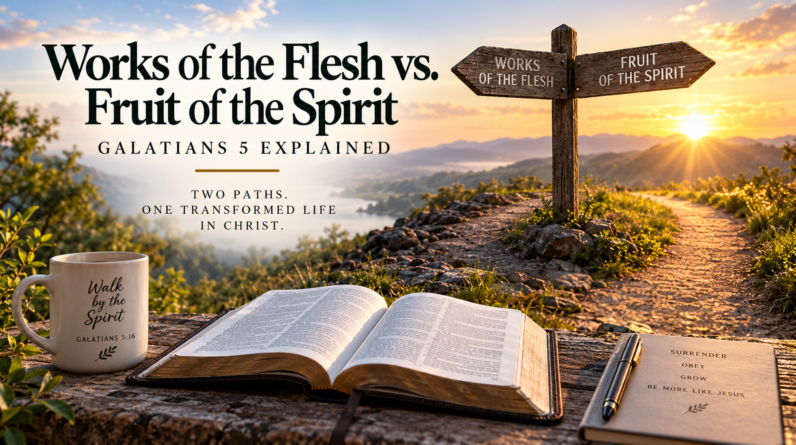



Have you ever wondered what the fruit of the Spirit looks like in real life? It is one thing to read about love, joy, peace, patience, kindness, goodness, faithfulness, gentleness, and self-control. It is another thing to see those qualities demonstrated when someone faces danger, disappointment, temptation, conflict, or an opportunity to help another person.
The Bible contains powerful stories that help us understand what these qualities look like through the choices people make. Some characters demonstrate remarkable faith, while others reveal their weaknesses and their need for God’s grace.
These fruit of the Spirit Bible stories offer practical lessons about Christian character and how believers can respond to everyday situations in ways that honor God.
In Galatians 5:22–23, the apostle Paul identifies nine qualities produced by the Holy Spirit in the lives of believers.
In this study, we will explore nine biblical examples, including the Good Samaritan, Paul and Silas, Abigail, David, Boaz, Zacchaeus, Daniel, Priscilla and Aquila, and Joseph. Each example provides an opportunity to reflect on one aspect of Spirit-shaped character.
These passages come from different periods of biblical history, and the Good Samaritan is a parable told by Jesus. They were not originally written as nine separate lessons on Galatians 5. Rather, they illustrate qualities that help us understand Paul’s teaching. As we study them, our ultimate example of perfect character remains Jesus Christ.
For a complete explanation of Paul’s teaching, begin with our foundational guide to the nine fruits of the Spirit explained.

What Can Bible Stories Teach Us About the Fruit of the Spirit?
The fruit of the Spirit describes the character the Holy Spirit develops in those who belong to Jesus Christ.
Paul introduces these qualities within a larger discussion about Christian freedom and the contrast between living according to sinful desires and walking by the Spirit.
Galatians 5:16–26 reminds believers that the Christian life involves depending on the Holy Spirit rather than allowing sinful desires to control their actions.
This is why studying biblical examples can be helpful. Stories allow us to consider how people respond when their faith is tested, when they must choose between right and wrong, or when another person’s needs require compassionate action.
We should also remember that biblical characters are not perfect. Their lives are recorded to teach us about God, His purposes, human weakness, and the importance of faith and obedience.
The goal is not to imitate every decision a biblical character makes. We must understand each story in its proper context and consider how its lessons align with the wider teaching of Scripture.
With that foundation, let’s explore nine examples of qualities that reflect the fruit of the Spirit.
1. Love — The Good Samaritan Helps a Wounded Stranger
Bible passage: Luke 10:25–37
Jesus told the parable of the Good Samaritan in response to a question about loving one’s neighbor.
In His story, a man was traveling from Jerusalem to Jericho when robbers attacked him, took his belongings, and left him badly injured.
A priest came along the road but passed by without helping. A Levite also saw the wounded man and continued on his way.
Then a Samaritan approached. Unlike the previous travelers, he responded with compassion. He treated the man’s wounds, placed him on his animal, brought him to an inn, and arranged for his continued care.
The Samaritan did not merely express sympathy. His compassion resulted in meaningful action, personal inconvenience, and financial sacrifice.
When Jesus asked which traveler had acted as a neighbor, the answer pointed to the person who had shown mercy.
What This Story Teaches About Love
Biblical love is more than warm feelings toward people we already know. It involves genuine concern for others and a willingness to respond when someone needs help.
The Samaritan’s actions challenged the idea that love should be limited by social boundaries or personal convenience.
For Christians today, love may involve helping a struggling neighbor, encouraging someone who feels overlooked, caring for a family member, or showing compassion to someone outside our usual circle of friends.
We cannot meet every need, but we can ask God to help us recognize opportunities to show practical love.
Reflection question: Is there someone I have overlooked because helping them would require my time, attention, or personal sacrifice?

2. Joy — Paul and Silas Worship God in Prison
Bible passage: Acts 16:22–34
Paul and Silas experienced serious opposition while serving God in Philippi.
After being beaten, they were placed in prison, where their feet were secured in stocks.
Their circumstances were painful and unjust. They had every human reason to feel discouraged, fearful, or exhausted.
Yet around midnight, Paul and Silas were praying and singing hymns to God while the other prisoners listened.
An earthquake suddenly shook the prison, opening the doors and loosening the prisoners’ chains. When the jailer feared that the prisoners had escaped, Paul assured him that they were still there.
The events that followed gave Paul and Silas an opportunity to share the message of salvation through Jesus Christ with the jailer and his household.
What This Story Teaches About Joy
The joy demonstrated in this account was not dependent on comfortable circumstances.
Paul and Silas continued turning toward God even while suffering. Their worship reflected a hope that imprisonment had not destroyed.
This does not mean Christians should pretend to be happy when they are hurting. Biblical joy allows us to acknowledge painful realities while continuing to place our hope in the Lord.
Perhaps you are experiencing disappointment, family difficulties, financial uncertainty, or unanswered prayer. You may not feel joyful in every moment, but you can continue approaching God honestly and remembering His faithfulness.
For additional encouragement, explore our study of joy as a fruit of the Spirit.
Reflection question: When circumstances become difficult, where do I look for lasting hope and encouragement?
3. Peace — Abigail Prevents David from Taking Revenge
Bible passage: 1 Samuel 25:14–35
Abigail was married to Nabal, a wealthy man who treated David’s messengers with contempt.
When David learned how his men had been treated, he became angry and prepared to retaliate violently against Nabal’s household.
One of Nabal’s servants informed Abigail about the danger.
Instead of ignoring the situation, Abigail acted quickly. She gathered provisions and approached David before he carried out his plan.
She spoke respectfully, acknowledged the seriousness of the situation, and appealed to David not to take vengeance into his own hands.
David listened to her counsel. He recognized that her intervention had kept him from bloodshed and accepted the provisions she brought.
What This Story Teaches About Peace
Abigail did not create peace by pretending that nothing was wrong. She recognized a dangerous conflict and took wise action to prevent further harm.
Her example reminds us that peacemaking often requires courage, thoughtful communication, and a willingness to address difficult circumstances.
When disagreements arise in our families, workplaces, or churches, we may be tempted to retaliate or defend ourselves harshly.
The fruit of peace helps us pursue solutions that honor God rather than allowing anger to determine our actions.
Peacemaking does not mean accepting abuse or placing yourself in danger. In unsafe situations, seeking appropriate help and protection is important.
Our study of the fruit of the Spirit in relationships explores how peace, patience, forgiveness, and self-control work together when relationships become difficult.
Reflection question: When conflict develops, do my words and actions help resolve the problem, or do they make it worse?

4. Patience — David Refuses to Harm King Saul
Bible passage: 1 Samuel 24:1–22
David had been anointed to become king, but his journey toward the throne was filled with danger and uncertainty.
King Saul repeatedly pursued him, forcing David to flee and live under difficult circumstances.
One day, Saul entered a cave where David and his men were hiding.
David’s men saw this as an opportunity for him to act against Saul. David approached and cut off a corner of Saul’s robe, but afterward he was troubled by what he had done.
He refused to allow his men to attack Saul.
When Saul left the cave, David came out and demonstrated that he had spared his life.
Although David had an opportunity to remove the person pursuing him, he chose not to take vengeance into his own hands.
What This Story Teaches About Patience
David’s restraint illustrates the importance of waiting on God rather than allowing frustration to justify wrongdoing.
Patience does not mean that difficult circumstances are unimportant. It means refusing to let anger, fear, or impatience control our decisions.
Perhaps you are waiting for an answer to prayer, working toward a goal, or experiencing an unresolved conflict.
You may feel tempted to take shortcuts, manipulate a situation, or respond harshly because progress seems slow.
David’s example encourages us to consider whether our actions honor God even when we have an opportunity to force the outcome we want.
We should not interpret this story as requiring someone to remain in an unsafe situation. David himself took steps to escape Saul’s pursuit.
Reflection question: Am I allowing impatience to influence a decision that requires prayer, wisdom, and self-control?
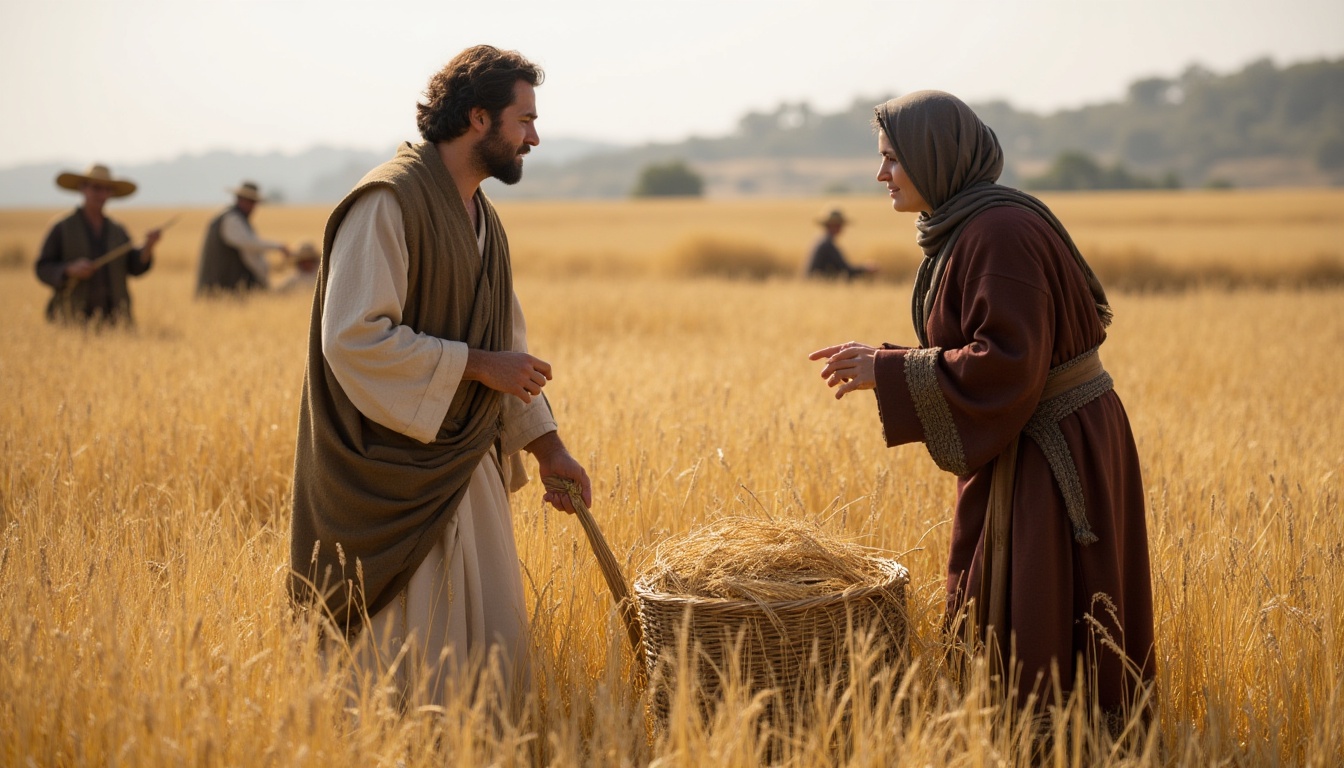
5. Kindness — Boaz Provides for Ruth
Bible passage: Ruth 2:8–16
Ruth was a widow from Moab who had chosen to remain with her mother-in-law, Naomi.
After arriving in Bethlehem, Ruth went into the fields to gather leftover grain so that she and Naomi could have food.
She eventually came to a field belonging to Boaz.
When Boaz learned about Ruth and her loyalty to Naomi, he treated her with kindness and respect.
He encouraged her to remain with the women working in his field, instructed his men not to mistreat her, and made water available to her.
He also provided food and arranged for her to gather additional grain.
Boaz used his position and resources to provide practical help to someone who was vulnerable.
What This Story Teaches About Kindness
Kindness involves more than speaking politely. It can include meeting practical needs, protecting another person’s dignity, and using our resources responsibly.
Boaz did not treat Ruth as an inconvenience or dismiss her because she was a foreigner.
His conduct illustrates how kindness can become visible through hospitality, generosity, and concern for another person’s well-being.
Today, this might involve assisting an elderly neighbor, supporting someone who is struggling financially, welcoming a newcomer, or offering practical help to someone experiencing hardship.
We do not have to possess great wealth to show kindness. Sometimes a thoughtful action or a small act of generosity can make a meaningful difference.
Reflection question: How can I use the resources, time, or opportunities God has entrusted to me to help someone else?
6. Goodness — Zacchaeus Responds to Jesus with Repentance and Restitution
Bible passage: Luke 19:1–10
Zacchaeus was a wealthy chief tax collector who wanted to see Jesus as He passed through Jericho.
Because he was short and could not see over the crowd, he climbed a tree.
Jesus noticed him and told him that He would stay at his house.
The crowd complained because Jesus was associating with a man they regarded as a sinner.
Yet Zacchaeus responded by announcing that he would give half his possessions to the poor and repay anyone he had cheated four times the amount.
Jesus then declared that salvation had come to his house and explained His mission of seeking and saving the lost.
What This Story Teaches About Goodness
Zacchaeus’s response demonstrates that genuine repentance affects the way we treat other people.
His willingness to make restitution was not a way of purchasing salvation. Rather, it showed that his encounter with Jesus had changed his response to wealth and wrongdoing.
Goodness involves doing what is right, acting honestly, and taking responsibility when our actions have harmed others.
For Christians, this may mean correcting a dishonest statement, returning something that does not belong to us, acknowledging a mistake, or addressing unfair treatment.
It is easy to speak about having good intentions. God also calls us to consider whether our decisions reflect integrity.
For a deeper understanding of the struggle between sinful desires and Spirit-shaped character, explore the works of the flesh versus the fruit of the Spirit.
Reflection question: Is there a wrong decision or unresolved situation that I need to address honestly and responsibly?
7. Faithfulness — Daniel Continues Praying Despite the King’s Decree
Bible passage: Daniel 6:1–23
Daniel served in a position of responsibility under King Darius.
Other officials became jealous and searched for a way to accuse him of wrongdoing. However, they could not find corruption or negligence in his work.
They eventually persuaded the king to establish a decree prohibiting prayer to anyone other than the king for a specified period.
Daniel knew about the decree, but he continued his established practice of praying to God.
His enemies reported him, and Daniel was thrown into the lions’ den.
God protected Daniel, and the following morning the king discovered that he was alive.
What This Story Teaches About Faithfulness
Daniel’s example demonstrates consistent devotion to God even when faithfulness becomes costly.
He did not begin praying merely to attract attention or challenge the authorities. Prayer was already part of his established relationship with God.
His faithfulness was also visible in his responsibilities, integrity, and dependable service.
For Christians today, faithfulness involves continuing in prayer, keeping appropriate commitments, acting truthfully, and remaining obedient to God even when others disagree.
We must also remember that Daniel’s deliverance does not mean every faithful believer will escape suffering or danger. Scripture records other servants of God who experienced severe hardship.
Faithfulness is ultimately about trusting the Lord rather than guaranteeing a particular outcome.
Reflection question: Am I seeking to remain faithful to God only when life is comfortable, or also when obedience requires sacrifice?
8. Gentleness — Priscilla and Aquila Help Apollos Understand God’s Way
Bible passage: Acts 18:24–26
Apollos was a knowledgeable and enthusiastic teacher who spoke accurately about Jesus, although his understanding was incomplete in an important area.
When Priscilla and Aquila heard him, they invited him to their home and explained God’s way more adequately.
The passage does not describe them humiliating Apollos publicly or treating him as an enemy.
Instead, it records a personal conversation in which they helped him understand more fully.
Their approach provides a useful illustration of correcting someone without making the correction an opportunity for personal superiority.
What This Story Teaches About Gentleness
Gentleness does not mean avoiding truth or refusing to address mistakes.
It means speaking and acting with humility, consideration, and appropriate restraint.
When someone misunderstands Scripture, makes a mistake, or needs guidance, our approach can either encourage learning or create unnecessary embarrassment.
Galatians 6:1 specifically teaches the importance of gentleness when restoring a fellow believer who has fallen into sin.
Priscilla and Aquila’s interaction with Apollos was a matter of instruction rather than moral restoration, but their example illustrates a thoughtful approach to helping someone grow.
This principle matters for parents, teachers, Bible study facilitators, pastors, and anyone responsible for guiding others.
We can communicate biblical truth clearly without using harshness as a measure of conviction.
Reflection question: When I correct someone, am I trying to help that person grow, or am I more concerned about proving that I am right?

9. Self-Control — Joseph Refuses Temptation in Egypt
Bible passage: Genesis 39:7–12
Joseph served in the household of Potiphar, an Egyptian official.
Potiphar’s wife repeatedly pressured Joseph to become sexually involved with her.
Joseph refused, explaining that such an action would violate the trust placed in him and would be a sin against God.
When she later grabbed his cloak and again demanded that he sleep with her, Joseph fled, leaving the garment behind.
He subsequently suffered a false accusation and imprisonment.
What This Story Teaches About Self-Control
Joseph’s response illustrates the importance of refusing wrongdoing and taking practical action when confronted with temptation.
He did not depend on repeatedly placing himself in the same situation while assuming that good intentions would always be enough.
He recognized the seriousness of what was happening and removed himself from the immediate danger.
We should also recognize the unequal power relationship in this account. Joseph was an enslaved person being pressured by someone with authority in the household. His refusal did not prevent him from suffering injustice.
For believers today, self-control may involve setting appropriate boundaries, avoiding situations that encourage sinful choices, managing impulsive reactions, or seeking support when facing persistent pressure.
This story should never be used to blame someone who experiences coercion or abuse. Responsibility for abusive behavior belongs to the person committing it.
The broader biblical lesson is that faithfulness to God may require difficult choices, and doing what is right does not always protect us from unfair consequences.
Reflection question: Are there situations where I need to establish wiser boundaries or seek help rather than relying only on my ability to resist temptation?
What Do These Nine Bible Stories Teach Us Together?
Although each story highlights a different quality, the fruit of the Spirit is not presented in Galatians as nine unrelated achievements.
These qualities belong together as the Holy Spirit develops Christlike character in believers.
Abigail demonstrated peace through wise action, but her response also required courage and self-control. Boaz showed kindness through practical generosity, while his conduct also reflected goodness. Joseph’s refusal involved self-control, faithfulness, and a desire to honor God.
The same is true in everyday Christian living.
When you respond patiently to a difficult person, you may also be demonstrating love and gentleness. When you refuse to retaliate during a disagreement, peace and self-control work together.
The fruit of the Spirit is not a checklist for proving that we are better than other people. It is evidence of God’s transforming work in our lives.
We should also resist the temptation to turn biblical characters into flawless heroes. Their stories ultimately direct our attention toward God’s faithfulness and our need for His grace.
Jesus Christ remains the perfect example of the character that believers are called to reflect.
How Can You Apply These Bible Stories to Your Own Life?
Reading biblical accounts is valuable, but the purpose of Bible study is not simply to collect information.
God’s Word calls us to respond in faith and obedience.
Consider the following practical approach when studying one of these stories.
Read the Entire Passage
Begin by reading the biblical text rather than relying only on a short summary.
Consider who is involved, what is happening, and why the event matters within the larger biblical account.
For example, understanding Abigail’s intervention requires recognizing the danger created by David’s intended retaliation. Understanding Zacchaeus requires paying attention to Jesus’ initiative and His mission of salvation.
Identify the Character Quality
Ask which quality the story illustrates and how the person’s choices demonstrate it.
Look for actual details in the passage rather than imagining motives, conversations, or events that Scripture does not record.
Some stories may illustrate several qualities at once.
Consider the Biblical Lesson
Think about what the passage teaches about God, human behavior, faith, and obedience.
Do not assume that every action recorded in Scripture is automatically presented as something to imitate.
Apply the Lesson Through Prayer and Obedience
Identify one situation in your own life where the lesson may be relevant.
Perhaps you need patience while waiting for an answer, kindness toward someone who is struggling, or self-control during a difficult conversation.
Ask the Holy Spirit to help you respond faithfully.
Our guide to walking in the Spirit according to Galatians 5 provides additional context for depending on God in daily life.
Fruit of the Spirit Bible Study: Nine Reflection Questions
These questions can be used for personal devotion, family Bible study, small groups, or Sunday school preparation.
| Fruit | Biblical example | Reflection question |
|---|---|---|
| Love | Good Samaritan | Who needs practical compassion from me? |
| Joy | Paul and Silas | Where am I placing my hope during difficulties? |
| Peace | Abigail | How can I respond wisely to conflict? |
| Patience | David and Saul | Am I allowing impatience to influence my decisions? |
| Kindness | Boaz and Ruth | How can I help someone with dignity and care? |
| Goodness | Zacchaeus | Is there a wrong I need to acknowledge or correct? |
| Faithfulness | Daniel | Am I consistent in my devotion to God? |
| Gentleness | Priscilla and Aquila | How do I respond when someone needs correction? |
| Self-control | Joseph | What boundaries help me make wise decisions? |
Choose one passage and read it carefully during your next devotional time. Record what the story teaches about God, what you learn about human character, and one practical response you can make.
For additional structured questions, explore our Fruit of the Spirit Bible study and reflection guide.
How Can Parents and Bible Study Leaders Teach These Stories?
Biblical narratives can help children, teenagers, and adults connect spiritual qualities with recognizable situations.
For younger children, begin with a simple retelling of the Good Samaritan, emphasizing compassion and practical kindness.
Teenagers may benefit from discussing Joseph’s choices, Daniel’s faithfulness, or how Priscilla and Aquila handled an opportunity to teach someone.
Adult Bible study groups can examine more complex questions, such as the difference between peacemaking and avoiding accountability, or the relationship between faithfulness and suffering.
The teaching method should fit the audience without changing the meaning of Scripture.
Encourage participants to read the passage, identify what actually happened, discuss its biblical significance, and consider a practical application.
For younger audiences, our companion article provides nine simple Fruit of the Spirit Bible lessons for kids.
Frequently Asked Questions
Are the nine fruits of the Spirit found in Bible stories?
Yes. Although Galatians 5:22–23 explicitly identifies the fruit of the Spirit, many biblical accounts and teachings illustrate qualities such as love, patience, goodness, and faithfulness. These stories help readers understand what godly character can look like in practice.
Did Old Testament characters have the fruit of the Spirit?
Galatians 5 describes the Spirit-produced character of believers in the context of life in Christ. Old Testament accounts also demonstrate qualities that reflect God’s character, and Scripture records the Spirit’s work before Pentecost. We should use these stories as illustrations without claiming that each character was explicitly identified as demonstrating the Galatians 5 list.
Who is the perfect example of the fruit of the Spirit?
Jesus Christ is our perfect example of godly character. His life demonstrates love, compassion, obedience, gentleness, truthfulness, and complete faithfulness to the Father.
Can one Bible story illustrate more than one fruit?
Yes. Biblical qualities often work together. Abigail’s wise intervention, for example, illustrates peacemaking while also involving restraint, courage, and concern for others.
How can I use these stories for a Bible study?
Choose a passage, read it in context, summarize what happened, identify the relevant character quality, and discuss how its lesson applies to everyday life. End with a reflection question and prayer.
Final Encouragement: Let God’s Word Shape Your Character
The fruit of the Spirit becomes easier to understand when we see how biblical truth connects with real choices.
The Good Samaritan reminds us to show practical love. Paul and Silas encourage us to worship God during hardship. Abigail teaches us to pursue peace wisely, while Daniel demonstrates faithfulness when obedience becomes costly.
These accounts remind us that our response to life’s challenges matters.
Yet our confidence does not rest in our ability to imitate biblical characters perfectly.
We grow through a living relationship with Jesus Christ and the transforming work of the Holy Spirit.
As Jesus teaches in John 15:4–5, fruitfulness is connected to remaining in Him.
Continue reading Scripture, bringing your struggles before God, and seeking to obey Him in everyday situations.
Over time, the Holy Spirit shapes our character so that our lives increasingly reflect Jesus Christ.
A Prayer for Growing in the Fruit of the Spirit
Heavenly Father, thank You for giving us Your Word and for allowing us to learn from the lives of people recorded in Scripture.
Thank You for the examples of love, joy, peace, patience, kindness, goodness, faithfulness, gentleness, and self-control that help us understand the character You desire to develop in us.
Holy Spirit, continue Your transforming work in my heart. Teach me to love others sincerely, find my joy in the Lord, pursue peace wisely, and remain patient when circumstances become difficult.
Help me demonstrate kindness through practical actions, choose what is right, remain faithful to Your Word, speak with gentleness, and exercise self-control when I face temptation.
Remind me that I cannot produce lasting spiritual fruit through my own strength alone.
Help me remain connected to Jesus Christ and become more like Him each day.
In Jesus’ name, Amen.
Continue Growing in Your Faith
-
The 9 Fruits of the Spirit Explained — Understand the meaning of each fruit and how the Holy Spirit develops Christian character.
-
Fruit of the Spirit Bible Study — Explore reflection questions and practical applications from Galatians 5.
-
Works of the Flesh vs. Fruit of the Spirit — Understand Paul’s contrast between sinful desires and Spirit-shaped character.