


Bible verses for caregivers can give you words to return to when love asks for more than you feel able to give. You may be helping an aging parent, caring for a spouse, supporting a child with additional needs, or visiting someone whose illness has changed everyday life. Much of that work happens quietly, one ordinary task at a time.
Scripture encourages caregivers to depend on God, treat people with dignity, receive help, and recognize their own limits. It does not promise that faithful care will always feel easy or that you must carry every responsibility alone. The same Lord who calls His people to love also teaches them to bear one another’s burdens.
The passages below are explained in their biblical setting and then applied to caregiving. They are not presented as though every verse was originally addressed to a modern caregiver. Read each passage through its BibleGateway link, consider what it reveals about God, and choose one response that fits the day before you.
How to Read Bible Verses for Caregivers Without Adding Pressure
When you are tired, even an encouraging verse can feel like another demand. You may hear “be patient” and think that a difficult emotion means you have failed. You may hear “serve others” and conclude that asking for a break would be selfish. Reading a passage in context helps protect you from those burdensome conclusions.
Ask what the passage says about God before asking what it asks of you. Notice whether it offers comfort, gives an instruction, describes a particular event, or addresses a whole community. Our beginner’s guide to studying the Bible in context explains this habit more fully.
You do not need to read all ten passages every day. One passage, read attentively, can be a meaningful beginning. These are places to learn trust, rather than a checklist you must finish before God will care for you.

1. Isaiah 46:3–4: Remember Who Carries You
Read Isaiah 46:3–4. In this chapter, God contrasts His faithful care for Israel with idols that must themselves be carried. He reminds His people that His commitment to them has not depended on their youth or strength.
For a caregiver, the passage invites a change of perspective. You may spend your day supporting someone else, but your life is also held before the Lord. His faithfulness is not something you must keep functioning through your own effort.
A simple application is to pause before a demanding task and remember whom you depend on. Ask for help with what is genuinely yours to do. Then consider whether someone else should share the work. Trusting God’s care does not require denying practical needs.
2. Psalm 121:1–2: Look Beyond Your Own Resources
Read Psalm 121:1–2. This psalm belongs to the Songs of Ascents and directs the worshiper toward the Lord, the Maker of heaven and earth, as the source of help.
Looking to God does not mean that a caregiver will never face loss or uncertainty. It means that the difficult situation is not the whole horizon. You can acknowledge what you do not know while turning to the One whose wisdom exceeds your own.
When you feel overwhelmed by a question, name it clearly in prayer. You may need guidance from a care team, a conversation with a relative, or help making a decision. Prayer can accompany those actions. If you need a starting point, use our simple guide to prayer.
3. Matthew 11:28–30: Come to Jesus as You Are
Read Matthew 11:28–30. Jesus invites weary people to come to Him, take His yoke, and learn from Him. His invitation is about belonging to Him and living under His gentle instruction.
This is more than a suggestion to relax for a few minutes. You are invited into a relationship with the Savior. Your tiredness does not make you unsuitable for that invitation. You can come honestly, without arranging your feelings into a more impressive spiritual appearance.
Ask what it would mean to learn from Jesus in the next interaction. Perhaps it means speaking gently, accepting help, or admitting a limit. His invitation also gives you a reason to receive pastoral encouragement when your inner life feels depleted. Read Signs You Are Spiritually Exhausted if that describes your present season.
4. Galatians 6:2–5: Share Burdens and Accept Responsibility
Read Galatians 6:2–5. Paul tells believers to help carry one another’s burdens and also reminds each person of personal responsibility. These instructions belong together. Christian community makes room for both accountable action and meaningful assistance.
Caregiving can become lonely when one person assumes that everything must fall on them. This passage does not support that assumption. A family member, friend, or congregation may be able to share a practical burden even when they cannot take over the whole role.
Choose one specific request rather than waiting until you can explain every difficulty at once. You might ask someone to prepare a meal, help with an errand, or discuss a dependable arrangement for relief. A clear request can make shared love more concrete.

5. Isaiah 40:28–31: Depend on God Without Pretending You Are Limitless
Read Isaiah 40:28–31. Isaiah speaks to people who need to remember the greatness and attentiveness of their God. Human strength fails; the Lord does not become exhausted or lose understanding.
The passage encourages hope in Him. It should not become a promise that a believer will always have enough physical energy to keep working without rest. Depending on God includes acknowledging the human limits that the passage itself recognizes.
When you are weary, ask for strength and consider what support is needed. God’s provision may include another person’s practical help, a change in responsibilities, or an opportunity to rest. Receiving those things can express dependence rather than a lack of faith.
6. Colossians 3:12–14: Let Compassion Shape Small Responses
Read Colossians 3:12–14. Paul describes the character that belongs to God’s people: compassion, kindness, humility, gentleness, patience, forgiveness, and love. The instruction grows out of their identity in Christ.
In caregiving, these qualities often appear in small ways. You explain something again without mocking the person. You preserve privacy. You listen before assuming that you know what is wrong. The person receiving care has dignity even when their abilities or responses have changed.
You can also take responsibility when you respond poorly. An apology and a practical change may be needed. Growth is more than telling yourself to try harder. Our guides to patience and kindness as fruits of the Spirit explore the character God forms in everyday relationships.
7. James 1:5: Ask for Wisdom in the Middle of Uncertainty
Read James 1:2–5. James addresses believers facing trials and encourages them to ask God for wisdom. Wisdom helps us live faithfully in difficulty; it does not require that every unanswered question immediately disappear.
A caregiver may need wisdom about how to speak with a loved one, how to share responsibility, or what to ask a professional. Asking God for wisdom can lead you toward careful listening and better information. It does not mean that you should replace appropriate advice with a feeling you have not examined.
Before a conversation, write down the question you most need answered. Then ask for humility to listen and courage to speak plainly. You can seek guidance without claiming certainty that you do not have.
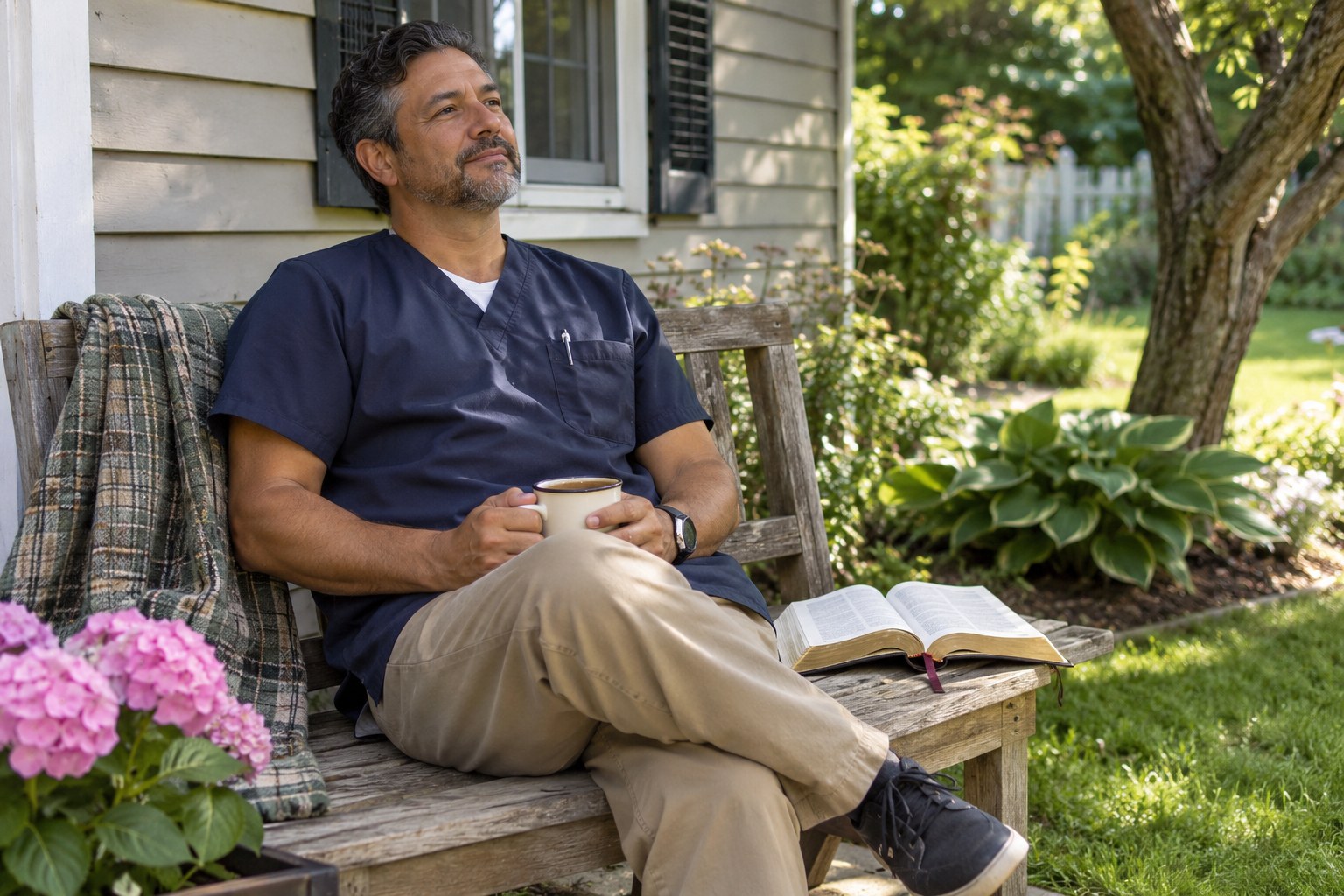
8. Mark 6:30–32: Recognize the Need for Rest
Read Mark 6:30–32. After the apostles return from their work, Jesus recognizes that they need to come away and rest. The surrounding story acknowledges the demands of serving people.
The scene does not offer a detailed respite-care plan, but it does challenge the idea that devoted service makes bodily needs unimportant. Needing food, sleep, or a break does not make a caregiver less loving.
Where continuous care is necessary, a break may require an appropriate handoff. Discuss what suitable help could look like rather than quietly assuming that rest will never be possible. A modest, dependable arrangement may be more useful than an ambitious plan that nobody can sustain.
9. Hebrews 6:10: Quiet Service Is Not Invisible to God
Read Hebrews 6:9–12. The writer encourages believers by recognizing their loving service to God’s people and calls them to continue with hope and diligence.
The passage reminds a Christian caregiver that recognition from others is not the only measure of meaningful service. A task can be ordinary and still be an expression of love. You do not need a public audience for God to know how you have served.
This truth also leaves room to tell someone that you feel unseen. Faithful service does not require emotional isolation. Reach out for encouragement and connection. Our article on God’s comfort during emotionally heavy seasons offers a place to continue.

10. Romans 8:26–27: You Can Pray When Words Are Hard
Read Romans 8:26–27. Within a chapter that acknowledges suffering and hope, Paul explains the Holy Spirit’s help in believers’ weakness and prayer.
You may not know how to put your concerns into sentences. You may feel several things at once: gratitude, grief, affection, impatience, and fear. The passage directs your confidence toward God’s gracious help rather than your ability to produce polished words.
Start with an honest sentence, or quietly bring the person and situation before the Lord. If you want to respond to a passage in your own words, our guide to praying Scripture explains a simple approach.
Common Questions About Scripture and Caregiving
Is “Blessed are the caregivers” a Bible verse?
That exact saying is not a biblical quotation. It can be used as an encouraging expression, but it should not be presented with an invented verse reference. Read actual passages about mercy, service, love, and mutual care, and explain what they say in context.
Does God promise that caregiving will never exceed my strength?
Scripture does not give caregivers a promise of unlimited personal capacity. In 2 Corinthians 1:8–9, Paul describes hardship beyond his own strength and dependence on God. Needing help is not proof that you have failed.
Which passage should I begin with today?
Choose according to the need you can name. Galatians 6 may help you consider shared support. Mark 6 acknowledges rest. Colossians 3 gives direction for a difficult interaction. Read the passage itself, and take one practical response rather than trying to turn every verse into a new assignment.
A Short Prayer for Caregivers
Father, help me receive Your Word with an honest heart. Give me strength for today, wisdom to recognize my limits, and kindness toward the person I care for. Help me ask for support and receive it with gratitude. Thank You that Your faithfulness is greater than my energy. Teach me to follow Jesus in both serving and receiving care. In His name, amen.
Let God’s Faithfulness Sustain Your Love
Bible verses for caregivers point beyond self-reliance. They call us toward the Lord who is faithful, toward the Savior who welcomes the weary, and toward a community that shares burdens. Let these passages shape how you understand God and how you respond to the next person before you.
You do not have to make caregiving look effortless to honor Christ. Depend on Him, serve with dignity, and receive appropriate help. May the Lord be praised in the love you give and in the trust with which you accept His care.
Continue Growing
Continue with Praying Scripture to turn your reading into personal prayer. For a small, repeatable rhythm, explore our simple daily prayer routine.