



Context is everything in Bible study. When you read a verse without its setting, you risk missing what God and the original author actually intended. You can think of context like a map: without it, you can wander in the wrong direction even if you recognize the landmarks. This guide gives you a friendly, step-by-step approach to studying the Bible in context so your reading becomes more accurate, more mature, and more spiritually fruitful.
In this guide you’ll learn what “context” really means, why it matters, how to read different kinds of biblical literature, and practical steps you can use immediately. You’ll also see examples of how context changes meaning and tips for trustworthy resources to help you go deeper.

Why Context Changes Everything
When you study any ancient book, context decides meaning. The Bible wasn’t written in isolation; each verse sits in a history, a culture, a genre, and a conversation. If you read a sentence from a modern novel without knowing the chapter or the plot, you could misinterpret it. The same is true for Scripture—sometimes wildly so.
Context prevents three common problems: taking a verse as a universal rule when it’s specific to a situation, reading it through modern assumptions instead of ancient ones, and missing the author’s purpose. When you study context well, you protect truth and avoid applying passages in ways the original audience never would have recognized.
What Is Context?
Context is not one thing. It’s a set of overlapping considerations that shape how you should understand a passage. In practice, focus on four main types of context: historical, cultural, literary, and canonical. Each one answers different questions about meaning.
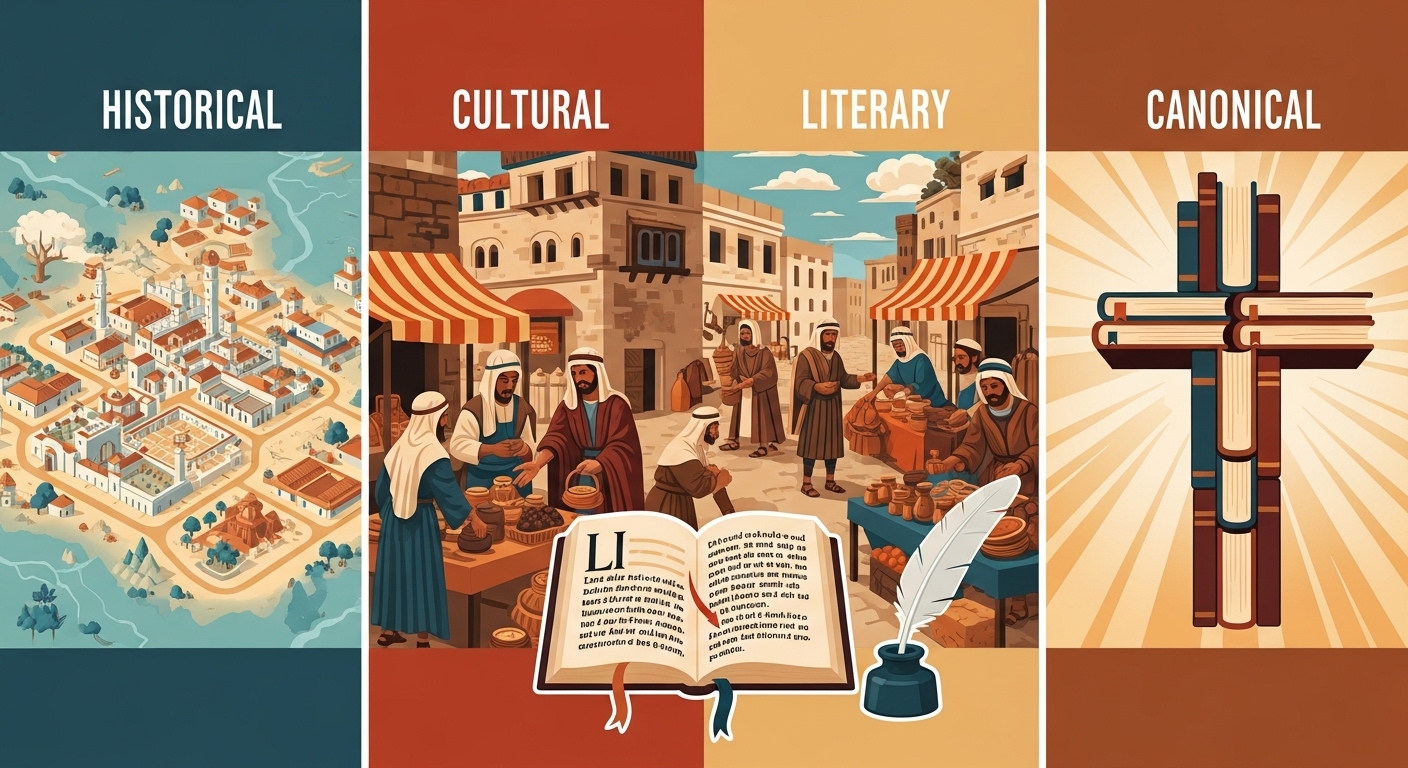
Historical Context
Historical context asks: Who wrote this? When? For whom? What events shaped the message? Understanding the original setting prevents anachronistic readings—where you impose modern assumptions onto ancient words.
For example, Paul’s letters come from a first-century Mediterranean world with different social norms and political realities than yours. Knowing that helps you see why he addresses household relations or civic duties the way he does. You’ll find it helpful to consult short background sketches (author, date, audience, purpose) before you dig into a passage.
Cultural Context
Cultural context explores daily life, religious practices, social structures, and common metaphors in the ancient world. That matters because words and images carry meaning that was obvious to the first readers but obscure to you.
Take hospitality, honor, shame, patronage, family structure, and synagogue life—these items inform much of New Testament behavior and teaching. Recognizing cultural norms prevents you from translating phrases into modern equivalents that miss the nuance of the original.
Literary Context
Literary context considers how a verse functions within its immediate text: the sentences and paragraphs that come before and after, the structure of the book, and the genre. This is often the most immediate and decisive context for interpretation.
You’ll want to ask: What is the paragraph about? What’s the main idea in this chapter? Is this verse part of a narrative, a parable, a law code, or a prophetic oracle? For instance, a command in a historical narrative may describe what someone did (descriptive) rather than instruct what you must always do (prescriptive). Reading the surrounding sentences often clarifies this.
Canonical and Theological Context
Canonical context sees the book as part of the whole Bible and asks how this passage fits into the broader witness of Scripture. It prevents odd theological leaps that contradict the overall teaching of the Bible.
For instance, you should compare a difficult verse with other relevant passages to ensure your interpretation aligns with the clear teaching of Scripture. The Bible itself models this approach: in Acts 17:11, the Bereans “examined the Scriptures daily” to confirm Paul’s teaching by comparing it with the text. See Acts 17:11.
The Inductive Method: Observe, Interpret, Apply
One of the most reliable beginner-friendly approaches to Bible study is the inductive method: observe what the text says, interpret what it means, and apply what it requires. Each step depends on careful attention to context.
Observe: Notice What’s There
Observation asks you to slow down and see the features of the text. Read several times, watch for repeated words and themes, note transitions, and mark questions. Observation keeps you honest: you’re less likely to import your own ideas when you’re cataloging what the text actually contains.
As part of observation, read the surrounding paragraphs and the whole chapter. In narrative, figure out the plotline; in letters, find the flow of argument. Also pay attention to textual markers like “therefore,” “but,” or “because.” These words signal logical relationships you can’t ignore.
Interpret: Ask Contextual Questions
Interpretation applies the context categories we described. Ask historical, cultural, literary, and canonical questions. Some helpful questions are: Who is speaking? To whom? Why? What genre am I reading? What does the surrounding text emphasize?
Use reliable tools—commentaries, study Bibles, and Bible dictionaries—to help answer historical and cultural questions. For doctrinal clarity, compare parallel passages. Remember that interpretation is not private: it aims to recover what the original author intended for the original audience.
Apply: Translate Meaning into Life
Application follows interpretation. Once you’ve established the original meaning, ask how the underlying principle applies to your life today. Application requires wisdom: you don’t graft your modern situation onto the ancient text; you translate the text’s timeless truth into contemporary practice.
For example, love for neighbor in Matthew 22:37-40 is a timeless principle, but how it expresses itself will differ in context. See Matthew 22:37-40.

Practical Steps to Study Scripture in Context
Here’s a simple routine you can use whenever you open the Bible. Follow these steps to make sure context shapes your reading.
- Read the whole book summary or introduction first. Knowing the big picture keeps you from over-interpreting isolated verses.
- Read the chapter aloud at least once, then read the immediate paragraph twice. Your ear catches transitions your eyes might miss.
- Identify the genre and the author’s purpose. Is this prophetic, epistolary, poetic, or narrative?
- Note key words, repeated phrases, and link words that show argument flow.
- Ask historical and cultural questions: who, what, when, where, why?
- Consult trusted resources for background and textual questions: commentaries, study notes, and maps.
- Compare parallel passages and check the rest of Scripture for balance.
- Formulate a concise one-sentence interpretation of the passage’s main point.
- Pray and apply—to yourself, your family, and your community.
Even when you’re short on time, steps 2–5 will give you a much safer initial read than grabbing a single verse out of nowhere.

Genre Matters: Read Like the Author
Recognizing genre is one of the most important skills for context. The Bible contains many literary types—poetry, law, narrative, prophecy, wisdom, gospel, epistle—and each demands a different reading posture.
Poetry uses imagery and compressed language. Don’t force poetic lines into precise, literal propositions. For example, Psalm 23 employs shepherd imagery to convey trust and care rather than a literal account of being led to grassy pastures. See Psalm 23:1-4.
Narrative tells what happened. When a character acts wrongly in a narrative, the text may narrate sin rather than commend it. Law sets specific commands for a covenant community with particular rituals and sanctions. Epistles often contain direct instruction but are wrapped in pastoral concerns and occasional rhetorical devices. Prophecy mixes calls to repentance with symbolic imagery and future hope.
If you want to study genre more, see our internal resources: Genre guide and the full Pillar on biblical interpretation.

Common Mistakes When Context Is Ignored
When you skip context, you’ll likely stumble into one of several pitfalls: proof-texting, over-literalizing metaphor, private interpretation, and isolating verses to support pre-existing views. Here’s how each looks and how context prevents them.
- Proof-texting: You pluck a verse to prop up an argument without checking if the verse addresses the issue. Context often shows the verse speaks to something else entirely.
- Over-literalizing: You treat poetic or symbolic language as a literal, technical statement. Context and genre help you discern metaphor from direct instruction.
- Private interpretation: You read a verse in isolation and treat it as a personal rule while ignoring how the early church understood it collectively. Comparing passages and trusted scholarship helps keep interpretation balanced.
- Application drift: You read a passage historically and then apply its cultural specifics as universal moral commands. Understanding historical and cultural context differentiates timeless principles from cultural arrangements.
If you want more warnings and examples, check the problems we cover in our guide on common mistakes: Mistakes article.
Examples: How Context Changes Meaning
Seeing real examples is the fastest way to learn. Below are a few passages commonly misread without context and how context restores their meaning.
Matthew 7:1 — “Do not judge”
Many people use Matthew 7:1 as a blanket prohibition on any kind of judgment: “Do not judge, or you too will be judged.” But in context, Jesus is addressing a specific form of hypocritical condemnation that ignores one’s own sin while condemning others. Read the surrounding verses—about removing the plank from your own eye—before you draw a conclusion. See Matthew 7:1-5.
Philippians 4:13 — “I can do all things”
Philippians 4:13 (“I can do all this through him who gives me strength”) is often quoted as a promise for every personal dream. In context, Paul is speaking about contentment amid need or abundance; he’s not promising you will succeed at anything you attempt, but that Christ strengthens you to endure and be content in various circumstances. Read the paragraph about contentment (Philippians 4:10-13) to see Paul’s intent. See Philippians 4:10-13.
John 3:16 — The Gospel in context
John 3:16 is a beloved summary of the gospel. Yet its power depends on the larger context where Jesus is explaining spiritual rebirth to Nicodemus and contrasting earthly thinking with the work of the Spirit. Reading the whole conversation helps you grasp the full theological weight of the verse rather than reducing it to a slogan. See John 3:14-21.
Luke 24:27 — Scripture explained
After the resurrection, Jesus “beginning with Moses and all the Prophets” explained to the disciples how the Scriptures pointed to him. This demonstrates how canonical context—reading Old Testament texts in light of God’s unfolding plan—helps you see continuity and fulfillment across Scripture. See Luke 24:27.
Tools and Resources for Contextual Study
You don’t have to do this alone. There are many accessible tools that respect context and help you interpret responsibly. Use them as aids, not substitutes for careful reading and prayer.
- Study Bibles with reliable notes (e.g., ESV Study Bible, NIV Study Bible) summarize historical background and structure.
- Commentaries (one-volume for shorter reads, verse-by-verse for deeper study) help explain difficult passages and historical-cultural questions.
- Bible dictionaries and encyclopedias give cultural and historical snapshots for people, places, and practices.
- Interlinear Bibles and lexicons help when you’re doing word studies—always check how words are used in their literary context before forming a doctrine from a single instance.
- Bible maps and atlases remind you of the geographic realities behind travel, trade routes, and military campaigns.
- Reputable online resources like Bible Gateway and Bible Hub (for links and passages) are useful for comparing versions quickly. When you cite Scripture to others, link to a trustworthy edition like Bible Gateway for clarity and verification.
When you use tools, prioritize authors and publishers who explain their assumptions and methodology. Good resources will distinguish between what the text says and what the commentator thinks.
Word Studies: Handle with Care
Word studies can be tempting—you might think focusing on a single Greek or Hebrew word will unlock the text. But single-word studies can mislead if you ignore how the author used that word in context and how words function within a language.
Before elevating a Greek or Hebrew root as the key to a verse, ask: How is the word used in the immediate literary unit? How is it used elsewhere in the same author? What does the broader semantic range look like? A good lexicon and corpus search will help you see the variety of uses.
For an example of word study pitfalls, consider the Greek word often translated “love” (agape). It appears in different relationships and contexts; its meaning is shaped by sentence and culture, not a fixed set of abstract definitions. Always return to the sentence and paragraph.
Textual Criticism and Variants
A small but important piece of context is the textual history of the Bible—the fact that ancient manuscripts sometimes differ. Most differences are minor (spelling, word order), but some affect interpretation. Textual criticism is the discipline that weighs manuscript evidence to determine the most likely original reading.
For everyday study, you don’t need to master textual criticism, but you should be aware that modern translations make editorial decisions. Study notes and commentaries will alert you when a significant textual variant exists. Hebrews 4:12 reminds us of the living, active nature of the Word, but even that great truth is best handled with attention to textual detail. See Hebrews 4:12.
Community and Teaching
Bible study in context flourishes in community. Studying with others—especially those with different strengths—helps you catch blind spots and test interpretations. Acts 17:11 commends the Bereans for examining the Scriptures carefully; you can imitate that by reading with humility and accountability. See Acts 17:11.
You should also seek teaching from pastors and teachers who model careful exegesis and depend on the broader Christian tradition. Teaching that consistently ignores historical, cultural, and literary context is likely shallow or skewed.
A Simple Week-Long Practice Plan (Beginner-Friendly)
If you want to build context-aware habits, try this seven-day practice. Each day focuses on one element of context so you form a holistic habit.
Day 1: Read the whole book’s introduction (if available) and note author, date, audience, and purpose.
Day 2: Read two full chapters to sense the flow, then paraphrase a paragraph in your own words.
Day 3: Identify the genre and note any poetic or rhetorical features.
Day 4: Research one cultural or historical background item (e.g., first-century synagogue life, Roman patronage).
Day 5: Do a short word study on a repeated key term, always in context.
Day 6: Compare a theme in your passage with other Scripture (canonical context).
Day 7: Apply: write one paragraph on how the passage shapes your life this week and commit to one tangible action.
This plan trains you to move from reading to interpretation to application while keeping context front-and-center.
When You Don’t Know the Answer
Sometimes you’ll hit a passage that remains difficult even after you follow these steps. That’s okay. Humility is part of honest study. When you don’t know, three helpful responses are: (1) hold the tension and keep studying, (2) ask someone wiser or check scholarly resources, (3) let the uncertainty fuel prayer and dependence on God.
2 Timothy 3:16-17 reminds you of Scripture’s usefulness for teaching, rebuking, correcting, and training in righteousness. Use the Bible to shape you, not just to prove points. See 2 Timothy 3:16-17.
Bible Verse Linking (for quick reference)
- Acts 17:11
- Matthew 7:1-5
- Philippians 4:10-13
- John 3:14-21
- Luke 24:27
- Psalm 23:1-4
- Hebrews 4:12
- 2 Timothy 3:16-17
- Matthew 22:37-40
🔗 Learn the Context—Then Understand the Bible Clearly
👉 Want the full beginner system? Start here first:
How to Understand the Bible (Simple Guide for Beginners)
👉 Still unsure how to study step-by-step? This makes it simple:
Observe–Interpret–Apply Method (Step-by-Step Guide)
👉 Reading different parts of the Bible? Don’t miss this:
How to Read Different Genres in the Bible (Avoid Common Mistakes)
Conclusion: Context Protects Truth
Context protects truth. When you read carefully—paying attention to historical, cultural, literary, and canonical context—you’re less likely to misapply Scripture or build theological errors. The Bible was written to particular people in particular times, but it also bears timeless truth. Your job is to recover the original meaning faithfully and then translate that meaning into your world with wisdom and humility.
Keep practicing the inductive method, use reliable tools, read in community, and pray for the Spirit’s guidance. Jesus himself showed how to read Scripture faithfully when he explained the law and prophets to those who listened. Follow that pattern: learn, test, and live the Word.
🙏 Short Prayer
Lord, open my eyes to see the context of your Word. Help me read carefully, interpret honestly, and apply faithfully. Guard me from pride and hasty conclusions. Teach me by your Spirit so that your truth shapes my life. Amen.