


Many people ask: where did Jesus go after He rose from the dead? You may have wondered whether He vanished right away, stayed nearby, or went straight to heaven. The Bible gives a clear answer—and understanding it helps you see what happened next in God’s plan and what it means for your life today.
Quick answer
After His resurrection, Jesus remained on earth for 40 days, appearing to many of His followers to prove He was alive and to teach them. Then He ascended into heaven, returning to the Father in a visible, witnessed event recorded by Luke and Acts. See Acts 1:9.
Key Bible verse
A clear picture of the final moment of Jesus’ earthly ministry after the Resurrection is found in Acts: “He was taken up before their very eyes, and a cloud hid Him from their sight.” Read the verse at Acts 1:9. That moment—often called the Ascension—marks the transition from Jesus’ physical presence on earth to His reigning presence in heaven.

What happened after the Resurrection
Jesus did not immediately leave earth after rising from the dead. Instead, He spent time with His followers, proving He was alive, teaching about the kingdom of God, and preparing His disciples for their future mission. The Scriptures repeatedly emphasize that His post-resurrection activity was intentional, relational, and instructive.
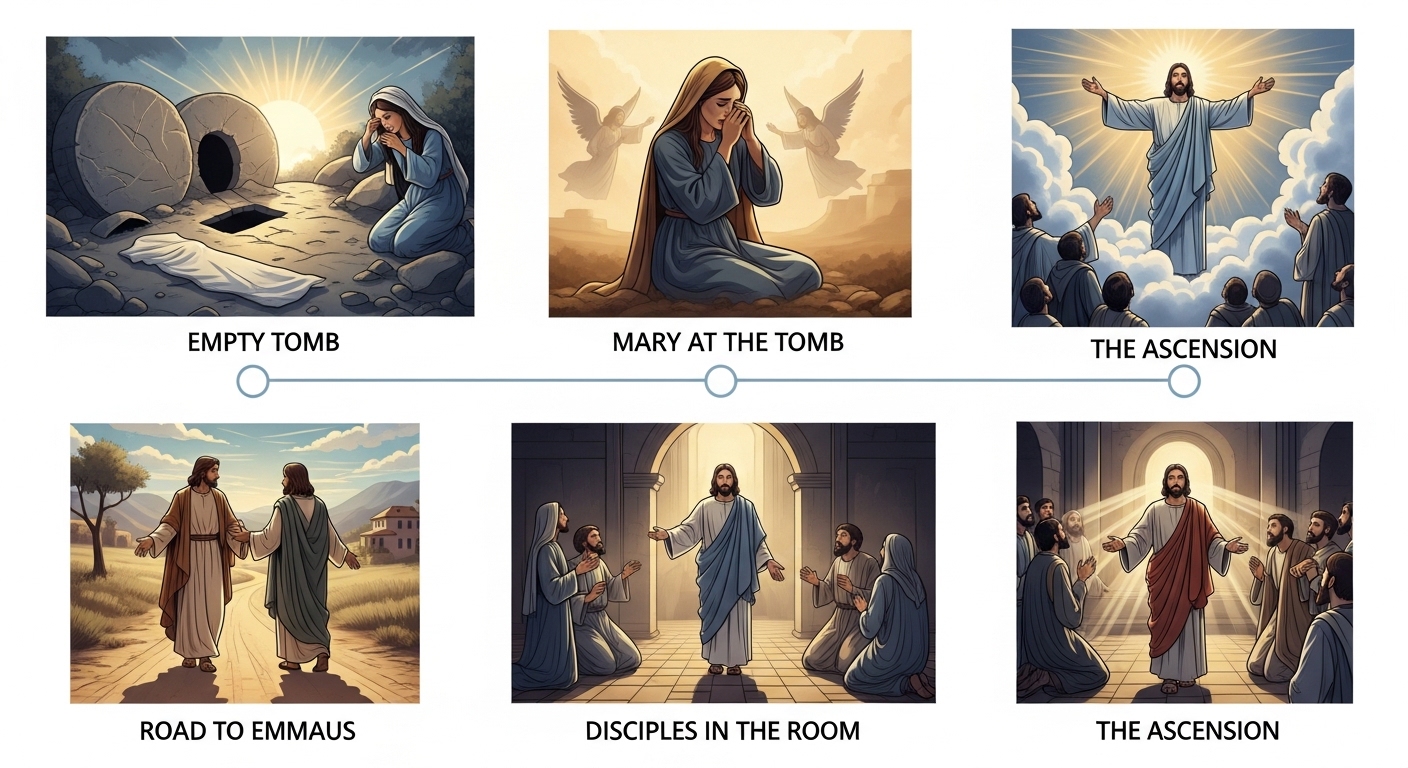
During those forty days you’ll read about several significant encounters. He met Mary Magdalene and commissioned her to tell the disciples that He had risen (John 20:11-18). He walked with two discouraged followers on the road to Emmaus and explained the Scriptures to them (Luke 24:13-35). He appeared to the gathered disciples in a locked room to bring peace and to address doubts (John 20:19-29). He showed Himself to Peter and to a larger group by the Sea of Galilee (John 21:1-14). Paul later summarizes that Jesus appeared to more than five hundred people at one time and to individuals including James and Paul himself (1 Corinthians 15:3-8). All of this shows that Jesus’ resurrection was real, public, and foundational to the early Church’s witness.

The Ascension into heaven
After these appearances and teachings, Luke and Acts describe what is known as the Ascension. Luke records that Jesus led His disciples out to Bethany, lifted up His hands to bless them, and was taken up into heaven (Luke 24:50-53). Acts gives the fuller narrative of the disciples watching as He was taken up and a cloud hid Him from their sight, with angels explaining that Jesus will return in the same way they saw Him go (Acts 1:9-11. The Ascension is not portrayed as Jesus disappearing into space; rather, it is a climactic, witnessed transition from His visible earthly ministry to His exalted position at the Father’s right hand.
This visible departure is the hinge between Jesus’ earthly work of atonement and teaching and His heavenly ministry of intercession and reign. The disciples’ role shifted from being students of a visible teacher to being witnesses and agents empowered to carry the Gospel into the world.

How long did Jesus stay on earth?
The New Testament explicitly tells you He stayed for forty days. Acts states that “He presented Himself alive to them after His suffering by many proofs…appearing to them during forty days and speaking about the kingdom of God” (Acts 1:3). That forty-day period gave the apostles time to see Him, question, learn, and prepare for the coming Holy Spirit and for mission work.
Forty days has symbolic and practical significance in Scripture. It calls to mind other forty-day events like Moses on Sinai and Elijah’s desert journey, times of preparation and transition. For you, knowing the timeline helps you see that Jesus’ physical absence didn’t happen suddenly—there was deliberate preparation for the next chapter of God’s plan.
Where in heaven did He go?
When Scripture tells you Jesus ascended into heaven, it emphasizes that He returned to the Father—in the presence of God and to a place of authority. Jesus had promised to go to the Father and prepare a place for His followers (John 14:2-3. The New Testament also describes Jesus as being “seated at the right hand of the Majesty in heaven,” a phrase that communicates honor, authority, and active rule (Hebrews 1:3. The “right hand” language affirms His ongoing role in God’s rule and His intercession for you.
The Bible does not give a floor plan of heaven, but it makes clear that Jesus’ ascension places Him in the center of divine authority and activity—reigning, interceding, and preparing the way for your ultimate hope.
Why the Ascension matters
The Ascension matters for several interconnected reasons. First, it signals that Jesus’ redemptive work was completed. His suffering, death, and resurrection accomplished the victory over sin and death; ascending to the Father is the public testimony that His mission was finished in its earthly phase. Second, the Ascension inaugurates Jesus’ reign. He is not a distant or silent savior—He rules and governs from heaven. Third, His departure sets the stage for the sending of the Holy Spirit. Jesus told His disciples to wait in Jerusalem until they were clothed with power from on high, and that promise is fulfilled at Pentecost (Acts 2:1-4. The sending of the Spirit equips you and the Church for mission and transforms the presence of Jesus into an indwelling, empowering reality.
For your faith, the Ascension reassures you that Jesus’ physical absence does not equal abandonment. Instead, He has moved into a role that enables a different kind of presence—one that is universal, sovereign, and active through the Spirit.

Jesus’ post-resurrection appearances: who saw Him and why it matters
The Gospels and Paul’s letters list numerous post-resurrection appearances. These encounters were not random; they had purpose. You can trace several major appearances that shaped the early Christian witness:
- To Mary Magdalene at the tomb, where He commissions her to tell the disciples (John 20:11-18. This first-person encounter underscores personal restoration and the role of women as primary witnesses.
- To the two disciples on the road to Emmaus, where Jesus opens the Scriptures and reveals how the Messiah’s suffering and glory were foretold (Luke 24:13-35. This scene points to the continuity between Old Testament promises and their fulfillment in Christ.
- To the gathered disciples in Jerusalem, where He appears despite locked doors, offers peace, and commissions them for their mission (John 20:19-23. This appearance establishes the authority and sending of the apostolic witnesses.
- To Thomas, addressing doubt with evidence and an invitation to faith (John 20:24-29. Jesus honors honest questions and invites belief grounded in relationship.
- To Peter and to the disciples by the Sea of Galilee, where He restores and commissions Peter for pastoral leadership (John 21:1-14. This meeting models forgiveness and mission.
- To more than five hundred at one time and to many others, demonstrating the public, verifiable reality of the resurrection (1 Corinthians 15:3-8. Paul’s list functions as a historical claim you can investigate and an apologetic for the faith.
Each appearance addressed specific needs—grief, doubt, instruction, mission—and together they provide a robust foundation for your confidence in the resurrection. The appearances also show Jesus’ concern for the Church’s formation: teaching, commissioning, forgiving, and equipping.
The role of the Ascension in God’s plan
The Ascension is an essential pivot in God’s unfolding plan of redemption. With Jesus now seated at the Father’s right hand, several important realities come into focus. First, Jesus intercedes for believers. The Bible speaks of Christ as an intercessor who represents you before the Father, ensuring your prayers and needs are presented (Hebrews 7:25. Second, the Ascension opens the way for the Holy Spirit to come. Jesus promised to send the Counselor, and His departure was necessary for the Spirit’s arrival and indwelling presence, which empowers the worldwide mission (Acts 2:1-4. Third, the Ascension assures you of Christ’s sovereign rule—He is exalted above all, and His authority shapes the life and mission of the Church.
This means your faith is not built on a figure confined to the past. Instead, you relate to a living, reigning Savior who is actively involved in the mission and sustenance of the Church.
What the Ascension means for your daily life
Practically, the Ascension shapes your spirituality and daily walk in several ways. You can take comfort that Jesus is reigning and interceding, which brings stability in times of uncertainty. You participate in a mission because the risen and ascended Christ sent the Spirit to empower you to be His witness (see Acts 1:8). Your prayer life is informed by the knowledge that Jesus brings your needs before the Father (Hebrews 7:25. And your hope for the future is anchored in the promise that He will return “in the same way” He went up (Acts 1:11.
Because Jesus ascended, you are also reminded to live expectantly. The Church’s life is not merely retrospective; it is forward-looking. You live in the tension of “already and not yet”: Christ’s kingdom has been inaugurated, but its full consummation awaits His return.
Timeline: key post-resurrection events
You may find it helpful to see the sequence of events in a simple narrative form. After Jesus rose on the first day of the week, He first appeared to individuals like Mary Magdalene and to small groups of disciples. He spent forty days appearing to various people, offering proofs of His resurrection and teaching about the kingdom of God (Acts 1:3. During that period He healed relationships, clarified Scripture, and commissioned His followers. At the end of forty days, He led the disciples to the Mount of Olives (near Bethany); there, He blessed them and was taken up into heaven before their eyes, a moment witnessed by the original apostles ([Acts 1:9](https://www.biblegateway.com/passage/?search=Acts+1:9&version=NIV]; Luke 24:50-53. Angels then reinforced the promise of His return, instructing the disciples that Jesus will come again in the same visible manner (Acts 1:11. Shortly after the Ascension, the disciples gathered in prayer and waited for the promised Spirit, which fell powerfully at Pentecost and launched the apostolic mission (Acts 2:1-4.
Common questions and brief answers
You may still have practical or theological questions. Here are responses to some common ones you encounter:
- Is Jesus physically in heaven now? The New Testament affirms that Jesus ascended bodily and is exalted in heaven Acts 1:9. His risen body is transformed and not limited by earthly constraints, but He retains real, bodily identity in exaltation.
- Will Jesus return the same way He left? Scripture says the disciples saw Him go and were told He will return “in the same way” they saw Him go Acts 1:11. This gives you confidence in a visible, bodily return.
- What is the connection between Ascension and Pentecost? Jesus told the disciples to wait for the Spirit after He ascended. The Ascension removed the physical limitation of Jesus’ presence and enabled the Spirit to come and dwell within believers, empowering the Church’s mission Acts 2:1-4. The Spirit is the ongoing presence of Christ in and through you.
- Where is Jesus now? The New Testament consistently places Jesus at the right hand of the Father in heaven, reigning and interceding Hebrews 1:3. For your spiritual life, that means Jesus is both supreme ruler and personal mediator.
How the early church responded
The early church responded to the Ascension with prayer, obedience, and evangelistic boldness. The apostles returned to Jerusalem, devoted themselves to prayer, and selected Matthias to restore their number to twelve, reflecting continuity with Jesus’ chosen leaders (Acts 1:12-26. Then, empowered by the Spirit at Pentecost, they preached courageously, baptized thousands, and multiplied churches. For you, the early church’s response models faithful waiting, communal prayer, and bold action once empowered by the Spirit.
Personal reflection: questions to ask yourself
The story of Jesus’ resurrection and ascension invites personal reflection. Ask yourself: Do I believe Jesus is alive and reigning? How does that change my prayer life, my confidence in trials, and my engagement in mission? Do you rely on the Spirit’s power, or on your own strength? Reflecting on these questions helps you move from intellectual assent to practical transformation.
Spend time re-reading a few key passages—such as Luke 24:36-49 and Acts 1:3—and ask the Spirit to make them real in your daily life.
Practical steps you can take
If you want your faith to reflect the reality of the Ascension, try small, practical habits. Grow in daily prayer, inviting Jesus—who intercedes for you—to guide your requests. Rely on the Spirit for boldness in sharing your faith; make space for the Word and for community so Scripture can instruct you like it did for the Emmaus disciples. Serve in your local church, remembering that the mission Jesus gave to His followers continues through you. These steps are simple, but they help you live in the reality of the risen and reigning Christ.
Final thoughts
After the resurrection, Jesus remained on earth long enough to confirm His victory, teach His followers, and prepare them for their mission. Then the Ascension moved Him into heaven, where He reigns, intercedes, and sends the Spirit. This sequence is not just a historical detail—it shapes your identity, your hope, and your calling. You belong to a story that began with the empty tomb and continues with an ascended Savior who actively rules and advocates for you.
🔗 Internal Resources to Explore
If you want to understand what happened after the resurrection more clearly, these guides will help you see the full picture and meaning behind each event:
📖 Main Hub
👉 What Happened After Jesus Rose From the Dead? (Full Timeline Explained)
📚 Go Deeper
👉 How Long Did Jesus Stay on Earth After He Rose?
👉 The 40 Days After the Resurrection: What It Means for Your Faith
🙏 Short Prayer
Heavenly Father,
Thank You for the risen Christ and the hope we have because He lives. As we reflect on where Jesus went after the resurrection, help us trust that He is alive, present, and preparing a place for us. Strengthen our faith when we do not see, and remind us that Your promises are always true.
Guide us to live with purpose, knowing that Jesus reigns and will return. Fill our hearts with peace, hope, and a deeper desire to follow You every day.
In Jesus’ name,
Amen
Sponsored recommendation

Acknowledgment: All Bible verses referenced in this article were accessed via Bible Gateway (or Bible Hub).
“Want to explore more? Check out our latest post on Why Jesus? and discover the life-changing truth of the Gospel!”