


Many people ask: how long did Jesus remain on earth after His resurrection? You may have wondered the same thing when reading the Gospels or when someone mentioned the “forty days” between Easter and Ascension. The Bible gives a clear answer, and understanding that period helps you see why those days mattered so much for the first followers and for your faith today.
In this article you’ll find the biblical answer, the key passages that describe what happened, why the forty-day period is significant, and practical ways you can apply what those days teach you about preparation, waiting, and mission.
Quick answer
Jesus stayed on earth for forty days after His resurrection. The book of Acts summarizes this concisely: “He appeared to them over a period of forty days and spoke about the kingdom of God” (Acts 1:3). Those forty days were not a gap of randomness; they were a deliberate season in which Jesus appeared to many people, gave convincing proofs of His resurrection, taught about the kingdom, and prepared the disciples for the mission that would carry the Gospel into the world.
Key Bible verse
The most direct biblical statement about the length of time is Acts 1:3. That verse ties together the reality of the resurrection, Jesus’ ongoing appearances, and the teaching He continued to provide. Read it in context and you’ll see the emphasis: He didn’t simply disappear after the empty tomb; He remained with His followers to establish the reality of His resurrection and to ready them for what was to come.
See the verse here: Acts 1:3.
What happened during the forty days
During these forty days Jesus appeared to many different people in a variety of contexts. Those appearances were meant to demonstrate that He was truly alive, to remove doubts, and to instruct His followers so they could carry on His work.
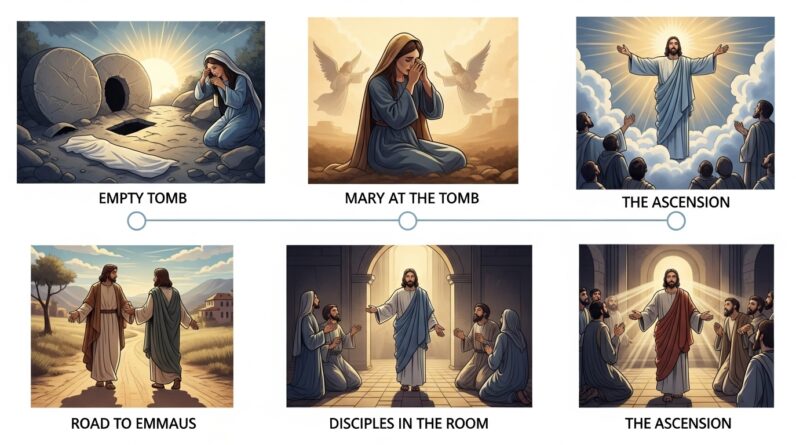
The Gospels and Paul’s summary in 1 Corinthians provide multiple accounts. For example, Mary Magdalene encountered the risen Jesus outside the tomb in a deeply personal appearance that changed her confusion into worship (John 20:11-18). Two disciples walking to Emmaus had a conversation with Jesus they did not initially recognize; He explained Scripture to them and was revealed to them when He broke bread (Luke 24:13-35). On the evening of His resurrection, Jesus appeared to the disciples behind locked doors, offering peace, showing His hands and side, and giving them the Holy Spirit (John 20:19-23). Later, He met the skeptic Thomas and invited him to touch His wounds, which led Thomas to a profound confession of faith (John 20:24-29). Luke records other gatherings in which Jesus ate with the disciples and spoke about the kingdom of God (Luke 24:36-49; Luke 24:41-43). Paul later summarized that Jesus appeared to Cephas (Peter), to the twelve, to more than five hundred brothers and sisters, and to James and others (1 Corinthians 15:5-8).
Each of these appearances served different purposes: personal restoration, teaching, commissioning, and communal witness. Taken together they form a sustained, tangible witness to the resurrection over a forty-day season.

Appearances: proof and presence
One of the most important reasons Jesus remained for forty days was to provide unmistakable proof that He had risen bodily from the dead. The accounts emphasize physical signs that counter the idea that the resurrection was only spiritual, visionary, or metaphorical. Jesus invited touch, showed the wounds in His hands and side, and ate with the disciples, demonstrating bodily reality (John 20:27; Luke 24:39-43). This kind of proof mattered because the early proclamation of the Gospel depended on credible witness. If the disciples could truthfully testify to a risen, embodied Lord, their message would be grounded in reality rather than wishful thinking.
Beyond physical proof, Jesus’ presence over forty days allowed the disciples to move from confusion and grief into conviction and clarity. He explained how Scripture had pointed to His suffering and resurrection, opening their minds to understand God’s plan (Luke 24:44-47). That teaching gave shape to their faith—so they would not merely remember an event, but interpret it in light of God’s promises and the coming kingdom.

Why the forty days matter
The number forty has deep resonance in Scripture: Moses spent forty days and nights on Mount Sinai (Exodus 24:18), Elijah fasted forty days on the mountain of God (1 Kings 19:8), and Israel wandered in the wilderness for forty years. The forty-day period after the resurrection can be seen as a climactic time of preparation and transition. During these days Jesus completed His ministry in a new way, bridging His earthly teaching and the forthcoming mission of the church empowered by the Spirit.
Practically, those days allowed the disciples to move from being eyewitnesses of a single event to being witnesses equipped to explain its meaning. Jesus taught them about the kingdom, trained them to interpret events through Scripture, and promised the Holy Spirit who would empower their testimony (Acts 1:4-5). The forty days were not merely a waiting room; they were an intentional season of validation, instruction, and commissioning.
How the forty days prepared the disciples for mission
You’ll notice that much of Jesus’ focus during these appearances was on preparing the disciples to carry out the mission He had given them. He repeatedly instructed them concerning the kingdom of God and made clear that their role was to proclaim repentance and forgiveness to all nations. The Great Commission captures that transition: Jesus commands them to make disciples, baptize, and teach what He had commanded (Matthew 28:16-20). The forty-day period helped shape their understanding of what that commission meant.
In addition to teaching, Jesus promised the Holy Spirit as the power they would need to fulfill the mission. He told them to wait in Jerusalem until they were clothed with power from on high (Acts 1:4-5). This promise was vital: it linked the disciples’ future work to God’s initiative rather than human ingenuity. The sequence is significant—you can see a pattern where Jesus first verifies the resurrection, then instructs the followers about its meaning, and finally commissions them while promising divine empowerment.
The ascension and what followed
The forty days culminated in the ascension—Jesus’ being taken up into heaven. The Gospels and Acts describe a final set of instructions and a blessing, followed by Jesus’ return to the Father in visible form. Luke records that Jesus led the disciples out to Bethany, lifted up His hands and blessed them, and was carried up into heaven (Luke 24:50-53). Acts gives a similar account and adds the detail of two men in white who told the disciples that Jesus would return in the same way He had gone into heaven (Acts 1:9-11). That moment marked a decisive shift: the physical, earthly presence of Jesus was concluded, and the era of the church empowered by the Spirit began.
The ascension doesn’t mean Jesus stopped caring, talking, or being present with His people. Instead, it signals a change in how He relates to humanity. He returned to the Father and took His place of authority and intercession, opening the way for the Spirit to come and dwell in believers and for the church to operate in Christ’s authority and power.

The theological implications of the forty-day period
Theologically, the forty days affirm several core truths you may already hold or want to think about more deeply. First, the resurrection is bodily and historical, not merely symbolic. Jesus’ interactions with His followers reinforce that reality. Second, the resurrection leads to ascension; Jesus’ victory over death culminates in exaltation to God’s right hand, which is crucial for understanding His present lordship and intercessory work on your behalf (Romans 8:34). Third, the pattern of verification and commissioning demonstrates that faith is rooted in truth and then released into mission. God doesn’t leave you in uncertainty—He grounds you in reality and calls you to act.
Finally, the forty days show that God equips those He sends. The promise of the Holy Spirit connects Jesus’ physical presence with the Spirit’s ongoing presence. The Spirit empowers the church to be Jesus’ hands and voice in the world, continuing the work Jesus began during His earthly ministry.
Common questions and misunderstandings
You might have encountered some common questions about this period, and it helps to address them briefly.
- Did Jesus appear only to the disciples? No. Paul’s list includes many witnesses beyond the twelve, and Gospel accounts show appearances to women, pairs of travelers, and larger gatherings (1 Corinthians 15:5-8; John 20:11-18; Luke 24:13-35). This widespread witnessing strengthens the credibility of the resurrection claim.
- Was every appearance the same kind of experience? No. Some were private and intimate, like the encounter with Mary Magdalene; others were public and communal, like the meeting with the disciples in Jerusalem. The variety underscores that Jesus met people where they were—in grief, doubt, confusion, and worship.
- Did the disciples need forty days to be convinced? People come to belief in different ways. For these disciples, the forty-day season provided time for the facts to sink in, for instruction to reshape understanding, and for their hearts to move from fear to boldness. The process mirrors how God often works in your life—through stages of seeing, understanding, and stepping forward.
A brief timeline summary
If you find timelines helpful, here’s a concise sequence you can hold in your mind:
- Early morning of the first day of the week: Women discover the empty tomb and encounter angels (Matthew 28:1-7; John 20:1-10).
- Same day: Jesus appears to Mary Magdalene (John 20:11-18).
- Same evening: Jesus appears to the disciples behind closed doors (John 20:19-23).
- Later within the forty days: The Emmaus road appearance and other encounters in Galilee and Jerusalem (Luke 24:13-35; Luke 24:36-49).
- Various times within the forty days: Appearances to Peter, the Twelve, more than five hundred, and others (1 Corinthians 15:5-8).
- Near the end of the forty days: Final instructions, a promise to wait for the Spirit, and the ascension (Acts 1:3-11; Luke 24:50-53).
This sequence highlights the pattern: resurrection, appearances and teaching, commissioning, promise, and ascension.
What this means for your life
The forty days after the resurrection teach you several practical lessons about how God works and how your faith grows.
First, God often brings you into seasons of preparation. Waiting isn’t wasted. Jesus used the time to teach, to reveal, and to prepare the disciples for mission. Your waiting can be a time when God shapes your understanding and readies you for what’s ahead.
Second, faith is strengthened by truth and encounter. The disciples’ faith deepened because they saw, heard, and were taught. Your faith can similarly be reinforced by honest engagement with Scripture, prayerful reflection, and community that points you back to the facts of what God has done.
Third, God’s mission usually comes with both command and empowerment. Jesus commissioned the disciples and promised the Spirit. You can expect that when God calls you, He also provides the help you need—often through the Holy Spirit, through the church, and through the Word.
Finally, remember that absence isn’t abandonment. Jesus’ ascension didn’t mean He was gone. It meant His mode of presence changed. He continues to intercede for you and to be present through the Spirit. If you’re feeling alone, reflect on the continuity between Jesus’ earthly ministry, His resurrection, His ascension, and the Spirit’s ongoing work.
Reflection questions for your season of waiting
Take a moment to reflect on what the forty-day story might mean for you personally. Ask yourself these questions slowly and prayerfully:
- Am I trusting God’s timing, even when the road seems uncertain?
- What is God preparing you for in this season?
- How can you be more intentional about learning, listening, and being trained by God right now?
- Where do you need the assurance of God’s presence to move from fear to faithful action?
These questions aren’t meant to produce quick answers but to invite you into a posture of attentive faith.
Closing thoughts
Jesus’ forty days on earth after His resurrection were densely packed with meaning and purpose. They confirmed the reality of the resurrection, strengthened belief through tangible encounters, taught the disciples to interpret Scripture in light of God’s saving plan, and prepared the church for the mission it would carry out empowered by the Holy Spirit. That period reminds you that God often works through seasons, that truth and relationship matter, and that He equips those He sends.
You can anchor your hope in the historical reality of the resurrection and the continuing presence of the risen Christ through the Spirit. As you wait, learn, and step into mission, remember that your own journey often mirrors the disciples’: a movement from confusion and fear to conviction and mission, guided by the risen Lord.
 Internal Resources to Explore
If you want to understand what happened after the resurrection more clearly, these guides will help you see the full picture and meaning behind each event:
 Main Hub
👉 What Happened After Jesus Rose From the Dead? (Full Timeline Explained)
👉 Go deeper
• Where Did Jesus Go After the Resurrection? (Bible Explained)
• The 40 Days After the Resurrection: What It Means for Your Faith
Short prayer
Lord, thank You that Jesus did not leave us in doubt but appeared and taught His followers. Help me to trust Your timing, to learn in the waiting, and to step into the mission You’ve given me with courage and the power of Your Spirit. Amen.
Sponsored recommendation

Acknowledgment: All Bible verses referenced in this article were accessed via Bible Gateway (or Bible Hub).
“Want to explore more? Check out our latest post on Why Jesus? and discover the life-changing truth of the Gospel!”