



If you struggle to understand the Bible, you are not alone. You’re not expected to decode Scripture by sheer intuition. The Observe-Interpret-Apply (OIA) method gives you a clear, repeatable, and friendly framework so you can read Scripture with confidence, hear from God more clearly, and put what you learn into real life. In this step-by-step guide you’ll learn what each step looks like, how to ask the right questions, and how to practice the method using a short passage. By the end, you’ll have a simple Bible study workflow you can use every day.

Why the OIA method works for you
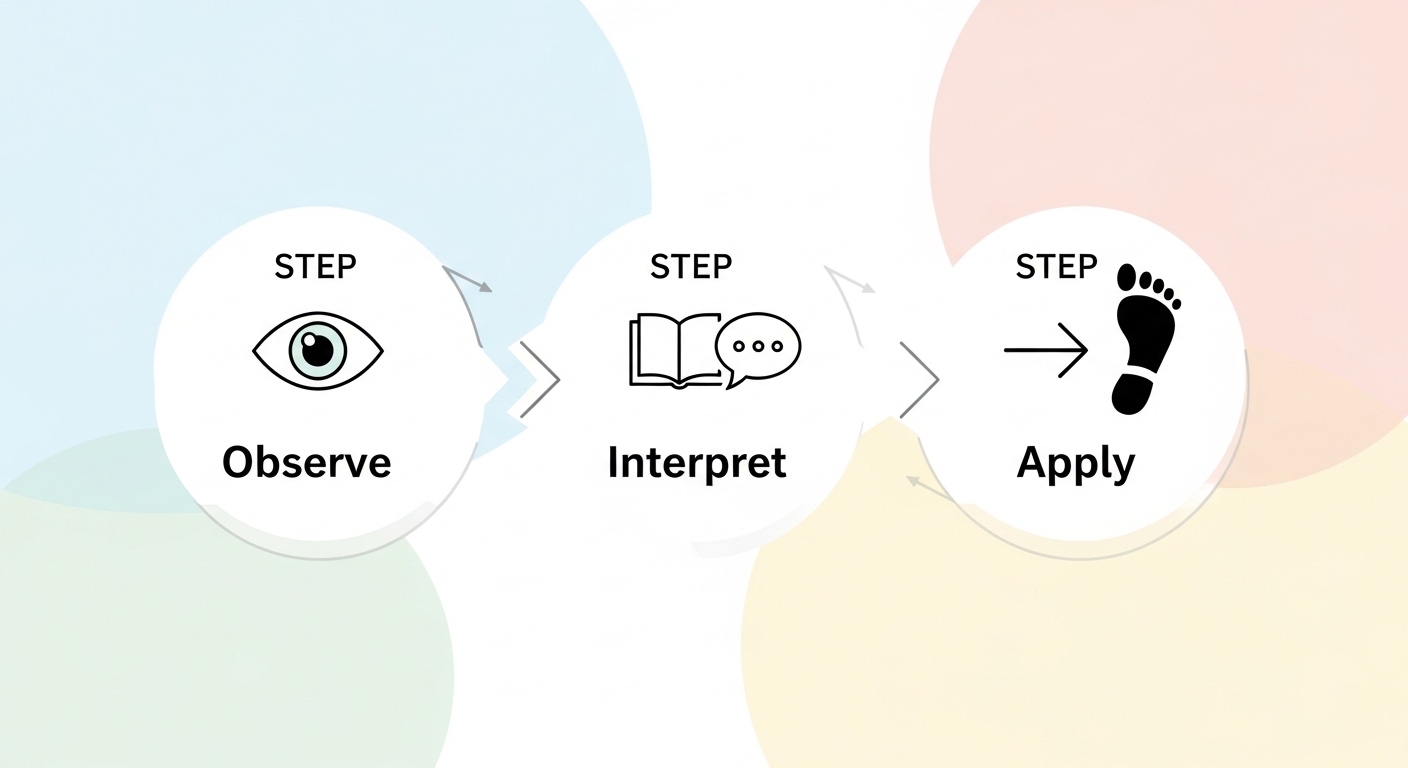
The OIA method breaks Bible study down into three manageable moves: notice what the text says, understand what it meant, and make it matter to your life. When you follow those three moves consistently you avoid two common traps: reading Scripture as a confusing textbook or treating it like a motivational quote. OIA helps you respect the text’s original meaning while discovering personal, life-changing application.
OIA works because it trains your attention, protects you from jumping to quick conclusions, and invites the Holy Spirit to guide interpretation and application. You’ll cultivate habits that produce spiritual growth: careful listening, thoughtful reflection, and obedient action.
A short Bible reminder about guidance
When you read Scripture with humility, you can ask God to help you understand. The Bible reminds us that the Spirit plays a role in understanding God’s Word: 1 Corinthians 2:14 says the Spirit helps us grasp spiritual truth. Keep that promise in mind as you study—the Spirit helps your mind and heart align with God’s message.
Step 1: Observe — Ask “What does the text say?”
Observation is the first and most crucial step. If you hurry past observation, you’ll frequently misunderstand what the text is actually saying. Observation is about paying attention to the text itself before you interpret or apply it.
When you observe, slow down and ask clear, concrete questions: What is the passage actually saying? Who is speaking? To whom are they speaking? What words or phrases repeat? What commands or promises appear? What tone does the passage have—comforting, instructive, corrective, warning, praising? Which words stand out to you?
You’ll want to mark or note repeated words, transitional phrases (but, therefore, because), and any contrast or comparison. A careful observation will also note the structure: is the passage a parable, a proverb, poetry, narrative, or a prophetic oracle? Each genre carries different expectations for how meaning is conveyed.
Observation is practical. Use a notebook, highlight key phrases, and write short answers to the observation questions. This builds a record you can return to.
Observation in practice: a brief example
Take a passage like Psalm 119:105. The verse reads, “Your word is a lamp for my feet, a light on my path.” Observe the metaphor (lamp/light), the possessive (your word), and the personal context (my feet/my path). Notice the imagery of guidance in darkness and movement along a path. Ask what repeats in the surrounding verses. Psalm 119 frequently praises God’s law and instruction, so this verse sits inside a larger theme of Scripture as guidance.
Observation prepares you to ask better interpretive questions because you’ve laid out the textual evidence.

Step 2: Interpret — Ask “What did this mean to the original readers?”
Interpretation is the heart of careful Bible study. It asks: what did this author mean to say? What would the original audience have understood? Interpretation looks for the original intent, not what you hope the text says.
To interpret well, consider context at multiple levels: immediate (the verses and chapter), literary (the book’s overall purpose), historical (who wrote, when, and to whom), and theological (how it fits the Bible’s broader teaching). Pay attention to genre: poetry uses metaphor, narrative tells a story with characters and consequences, and epistles often contain teaching with practical commands.
Ask questions like: What is the historical situation? What problem or situation provoked this writing? Is the author using figurative language? Are there cultural words or practices that need explanation? Consult simple resources—Bible study notes, a reliable commentary, or cross-references—to clarify difficult terms or cultural background.
Don’t forget to invite the Holy Spirit into your interpretation. You study hard, but you pray for God’s Spirit to illuminate what the words mean for your heart and the church’s life—1 Corinthians 2:14 is a helpful reminder.
Tools for interpretation
You don’t need a seminary education to interpret responsibly. Use accessible tools that guide you to context and meaning: a good study Bible, cross-references, a concise commentary, and trustworthy online resources. Keep a list of background facts and reasons behind your interpretation. When you cite conclusions, ask, “Which observations support this interpretation?” This keeps interpretation rooted in the text rather than opinion.

Step 3: Apply — Ask “What should I do now?”
Application is where study becomes life change. After you’ve observed and interpreted, you ask: how does this truth shape your thinking, feelings, or actions? Application isn’t merely moralistic or trite. It’s concrete, personal, and measurable. A good application answers who will change and how that change will look.
Move from general to specific. If a passage emphasizes God’s guidance, you might determine the general principle—God’s Word guides the believer—and then craft a specific action: commit to reading Scripture daily, memorize a verse, or pause to ask God for direction in a decision this week. Application can include repentance, a new practice, a change in relationships, a prayer posture, or a service commitment.
Make applications small enough to be realistic and big enough to be meaningful. You want action steps that transform daily rhythms: prayer before decisions, Scripture memory, confession, or generosity.
Real application example using Psalm 119:105
From Psalm 119:105 you might interpret that God’s Word provides guidance for daily living. A practical application could be: tonight and tomorrow morning, before you make an important decision, read a short passage and invite God to guide you. Memorize the verse for encouragement the next time you feel uncertain. That’s specific, immediate, and measurable.

How to structure a short OIA Bible study session
You don’t need hours to do a meaningful study. A 20–40 minute session can be powerful if you keep the structure.
Start with observation (5–10 minutes): read the passage slowly and note repeated words, commands, or contrasts. Read the passage aloud and read a second time in a different translation.
Move to interpretation (10–20 minutes): ask context questions, identify the author and audience, and check quickly against a short commentary or study notes. Write down a one-sentence interpretation of the passage’s main point.
Finish with application (5–10 minutes): write at least one specific action step for the next 24–72 hours. Pray and ask God to help you live it out.
This structure trains discipline: the rhythm of see → understand → do.
A full OIA walk-through: Psalm 119:105 (step-by-step)
Below is a sample study using the verse you likely know: Psalm 119:105. I’ll show the exact questions you can answer in your notebook.
Observation
- Read the verse aloud slowly.
- Note the metaphor (lamp/light) and the object (your word).
- Look at surrounding verses in Psalm 119 to see the theme—love for God’s law and its benefits.
- Ask what the immediate setting is (Psalm of instruction and devotion).
Interpretation
- Consider the metaphor in its ancient context: lamps and torches were the way to see at night and navigate rough paths.
- The original readers would understand “word” to mean God’s instruction, law, and revelation.
- The idea: God’s revealed truth provides guidance and protection in life’s journey.
Application
- Personalize: “God’s Word will guide me today when I face X.”
- Practice: memorize the verse and use it as a prayer when unsure.
- Specific action: before you make choices this week, read a short Psalm and ask God for direction.
Walking a passage like this in your notebook makes the steps concrete and repeatable.
Practical questions you should always ask in OIA
When you practice OIA, you can use a short checklist of questions. These help keep your study focused and clear.
Observation questions you can ask each time:
- What is the verse literally saying?
- What words stand out or repeat?
- What genre is this passage?
Interpretation questions you can ask each time:
- What did the original audience understand?
- Are there cultural or historical details I need to know?
- How does this fit within the book’s overall message?
Application questions you can ask each time:
- What is God calling me to change?
- What concrete action will I take in the next 24–72 hours?
- How will I evaluate whether I acted on this truth?
Use these questions as a short, practical routine you can use daily or weekly.
Common mistakes to avoid when using OIA
When you’re learning OIA, you’ll be tempted to take shortcuts. Here are common mistakes and how to avoid them.
Mistake: Skipping observation and jumping straight to application. How to avoid: Force yourself to write at least three observational notes before you interpret.
Mistake: Reading modern meanings back into ancient texts. How to avoid: Ask what the original audience would have understood and check context.
Mistake: Making application vague or impractical. How to avoid: Turn principles into measurable actions (e.g., “I will read Psalm 119 for five minutes each morning” rather than “I’ll read more”).
Mistake: Treating interpretation as purely personal impression. How to avoid: Ask text-based questions and check your interpretation against simple commentaries or trusted teachers.
By learning to avoid these mistakes you’ll develop clarity and humility in your study.
Tools and habits to help OIA become daily practice
You’ll benefit from a few consistent tools and habits:
- Notebook: Keep a dedicated Bible study notebook where you record observation notes, interpretation statements, and applications.
- Short checklist: Use the observation/interpretation/application questions each time.
- Study Bible or concise commentary: A reliable, conservative study Bible offers quick context and helpful notes.
- Translations: Read the passage in two or three translations if a phrase puzzles you.
- Prayer habit: Begin each session asking the Holy Spirit to guide your understanding and your will.
- Accountability: Share your one concrete application with a friend or small group and check in the next week.
A few consistent habits will make the method feel natural and fruitful.
How the Holy Spirit helps in OIA
God invites you to rely on the Spirit for understanding and obedience. As you study, pray for illumination and for the power to live out what you learn. Scripture is not only informative; it’s formative. The Spirit works through Scripture to change your heart, not merely to give information.
Remember the assurance in 1 Corinthians 2:14: spiritual truth is grasped with the Spirit’s help. You study in humility, ask God to open your eyes, and then act on what He reveals.
For more on how the Spirit aids Bible study, see the internal article on the role of the Holy Spirit in study: Holy Spirit role article.
Sample practice plan (4-week beginner routine)
If you want to build a study habit, try a simple four-week plan. Each week has a focus so you develop skill in all three parts of OIA.
Week 1: Observation focus — pick a short chapter and practice noting repeated words, commands, or contrasts. Keep a page of observations.
Week 2: Interpretation focus — pick a passage, read surrounding context, and write a one-sentence interpretation. Consult a brief commentary to check your understanding.
Week 3: Application focus — select two verses and write specific, measurable application steps. Share one step with a friend.
Week 4: Integration — use the full OIA method daily for five days on short passages. At the end of the week, review your notebook and celebrate what changed in your thinking or actions.
This plan helps you grow in each skill without feeling overwhelmed.
Sample passages to practice OIA (try these)
If you want a few passages to practice, try these short options. Read slowly, observe, interpret, and apply.
- Psalm 119:105 — guidance and Scripture’s role.
- Proverbs 3:5-6 — trust in the Lord and how it shapes decisions.
- James 1:22 — the call to be doers of the word.
Use the three-step OIA on each: list observations, write a one-sentence interpretation, and create a measurable application.
How to apply OIA in group Bible study
OIA works well in small groups. In a group setting, you can assign roles: someone reads the passage, another lists observations, a third leads interpretive discussion with context questions, and another proposes applications. Group interaction highlights parts you missed and tests interpretations against different perspectives.
Group study should still follow the same discipline: observe together first, then interpret with humility, then propose personal applications. Encourage accountability by having group members report on one applied step during the next meeting.
If you’re leading a group, prepare by reading the passage beforehand with the OIA method yourself so you can guide questions and keep the conversation focused on text-based conclusions.
Frequently asked questions (brief)
Q: How long should a Bible study using OIA take? A: A meaningful session can be 20–40 minutes. If you have time, dive deeper. Regular short sessions beat occasional marathon sessions.
Q: Do I need to know Hebrew or Greek to use OIA? A: No. Use good translations and accessible resources. Language tools help, but careful observation and prayerful interpretation are sufficient for life application.
Q: What if I disagree with a commentary? A: Compare the commentator’s reasons with the text. Trust the strongest evidence rooted in context and grammar. If uncertainty remains, hold your interpretation with humility and consider alternative readings.
Mistakes to avoid when applying Scripture
Application can go wrong if it lacks humility or accountability. Avoid using Scripture as a personal weapon or to justify selfish choices. Don’t assume application is only for you—some passages call for communal response. Finally, avoid making all application instant: some truths take time to form into habit. Use spiritual disciplines and community for sustained change.
Advanced tips for confident interpretation
As you gain skill, adopt a few advanced habits:
- Always read the paragraph or chapter, not just a single verse.
- Track how a word functions across the book; repeated themes shape the book’s message.
- Use cross-references to see how the Bible interprets itself.
- Keep theology integrated—Scripture is coherent; let clearer passages inform harder passages.
- When in doubt, favor interpretations that call for humility, love, and obedience.
These habits keep your study grounded and Christ-centered.
Short prayer to close your study
Pray briefly to ask God to help you apply what you’ve learned. For example: “Lord, thank you for speaking through your Word. Help me understand and apply this truth by your Spirit. Give me the courage to obey and the humility to learn. Amen.”
🔗 Take Your Bible Study to the Next Level
👉 New to Bible Study? Start Here First:
How to Understand the Bible (Simple Guide for Beginners)
👉 Still Confused About Certain Verses? This Will Help:
How to Study the Bible in Context (Beginner-Friendly Guide)
👉 Reading Different Parts of the Bible? Don’t Miss This:
How to Read Different Genres in the Bible (Avoid Common Mistakes)
These short reads will complement your OIA practice and accelerate your growth.
Conclusion: OIA turns confusion into clarity
The Observe-Interpret-Apply method is simple, practical, and powerful. You’ll move from confusion to confidence when you regularly practice the three moves. OIA trains you to read carefully, interpret responsibly, and live obediently. Start small: pick a verse, follow the three steps in your notebook, write one specific action, and try it this week. Over time, these small steps become a stable way of hearing from God and living the faith you profess.