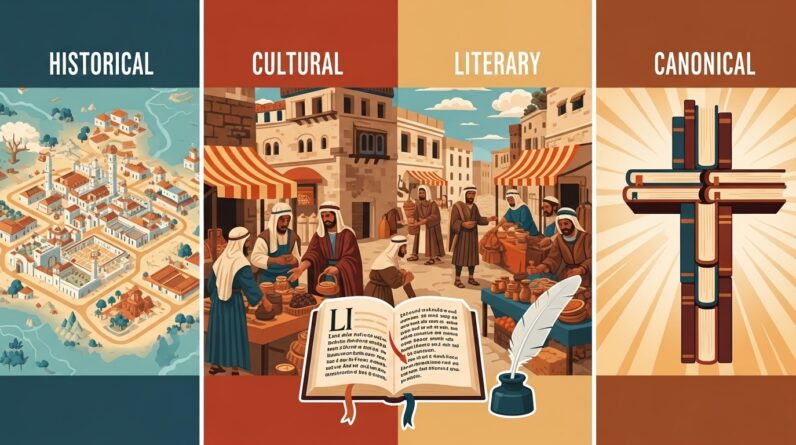


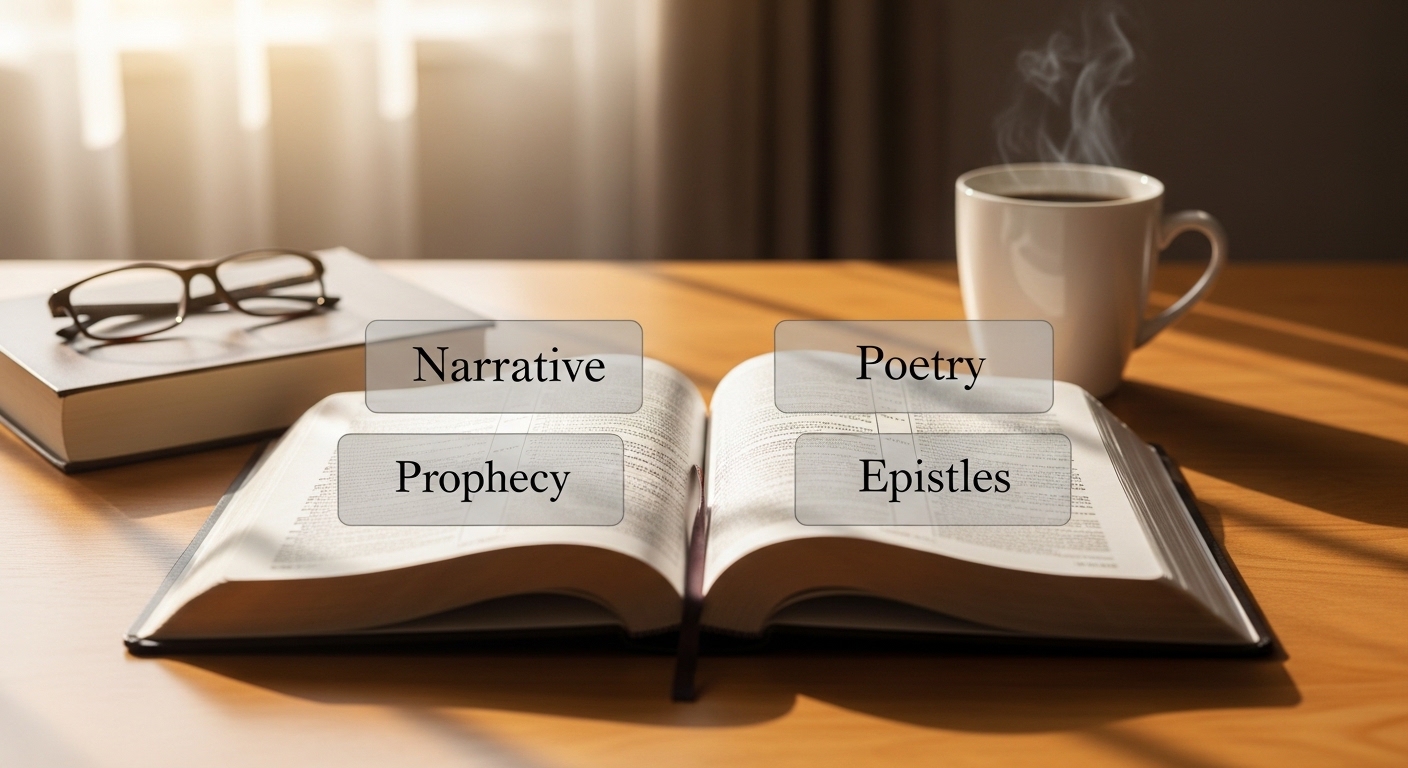
Not all parts of the Bible are read the same way. If you approach every passage as if it were a straightforward news report or a personal letter, you can easily miss what the original writers intended — and end up confused or misapplying Scripture. In this guide you’ll learn how to recognize the major Bible genres and how to read each in a way that helps you understand its original meaning and apply it wisely. You’ll also get practical reading tips, example walkthroughs, and resources to deepen your study.
Before we begin, remember that paying attention to genre is not about diluting spiritual truth. It’s about honoring the text’s form so you can hear its message clearly.

Why Genre Matters
When you read anything — a poem, a legal contract, or a novel — you read it differently depending on what it is. The Bible contains a mix of literary forms written across centuries, cultures, and languages. Each form shapes how the message is delivered. Ignoring genre can lead you to interpret metaphors as literal instructions, prophecies as modern predictions, or personal letters as universal rules without context.
Genre awareness protects you from misunderstanding, helps you draw accurate theology, and lets you apply Scripture more faithfully to life. As you learn to see the Bible’s genres, you’ll notice patterns: narrative scenes that tell God’s work in history, poems that express heart-level truth, prophetic messages that combine immediate address with future hope, and letters that coach churches on theology and practice.
Main Genres
Below are the primary Bible genres you’ll encounter most often. Each subsection explains what to look for and gives practical reading tips.
Narrative — History and Story
Narrative passages tell stories: they present events, characters, and sequences that shape the Bible’s historical frame. Books like Genesis, Exodus, the historical books (Joshua through Esther), and the Gospels are largely narrative.
How you should read narrative:
- Ask who is speaking and who is the audience.
- Look for plot, character development, and how events connect with God’s covenant purposes.
- Recognize that narratives show how people acted and how God worked; they don’t always give direct commandments for you to copy step-for-step.
Example: Genesis 1:1 is part of a larger creation narrative that sets the stage for the Bible’s story of God and creation. Read Genesis 1:1 in context rather than isolating it as a single proof-text. See Genesis 1:1.
Narratives help you understand the big picture — who God is, what he does, and how his people respond across history.

Poetry — Emotional and Symbolic
Poetry in the Bible uses parallelism, vivid imagery, metaphor, rhythm, and concentrated language to communicate truth. The Psalms, Song of Solomon, and many sections of the prophets contain poetry.
How you should read poetry:
- Pay attention to imagery and metaphor; don’t force a literal, physical interpretation when the poet intends symbolic or emotional meaning.
- Read aloud when possible — the cadence and repetition often reveal emphasis.
- Let the emotion guide you: poetry communicates heart-level truth (praise, lament, trust, anger, longing).
Example: Psalm 23:1 — “The Lord is my shepherd…” — is not a literal how-to guide for shepherding. It’s a poetic expression of trust and God’s caring provision. Read Psalm 23 as a metaphor for God’s relationship with you.
Poetry invites you to feel as well as think; it shapes devotion and honest expression before God.

Prophecy — Warnings, Covenant Address, and Future
Prophetic literature combines immediate prophetic address with covenant critique and, at times, future-oriented announcement. Prophets like Isaiah, Jeremiah, and Amos spoke into their communities about sin, judgment, hope, and restoration; they sometimes used symbolic actions and vivid imagery.
How you should read prophecy:
- Distinguish the near-term circumstance from long-term fulfillment. Many prophecies have an immediate application for the prophet’s audience and also point forward to broader fulfillment.
- Don’t assume every symbolic detail must be explained with a single modern or futuristic event.
- Identify whether the prophet is addressing Israel/Judah, surrounding nations, or the messianic hope.
Example: Isaiah 53 speaks to suffering and redemption in powerful poetic prophecy. Read it for its immediate message to Israel and its broader Christian interpretation about the suffering servant.
Prophecy often calls you to repentance and trust, reminding you that God is both judge and redeemer.

Epistles — Instruction and Theology
The New Testament epistles (letters) — such as Romans, 1 Corinthians, and Philippians — were written to specific churches or leaders to address theological errors, ethical problems, and pastoral concerns. They combine doctrinal teaching with practical application.
How you should read epistles:
- Identify the historical situation behind the letter. Paul’s instructions to Corinth addressed body-of-Christ issues that might differ from your context.
- Distinguish between timeless theological truth and culture-specific guidance.
- Pay attention to the flow of argument: epistles often have theological exposition followed by ethical response.
Example: Romans 12:2 gives practical guidance to live out transformation, but it is rooted in the theological argument built earlier in the letter. Read Romans 12:2 in the context of Paul’s larger teaching.
Letters are deeply practical; they aim to shape how you live in light of the gospel.
Other Common Forms You’ll Meet
While the four genres above are central, you’ll also see other literary forms. Recognizing them sharpens your interpretation.
- Law: Found in books like Exodus and Deuteronomy, laws are covenant stipulations for ancient Israel. Read them in their covenantal and cultural context. Example: Exodus 20:3 (the First Commandment).
- Wisdom: Proverbs and Ecclesiastes contain concise sayings and reflections on living well. Wisdom literature gives general principles rather than absolute promises. Example: Proverbs 3:5–6.
- Apocalyptic: Revelation and parts of Daniel use symbolic imagery to reveal God’s sovereignty over history. Read apocalyptic with attention to symbolism and the book’s original context. Example: Revelation 1:1.
Recognizing these forms helps you avoid forcing one genre’s rules onto another.
How to Identify Genre
You can learn to spot genres quickly by looking for clues within the text. Here are practical markers you can use.
Language and Structure
Poetry often features parallelism and concentrated lines. Narrative will have verbs and sequential events. Letters include greetings, thanksgiving, doctrinal sections, and ethical commands. Prophecy might include formulaic phrases like “This is what the Lord says” and symbolic actions.
Vocabulary and Tone
Legal sections use formal stipulative language. Wisdom literature uses maxims and general observations. Prophetic tone often includes indictment, lament, and hope. Pay attention to shifts in tone; sudden changes can signal a change in genre or a poetic section inside prose.
Historical and Literary Context
Look at where the passage sits within the book. A poetic psalm is likely self-contained; a prophetic oracle may be part of a broader indictment. The surrounding context often tells you whether the passage is narrative, poetry, prophecy, or a letter.
External Indicators
Consult chapter headings in your Bible (use cautiously — they’re modern), study notes, or a Bible dictionary. Tools such as a study Bible or commentaries will label genres and help you confirm your sense.
Practical Reading Strategies by Genre
You’ll want a slightly different approach to reading each genre. Below are actionable steps you can use next time you sit down with the Bible.
For Narrative
- Read the passage straight through to see the story arc.
- Identify the characters, their motives, and consequences.
- Ask how the narrative shows God’s character or covenant work.
- Be careful about drawing single-sentence commands from stories (ask why the author told the story).
Example: When you read the story of David and Goliath, notice how the narrative highlights faith, God’s sovereignty, and the dangers of pride — more than it performs as a “formula” for winning every conflict.
For Poetry
- Read slowly and aloud.
- Identify metaphors and images; ask what they reveal about God or the human condition.
- Embrace the emotion — poems season your spiritual life by giving language to feelings.
- Avoid forcing metaphors into literal categories.
Example: When you read Psalm 23, sit with the imagery (shepherd, valley, table) and let them shape your trust, not your agricultural practices.
For Prophecy
- Identify the original audience and historical circumstance.
- Separate immediate judgment or promise from later or ultimate fulfilment.
- Track symbolic language and ask what the symbols would mean to the original readers.
- Remember prophecy often calls for repentance and signals God’s long-term purposes.
Example: Many first-century readers would interpret messianic language differently from modern readers; check how Gospel writers quote Old Testament prophecy and how they interpret fulfillment.
For Epistles
- Read the introductory sections to understand the writer’s purpose and audience.
- Trace the theological argument before you apply concluding commands.
- Ask which commands are universal and which were tailored to a specific church problem.
- Compare parallel passages; Paul often addresses similar issues in multiple letters.
Example: When Paul writes about spiritual gifts to Corinth, note the particular dysfunctions he addresses. You can extract principles about unity and love even if the specific cultural expressions differ today.
Example Walkthroughs
Seeing the method applied step-by-step helps you practice genre-reading yourself. Below are short walkthroughs for four passages.
Psalm 23 (Poetry)
Step 1: Read aloud and note imagery — shepherd, green pastures, valley, rod, table. Step 2: Ask: What emotional state does the psalmist express? Trust and confidence in God’s care. Step 3: Avoid literalism — the psalm doesn’t command you to become a shepherd to know God. Step 4: Apply: What does God’s care mean for your anxieties today? Where do you need to trust his guidance?
Isaiah 6 (Prophecy and Vision)
Step 1: Recognize symbolic language — seraphim, coal, a holy throne. Step 2: Ask: Who is speaking and who is being commissioned? Isaiah’s vision leads to a prophetic call. Step 3: Distinguish the immediate call to serve Israel and the wider theological theme of holiness and forgiveness. Step 4: Apply: Consider your response to God’s call to speak his truth in your life and community.
John 3:16 (Gospel/Narrative + Theological Core)
Step 1: Recognize the setting — Jesus teaching Nicodemus at night. Step 2: Notice the theological summary: God’s love, giving his Son, belief, and eternal life. Step 3: Apply: What does belief mean in your context? How does the narrative show transformation?
Romans 12:2 (Epistle — Application)
Step 1: Read the surrounding argument: earlier chapters outline what God has done in Christ. Step 2: See Romans 12:2 as the ethical response to theological truths (renewal vs. conformity). Step 3: Apply: Map the command to renew your mind into practical disciplines — prayer, Scripture, community.
Common Mistakes and How to Avoid Them
You’ll grow quickly if you learn to sidestep frequent missteps many readers make.
Treating Poetry as Literal Instruction
When you interpret poetic images literally you can develop odd doctrines or personal rules that the text never intended. For instance, taking the shepherd image in Psalm 23 as a manual for animal care is a category error. Read poetry on its own terms.
Ignoring Context in Epistles
Pulling verses out of an epistle’s argument can create contradictions or legalism. Always ask how a verse fits into the larger section.
Reading Prophecy as Single-Event Prediction
Many prophecies have layered meanings — an immediate and a later fulfillment. Don’t force a single modern event as the only fulfillment without strong textual evidence.
Applying Narrative Commands as Universal Rules
Just because a Bible character acted in a certain way doesn’t mean you’re commanded to imitate that specific action; sometimes it’s an example to learn from, sometimes it’s a negative example to avoid. See the story’s theological point.
For more on common interpretive errors and how to correct them, check this article: Mistakes article.( to follow)
Tools to Help You Read by Genre
You don’t have to go it alone. Use these resources to confirm your genre identification and deepen understanding.
- A study Bible that labels literary forms and offers background notes.
- Bible dictionaries and handbooks explaining genre and historical context.
- Commentaries focusing on literary and theological interpretation.
- Online resources like Bible Gateway and Bible Hub (text search and cross-references).
- A parallel Bible or multiple translations to compare idioms.
- A good translation (NIV, ESV, NRSV) balanced between readability and accuracy.
When you encounter a difficult passage, check a reliable commentary or consult multiple translations. These tools will help you recognize whether you’re reading poetry, narrative, prophecy, or a letter.
How Genre Affects Application
Applying Scripture responsibly means combining genre awareness with theological reflection. The goal is not to reduce the Bible to a set of relevant proofs, but to see how God’s word shapes your life.
- With narrative, ask: What does this reveal about God, humanity, and God’s purposes? What principles for faith and character emerge?
- With poetry, ask: How does this shape my emotions, trust, and worship?
- With prophecy, ask: What does this demand in terms of repentance, justice, or hope?
- With epistles, ask: Which commands are timeless and which are culturally shaped? How do the theological cores translate into modern practices?
Application should be humble: you’re a reader trying to bring an ancient text into contemporary life — not an architect forcing the text to support your preferences.
Quick Checklist for Reading Any Passage
When you open a Bible passage, run through this mental checklist:
- Identify the genre (narrative, poetry, prophecy, epistle, law, wisdom, apocalyptic).
- Read the immediate context (a few chapters before and after).
- Note literary features (imagery, repeated phrases, structure).
- Ask historical questions (who, when, why).
- Consider theological themes and practical implications.
- Consult trusted resources for tricky passages.
This habit will save you from many interpretive pitfalls and deepen your confidence.
A Short Prayer
Take a moment before you read: ask for clarity, humility, and honesty. Prayer doesn’t replace careful reading; it prepares your heart to receive truth.
Heavenly Father, open my eyes to see your Word as it was meant to be read. Help me honor your voice, understand your truth, and apply it with wisdom and love. Amen.
Conclusion
Genre awareness prevents misunderstanding. When you learn to read narrative, poetry, prophecy, and epistles on their own terms, you’ll interpret Scripture more faithfully and apply it more wisely. The Bible is literary, historical, and theological — and reading it well honors the God who inspired it.
If you want to dig deeper, start by choosing a short passage and asking, “What genre is this? What is it doing?” Then read slowly, ask good questions, and use resources that respect both the text and its original context. You’ll be rewarded with clearer meaning and more meaningful application.
🔗 Understand the Genre—Then Understand the Bible Clearly
👉 Want the full beginner system? Start here first:
How to Understand the Bible (Simple Guide for Beginners)
👉 Still confused why verses seem unclear? This will fix it:
How to Study the Bible in Context (Beginner-Friendly Guide)
👉 Need a simple method to interpret any passage correctly? Don’t skip this:
Observe–Interpret–Apply Method (Step-by-Step Guide)
Suggested study resources:
- Study Bible (notes on genre)
- Bible Gateway for verse comparisons
- A trusted commentary for deeper background