



You try to pray—but your mind goes everywhere. You sit down, close your eyes, and somewhere between the third breath and the second sentence your grocery list, deadlines, or an argument from last week barges in. If you’ve asked yourself, “Why do I get distracted when praying?” you’re not alone. Distraction during prayer is one of the most common struggles people face, and it doesn’t mean you’ve failed spiritually. It usually means you’re human—and that attention needs training.
For many people, distraction is the number one reason they quietly give up on prayer.
This article helps you understand the root causes—mental, spiritual, and practical—and gives clear, friendly steps to help you pray with greater focus. You’ll find short routines, sample prayers, a structure you can use immediately, and a simple training plan you can follow week by week. By the end you’ll see that focused prayer isn’t a mysterious gift reserved for a few; it’s a skill you can cultivate.
You might describe this struggle in different ways:
• Why can’t I focus when praying?
• Why does my mind wander during prayer?
• How do I stop distractions when I pray?
These are all the same core issues—and they all have simple, practical solutions.
Quick Answer
You get distracted when praying because of mental overload, lack of structure, and untrained attention. If your mind keeps wandering during prayer, the solution is to use a simple structure (like ACTS), remove distractions, and practice shorter, focused prayer sessions consistently.
Frequently Asked Questions About Distraction in Prayer
Why does my mind wander when I pray?
Your mind wanders during prayer because your brain is used to constant stimulation and multitasking. When you slow down, your thoughts naturally surface. This isn’t failure—it’s normal. The solution is to gently refocus using simple structure, short prayers, or Scripture.
How do I stop getting distracted when praying?
You can reduce distractions by using a simple prayer structure (like ACTS), removing external interruptions (phone, noise), and starting with shorter prayer sessions. Consistency matters more than length.
Is it normal to feel distracted during prayer?
Yes, it’s completely normal. Even spiritually mature people experience distraction. Prayer is a skill that improves with practice, not perfection.
Does distraction mean my prayer isn’t working?
No. Distraction doesn’t cancel your prayer. What matters is returning your attention to God each time your mind wanders. That act of returning is part of spiritual growth.
What is the best way to focus during prayer?
The most effective ways to focus are:
– Use a structure like ACTS (Adoration, Confession, Thanksgiving, Supplication)
– Pray with Scripture
– Use short “breath prayers.”
– Keep sessions short and consistent
How long should I pray to avoid distraction?
Shorter prayers (5–10 minutes) are often more effective for focus, especially for beginners. If you’re unsure what works best, see How Long Should You Pray Each Day? for a practical guide.
Can I pray even if I feel distracted or unfocused?
Yes. You don’t need perfect focus to pray. Show up as you are, and keep returning your attention to God. Consistency builds focus over time.
What should I do when I keep thinking about other things while praying?
Write down distracting thoughts before or during prayer, then return your focus. You can also turn those thoughts into prayers—for example, if you’re worried about something, bring it directly to God.

Why distraction happens
Distraction during prayer is rarely one thing. It’s usually several layers: your brain’s wiring, your life’s rhythms, and sometimes spiritual or emotional barriers. Recognizing these layers helps you respond kindly and practically.
Mental overload
Your modern life pours content and tasks into your attention all day: email, notifications, responsibilities, news, and internal chatter. The brain’s attention system has limits. When you sit to pray, the “default mode network” or habit circuits often kick in, replaying worries, plans, or random thoughts. That’s normal. Your mind is built to process many signals; it doesn’t instantly switch to spiritual mode.
The good news is that attention is trainable. Practices that reduce mental load—like short pre-prayer breathing, writing down tasks beforehand, or a brief “brain dump”—give your working memory room to focus. Over time, these habits create a calmer baseline, so prayer becomes less interrupted.
No structure
If your prayer time is a free-floating stream of consciousness, your mind can drift and pick up any stray thought it finds. Structure gives the brain friendly boundaries. When you use a pattern—like the ACTS model (Adoration, Confession, Thanksgiving, Supplication), a Scripture reading, or a five-minute script—your attention knows what to do next. Structure doesn’t make prayer mechanical; it offers a scaffold that supports deeper focus.
Scripture itself points you toward ordered prayer—Jesus gives a clear instruction for focused, distraction-free prayer in Matthew 6:6. Structure helps you enter that private space with fewer interruptions.
Habit issues
Distraction is often a habit. If you grew up with hurried devotions, or if your only experience of prayer was a rushed one before bed, your nervous system associates prayer with distraction and incompletion. Habits can be changed, but it requires repeated, small choices: consistent time, place, and a simple routine. You rewire your attention by doing small things consistently until a new habit forms.
Also, emotional states—shame, unresolved anger, fear—can hijack your prayer. Those feelings are real and need to be named and addressed. Prayer time can become a safe place to bring those emotions, but sometimes you need additional steps (journaling, therapy, or a trusted conversation) to clear the clutter that keeps returning.
If inconsistency is your main struggle, learn how to build a repeatable rhythm in How to Start Praying Consistently.

3 Proven Ways to Stop Getting Distracted in Prayer
The solutions blend spiritual practices, practical changes, and small cognitive tools. You don’t need to overhaul your life overnight. Start with one or two changes and be gentle with yourself.
1. Use structure
Structure is a prayer friend. It helps you move from scattered beginnings to focused conversation.
- How to Pray Effectively
Begin by choosing a simple pattern and commit to it for a few weeks. Here are three structured approaches you can use immediately:
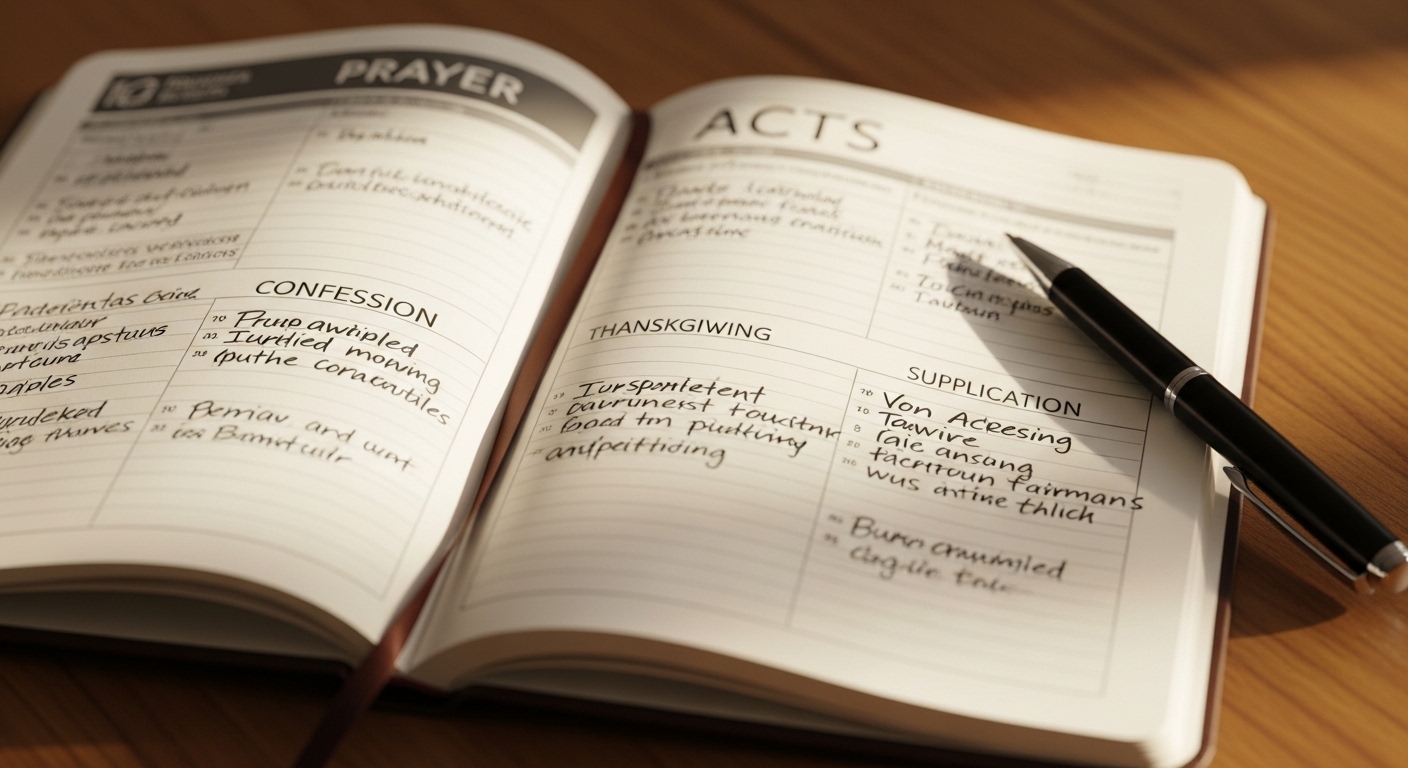
- ACTS (Adoration, Confession, Thanksgiving, Supplication)
- Adoration: Start by praising God for who He is. Focusing on attributes (goodness, faithfulness, love) draws your attention away from you and onto God.
- Confession: Name what’s getting in the way—unforgiven anger, pride, distractions—and ask for help.
- Thanksgiving: List things you’re grateful for. Gratitude narrows attention and reduces anxiety.
- Supplication: Bring your requests and the needs of others before God.
When you follow ACTS, your mind flows predictably. You won’t need to invent what to say next, and that reduces wandering.
- Scripture-Guided Prayer (Lectio Divina—simple version)
- Read a short passage slowly (one or two verses).
- Pause and let a single phrase catch your attention.
- Meditate on that phrase and speak a short prayer about it.
- Respond in a sentence and close with gratitude.
Using Scripture centers your prayer on God’s words rather than your own anxious thoughts. For encouragement about God’s presence and guarded peace, consider Isaiah 26:3.
- Breath-Prayer and Timed Focus
- Choose a short phrase (e.g., “Lord, be my peace”).
- On the inhale, say the first half; on the exhale, say the second half.
- Continue for 3–5 minutes, then move into a short ACTS or Scripture prayer.
Timed focus helps your mind accept limited, contained intentionality. Start small—3–5 minutes—and build up.
- Sample 10-minute Script
- Minute 0–1: Settle and breathe; name one thing on your mind and set it down on paper.
- Minutes 1–3: Read a short Psalm (e.g., Psalm 46:10) and let one phrase sink in. See Psalm 46:10.
- Minute 3–6: ACTS—Adore for one minute, confess for one minute, give thanks for one minute.
- Minute 6–9: Pray for specific requests (yours and others’).
- Minute 9–10: Close with a short trust statement (e.g., “I trust you, Lord”) and a breath.
Structure doesn’t remove authenticity; it channels it. If your mind wanders, gently bring it back to the next step.
If you need a complete system, follow How to Pray Effectively (Biblical Method That Works).
2. Shorten your prayer
Long prayers aren’t necessarily better. Sometimes shorter, repeated prayers are more effective because they fit how attention naturally works.
- Daily Prayer Routine
You can build a rhythm using short prayer windows throughout your day rather than one long stretch. Small pockets of intentional prayer keep you connected and reduce pressure for a “perfect” longer session.
Here’s a sample micro-prayer rhythm you can adopt:
- Morning (2–5 min): A breath prayer and a single Scripture (e.g., Philippians 4:6-7) to start the day with peace.
- Midday (1–3 min): A gratitude list or “help” prayer for the tasks ahead.
- Afternoon or commute (1–3 min): A breath prayer to reset focus.
- Evening (5–10 min): A short review—thanksgiving, confession, requests.
Micro-prayers are flexible and meet you where you are. Over time, they build attention muscles. Jesus also modeled an economy of words in prayer, showing that concise, heartfelt prayer is powerful (see Matthew 6:6).
- Breath prayers and single-phrase prayers
These are especially useful when distraction seems inevitable. Choose a phrase tied to Scripture or an attribute of God and repeat it rhythmically. For example:
- “Lord, be my peace” (inhale: “Lord,” exhale: “be my peace”)
- “Jesus, have mercy” (inhale: “Jesus,” exhale: “have mercy”)
Repeating a simple phrase anchors attention because it pairs breath, body, and speech—multiple channels the brain uses to focus.
If you’re unsure how long to pray, see How Long Should You Pray Each Day? for a practical guide.

3. Remove distractions
Environment matters. Your physical space, devices, and the cues around you strongly affect attention. Make your prayer place as inviting as possible.
- Physical setup
- Choose a quiet corner or a consistent chair. When your body learns the location, your mind learns that this place is for prayer.
- Minimize clutter. A clear surface, a closed notebook, or a single candle can signal “this is prayer time.”
- Consider posture—sitting upright, kneeling, or walking—whichever helps you remain alert without strain.
- Digital hygiene
- Turn your phone to Do Not Disturb or airplane mode. If you need a timer, set it and place the device face down.
- Remove open tabs or apps that trigger your attention.
- If you use music, pick quiet instrumental or ambient tracks—avoid lyrics that compete with your internal prayer words.
- Sensory anchors
- Light a candle, use a textured cloth, or hold a small object (a smooth stone or rosary) to give your hands something simple to do. Anchors reduce mind-wandering by providing a tactile focus.
Environment alone won’t fix everything, but it creates the conditions that allow structured prayer and shorter forms to succeed.

Simple Tools to Train Your Focus
Beyond structure and environment, a few specific tools will accelerate your progress.
The 10-5 Rule: Ten breaths, five minutes
Before you start speaking, take ten slow breaths. If distraction still rises quickly, give yourself five focused minutes of any of the routines above. Small wins compound: five minutes done calmly today makes it easier to do six tomorrow.
Journal before you pray
Spend two minutes writing everything on your mind. This “brain dump” reduces intrusive thoughts—your worries won’t feel like they need to invade prayer if they’re acknowledged on paper. Then fold the paper or place it beside you and start your prayer structure.
Use Scripture as your guide
When you feel lost, read a verse and make it your prayer seed. Scripture frames your language and keeps you from becoming self-absorbed. Try praying a Psalm aloud, then respond to it with your own words. For example, pray through Psalm 23:1 or read and respond to Philippians 4:6-7 for anxiety.
Accountability and small groups
Prayer partners or small groups create invitations to focus. When someone meets with you or holds you accountable, you form a pattern that’s easier to maintain. You don’t need perfection—just a reliable rhythm.
Apps and tools—with guardrails
Prayer apps can help you set reminders, structure prayers, or keep request lists. Use them intentionally: set them to help, not distract. Turn off notifications except for scheduled reminders.
Troubleshooting common roadblocks
Even with good habits, old obstacles pop up. Here’s how to work through them.
Your mind races with tasks
If to-dos keep dominating, use the journal dump before prayer and write an action: “Today, I will…” That frees mental energy. If interrupting thoughts are recurring (e.g., “I forgot to call X”), designate a single line in your journal labeled “post-prayer tasks” and add it there.
You feel guilty or unworthy
Shame and perfectionism are counterfeit distractors. When they arise, name them quickly: “I feel guilty that I’m distracted.” Then pray a short confession or a breath prayer asking for mercy. Remember that prayer is a space of grace—see Colossians 3:2 for the invitation to set your mind on higher things.
You’re exhausted or burned out
Distraction can be the body’s cry for rest. Prioritize sleep and Sabbath rhythms. Sometimes the best prayer is simply resting in God’s presence—being still. The psalmist’s command, “Be still, and know that I am God,” points you to a posture of restful attention: Psalm 46:10.
You keep returning to the same worry
If a specific anxiety repeats, respond to it directly. Pray Scripture over it, journal what you can control, and take small practical steps. You may also need to talk with a pastor, counselor, or friend for deeper support. Remember that prayer and action go together—God often invites you into practical steps as part of prayer.
A 30-day training plan to strengthen focus
Building focus takes time. Here’s a gentle 30-day plan you can adapt.
Week 1: Foundation
- Days 1–3: Choose a place and a two-minute breath prayer twice a day.
- Days 4–7: Add a daily five-minute structured prayer (use the 10-5 Rule + ACTS).
Week 2: Consistency
- Days 8–14: Keep the five-minute prayer and introduce a Scripture seed each day (one verse to meditate on). Write one sentence after prayer about what you sensed.
Week 3: Expansion
- Days 15–21: Increase one session to 10 minutes (morning or evening). Add a short journal dump before this session. Share your progress with a friend or partner.
Week 4: Deepening
- Days 22–28: Practice two micro-prayer windows (midday and evening), continue the 10-minute session, and add a sensory anchor (candle or stone).
- Days 29–30: Reflect on progress. Write what worked and what didn’t. Celebrate small wins.
The goal is consistent exposure, not perfection. If you miss a day, begin the next morning again without shame.
Sample prayers and phrases to use
If you struggle to find words, these short prayers will help you start and keep focus.
- Breath prayer (3–5 minutes): “Lord Jesus, be with me.”
- Morning anchor: “God, give me clarity and peace today.”
- When anxious: “Father, I give you this worry; fill me with your peace” (see Philippians 4:6-7).
- For focus before work: “Lord, guide my hands and mind today.”
- Short confession: “Lord, forgive me for where I turned away. Help me return.”
Keep these short phrases handy—write a few on a card in your prayer spot. Your attention will latch onto them faster than long monologues.
You can also use ready-made examples from Short Prayers for Beginners.
Spiritual perspective: distraction doesn’t equal failure
Spiritually, wandering thoughts in prayer are not unusual. The Apostle Paul’s instruction to “pray continually” acknowledges a rhythm of ongoing dependence rather than uninterrupted monologue (see 1 Thessalonians 5:17). That doesn’t mean constant vocal prayer all day, but cultivating an awareness of God’s presence in the midst of ordinary life.
When distractions come, gently redirect. Jesus’ model in Matthew 6:6 invites you to private, sincere prayer rather than public performance—prayer that is honest about weakness and persistent in turning back to God (Matthew 6:6).
Short Prayer
🙏 Lord, help me come into your presence with honesty and calm. When my mind wanders, gently bring me back and teach me to rest in you. Give me patience with myself as I learn to focus. Amen.
Conclusion
Focus in prayer is not automatic; it’s trained. With simple structure, shorter and more frequent prayers, an uncluttered environment, and consistent practice, you’ll find your prayer life growing in depth and clarity. Start small, be kind to yourself, and remember that distraction is often a sign of being human rather than a sign of spiritual failure. Keep practicing—God meets you in the turn of attention.
If you want to go deeper, continue here:
• Learn the full foundation: How to Pray (Step-by-Step for Beginners)
• Build consistency: How to Start Praying Consistently
• Fix deeper issues: Why Is My Prayer Not Working?