


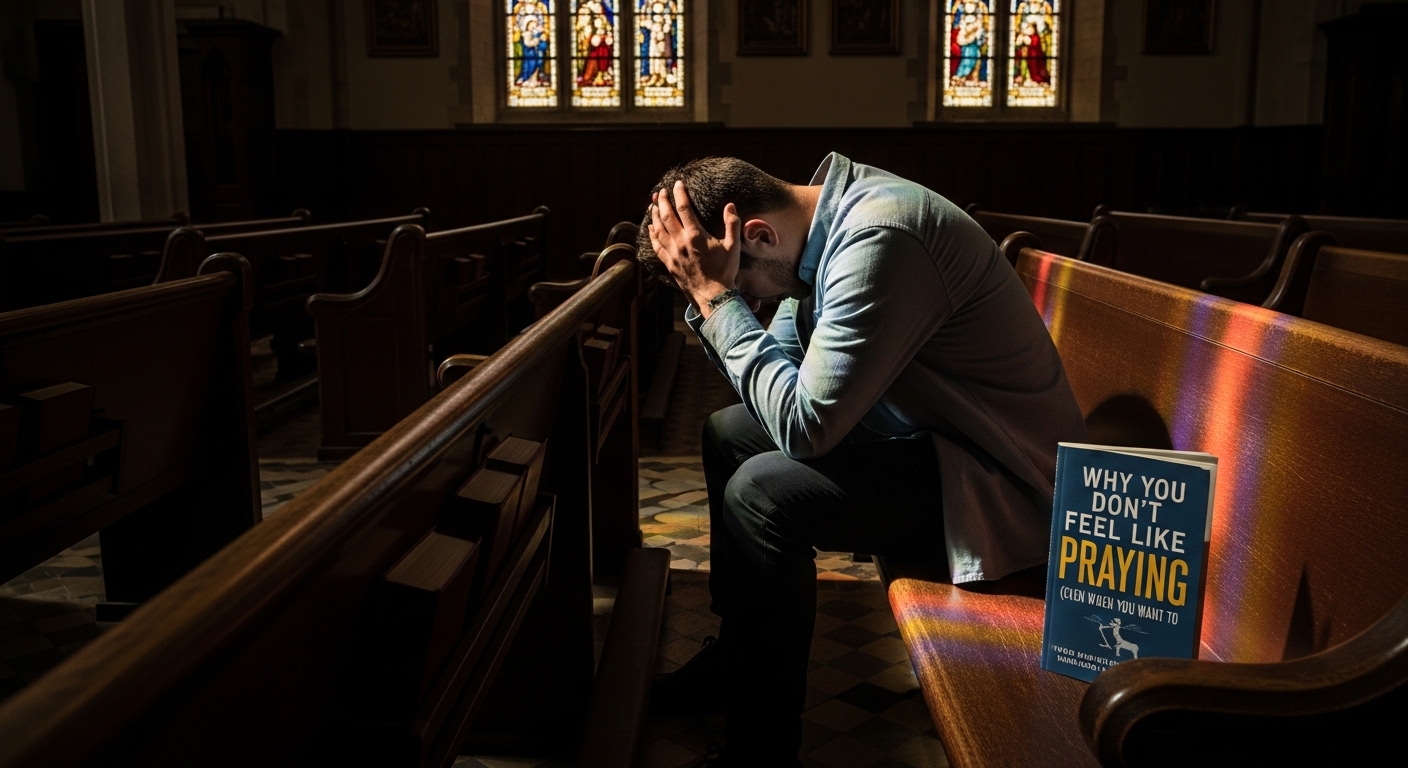
You want to pray—but when you try, something feels off.
Maybe you feel:
- emotionally flat
- spiritually distant
- distracted
- or simply unwilling, even though you want to want to pray
This can be confusing and even discouraging.
If that’s your experience, you’re not alone—and it doesn’t automatically mean something is wrong with your faith.
This article helps you understand the real reasons behind prayer resistance, so you can respond with clarity instead of shame.
It is not a step-by-step guide. It is an explanation of what’s happening beneath the surface.
If you want practical next steps after understanding this, see:
👉 What to Do When You Don’t Feel Like Praying (Simple Steps for Dry Seasons)

You’re Not Alone in This Experience
Feeling distant from prayer is not unusual.
Even strong biblical figures experienced seasons of dryness and emotional distance:
- David expressed emotional heaviness in the Psalms
- Jesus’ disciples struggled with spiritual fatigue in prayer (Matthew 26:40–41)
- Paul acknowledged human weakness in prayer life (Romans 8:26)
The Bible does not present prayer as always emotionally easy.
Instead, it presents prayer as faithful relationship across changing seasons.
Recognizing this removes shame and helps you see your experience more clearly.

Why You Don’t Feel Like Praying (Quick Overview)
Common reasons include:
- Spiritual dryness or emotional distance from God
- Guilt, shame, or unresolved sin
- Emotional exhaustion or mental fatigue
- Distraction and constant busyness
- Doubt or unanswered prayers
- Unrealistic expectations or comparison
These often overlap.
Understanding them helps you respond wisely instead of reacting emotionally.
The Real Reasons Why You Don’t Feel Like Praying
Below are several common root causes—spiritual, emotional, and practical—that explain why you don’t feel like praying even when you want to. Each one can stand on its own or overlap with others. The goal here is to help you recognize patterns so you can see what’s happening inside you without rushing to quick fixes.
1. Spiritual dryness or a sense of distance from God
Sometimes your soul experiences a season where God’s presence, which once felt vivid, seems faint. Spiritual dryness isn’t necessarily a punishment—often it’s part of God’s refining work. St. John of the Cross and other spiritual writers called this the “dark night of the soul,” a time when consolations are reduced so you learn to love God for who He is more than for what you feel. The Psalms speak honestly about feeling far from God even while longing for Him: “Why, my soul, are you downcast?” speaks to this paradox of desire amid dryness.
You might interpret dryness as loss of faith, but Scripture invites a broader framing: God permits times of testing and hiddenness to deepen dependence and produce perseverance. Look at Abraham’s waiting, or the silence that preceded prophetic revelation in the Old Testament. These silent seasons can be formative even when they feel empty. Understanding dryness as a possible spiritual workshop can help you remove the added burden of self-blame, though it won’t instantly make the feelings fade.

2. Unresolved guilt, shame, or conscious sin
If you’re carrying unresolved sin, deep guilt, or shame, your heart may recoil from intimacy with God. Prayer can feel risky when you suspect your heart is unclean. David’s confession in Psalm 51:10 shows that sin creates an inner barrier—he asks God to create in him a clean heart because the sense of guilt had cut off his free worship. When you feel unworthy, you may avoid prayer rather than expose your brokenness.
This avoidance is not merely moralism; it’s psychological self-protection. Facing God with your sin can feel like confronting an accusing prosecutor—so you keep silent. Yet Scripture repeatedly calls sinners into God’s presence for mercy rather than condemnation. Even so, the emotional reality of shame can make prayer arduous and uncommon. Naming the shame and seeing how it functions as a barrier is an important part of understanding why you don’t feel like praying.
3. Emotional exhaustion, depression, or grief
Your emotional state has a profound effect on your spiritual life. Depression, chronic anxiety, or recent trauma can blunt your desire and capacity to pray. When your energy is drained and cognition is foggy, prayer can feel like an added burden rather than a refuge. The Bible recognizes seasons when the soul is weary. The psalmist says, “My soul is cast down within me; therefore I remember you…”—an honest portrayal of mood affecting spiritual memory.
Medical and pastoral realities both matter here. Depression isn’t simply spiritual failure; it’s a condition that affects neurotransmitters, sleep, appetite, and motivation. Grief after loss can stall prayer for a season as you process sorrow. You might still long for God but lack the psychological fuel to reach him in the ways you used to. Recognizing emotional exhaustion as a major cause helps you stop conflating spiritual dryness with moral failure.

4. Distraction, busyness, and fragmented attention
Modern life fragments attention. Your day is filled with notifications, work demands, family duties, and the small urgencies that crowd out quiet. Prayer requires attention and, often, solitude. When your life is a constant motion machine, your mind may be trained away from stillness and from the habit of turning to God. Jesus taught about hidden prayer: “But when you pray, go into your room, close the door and pray to your Father, who is unseen.” The instruction highlights attention and intentionality—things that busyness erodes.
Beyond busyness, the modern habit of multitasking trains your brain to flit rather than to dwell. Prayer isn’t always about long sessions; it’s about presence. But presence is hard to access when you’ve become accustomed to fragmented attention. Over time, the habit of distraction can diminish the felt need to pray; you simply don’t perceive the space from which prayer would naturally arise.

5. Doubt, theological struggle, or unanswered prayer
Doubt is a normal part of faith, not its opposite. Yet when doubt lingers—about God’s goodness, about prayer’s efficacy, or about God’s sovereignty—it can dampen your desire to pray. Repeatedly unmet expectations—prayers left seemingly unanswered—can deepen theological wrestling.Jesus modelled honest wrestling in Gethsemane, showing that wrestling and questioning are part of faithful relationship. Paul acknowledged that we don’t always know how to pray and that the Spirit intercedes for us: “Likewise the Spirit helps us in our weakness.”
Doubt may look like intellectual questions, but it often expresses itself emotionally: hesitation, fear, or cynicism about prayer’s value. You might worry that prayer changes nothing, or that your needs are too small or too messy. Those wounds reduce the felt warmth for prayer and can make it seem pointless. Recognising doubt as an honest indicator of deeper questions helps you take it seriously without letting it become a reason to withdraw permanently.
6. Unmet expectations, perfectionism, or spiritual comparison
If you expect your prayer life to look like someone else’s Instagram feed—a steady stream of ecstatic mornings, perfect phrases, and consistent discipline—you’ll feel inadequate when yours doesn’t measure up. Perfectionism and comparison are lethal to honest prayer. You may avoid prayer because you believe it must look or feel a certain way. Unmet expectations—about frequency, depth, or the emotional tone of prayer—can create anxiety that chokes off desire.
Scripture warns against public spirituality for reputation’s sake—Jesus criticized those who pray for the show. “When you pray, don’t be like the hypocrites…” But the quieter, internal pressure to perform or to match a model can be just as paralyzing. If you’re measuring yourself against others or an ideal that doesn’t account for your season, you’ll likely feel resistant to prayer—not because you don’t want God, but because you’re afraid your prayer won’t be acceptable.
Why Understanding Your Struggle Matters
Understanding the reasons behind prayer resistance helps in three ways:
- It removes false guilt and shame
- It helps you respond appropriately instead of forcing change
- It protects your relationship with God during difficult seasons
Different causes require different responses. Without understanding, it’s easy to misinterpret your experience or apply the wrong solution.
Scripture often shows people naming their condition before experiencing renewal (see Psalms of lament).
Understanding is not the end—it is the beginning of clarity.
👉 Related Prayer Help Guides
If you want to take the next step:
- What to Do When You Don’t Feel Like Praying
- How to Start Praying Consistently
- Simple Daily Prayer Routine (5–10 Minutes That Actually Works)
- How to Hear the Holy Spirit
That guide will walk you through gentle, realistic steps based on what you’re experiencing—so you can begin again without pressure or overwhelm.
🌿 Optional Reflection
Prayer also shapes how we see and honor the people around us.
If you want a reflection on gratitude, family, and faith, you may also read:
Mother’s Day Devotional: Honoring Moms With Scripture, Prayer, and Gratitude
Understanding Is the First Step Forward
When you understand why prayer feels difficult, you stop interpreting your experience as failure.
Instead, you begin to see it as:
- a season
- a condition
- or a mixture of emotional and spiritual factors
This clarity creates space for gentle restoration instead of pressure.
Conclusion
You are not failing God by struggling in prayer.
You are experiencing something deeply human.
Whether the cause is emotional, spiritual, or practical, naming it is already a step toward healing.
God is not distant from your struggle—even when prayer feels distant to you.
If anything, your awareness of the gap is itself a sign that your heart is still reaching.
Let this understanding guide you gently toward the next step, without shame or pressure.
🙏 Short Prayer
Lord, you know the places in my heart that feel dry, weary, or ashamed. Meet me in my silence. Hear the longing I cannot name, and hold me in your mercy. Help me to see the reasons I struggle without despair, and give me patience as I wait for renewal. Teach me to trust you when feelings fail and to rest in your unchanging love. Amen.