


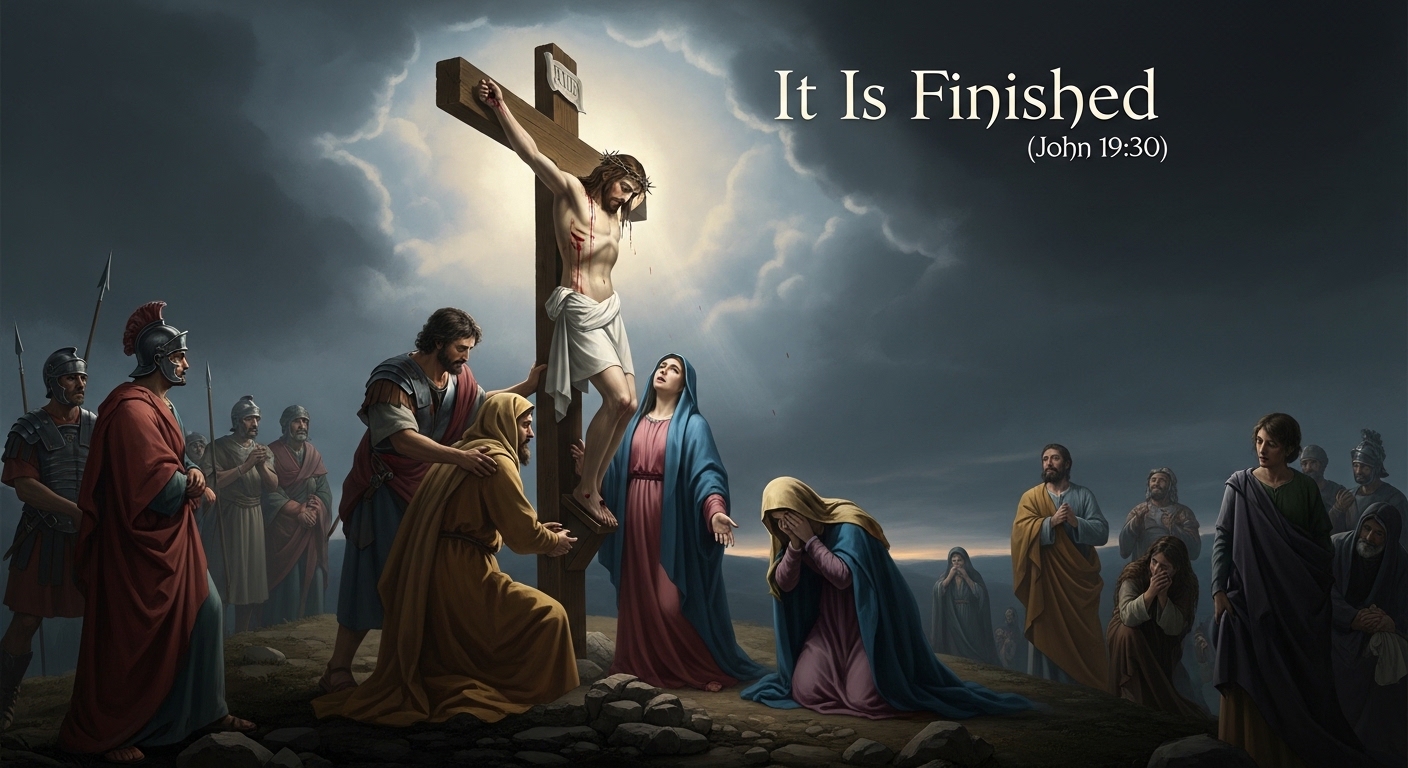
Devotional 1 — “Finished” as Fulfillment and Completion
Intro
You’ve likely heard Jesus’ last words on the cross: “It is finished.” Those three words have weight, depth, and a lifetime of meaning packed into them. They weren’t an aside or a surrender; they were a declaration. When you slow down and listen, those words reshape how you think about suffering, sin, and God’s work on your behalf. In this devotional, you’ll explore what “It is finished” meant in history and how it changes your life today.

Meaning
When Jesus said, “It is finished,” He wasn’t talking about dying as though it were the end of a failed project. Instead, He announced the completion of a purposeful work — the work God sent Him to do. Read the moment in Scripture: John 19:30. The original Greek word translated “finished” (tetelestai) was used in business to mark a debt as fully paid. That image helps you grasp the radical truth: the debt that sin had created — your debt and the world’s debt — has been addressed by Jesus’ sacrifice.
This completion is also the fulfillment of prophecy and promise. Centuries earlier, the suffering servant had been described as one who would bear transgressions and bring righteousness (see Isaiah 53:4–6). Jesus’ words tie His suffering to God’s redeeming plan. In the New Testament, writers reflect back on this completion as decisive: Jesus’ one offering purified and secured you (see Hebrews 10:10). The cross wasn’t the end of a story that needed more pages to be finished later. It was the pivot — an accomplished act that changed everything.
You also see in this declaration the idea of satisfaction. God’s justice and mercy meet at the cross. Colossians explains how Jesus canceled the record of legal demands against you and nailed it to the cross (Colossians 2:14). That doesn’t minimize your need for repentance or the call to follow Him. It does mean that the core problem — your separation from God because of sin — has a decisive solution in Christ.
Application
So how does this ancient declaration shape your everyday choices? First, rest becomes a spiritual discipline for you, not an optional luxury. If the core work of your salvation is already finished, you can learn to live out of rest rather than constant anxious striving. Practically, that might look like starting your day with a five-minute reminder: “It is finished,” followed by a short breath prayer or quiet reading of John 19:30. Use this truth to calibrate your efforts. Work hard at your job, your relationships, and your faith, but do so as someone whose acceptance before God does not hinge on performance.
Second, confession and honesty with God flow out of trust rather than fear. Because Jesus has paid the debt, you can bring your regrets and failures to God without crafting a checklist to earn mercy. Practice immediate, brief confession when you blow it, saying something like, “Lord, I’m sorry; thank you that it’s finished.” This keeps you honest and humble, and it’s liberating.
Third, live in gratitude that fuels obedience. If finishedness removes the burden of earning salvation, it frees you to serve joyfully. Let gratitude move you toward small, concrete acts: a forgiving phone call, a patient conversation, a sacrificial gift. The cross’s completion invites you to say no to performance-based faith and yes to service that springs from thankfulness.
Finally, let the finished work inform how you handle doubt and fear. When anxiety tells you that you don’t measure up, counter it with truth: “It is finished” and then cite a related verse like Romans 8:1 — there is no condemnation for you. Keep a sticky note of one or two promises and read them when your mind spirals.

Prayer
Lord, thank you that the work of redemption is finished in Jesus. Help me receive that truth—not as a slogan but as the reality that frees me to rest, confess, and serve. When I’m tempted to prove myself, remind me of the cross. Teach me to live from completion, not from compulsion. Amen.
Devotional 2 — “Finished” and Your Identity in Christ
Intro
You live in a world that defines you by lists, likes, and achievements. It’s exhausting. The word “finished,” spoken by Jesus, is an invitation to anchor your identity somewhere solid. In this devotional, you’ll explore how the finished work of Christ reorients who you are — not by what you do, but by what has already been done for you.
Meaning
“It is finished” settles the most fundamental question about your status before God. Because of Jesus’ completed work, you aren’t primarily what you accomplish; you are a beloved child of God. The New Testament writers repeatedly point to the certainty of that status: because Jesus offered one perfect sacrifice, you are made holy (see Hebrews 10:14). Because Christ declared completion, the legal accusations that once condemned you have lost their force. As Romans 8:1 says, there is no condemnation for those in Christ Jesus.
Look at Colossians for the business-like language: your record of debt, with its list of demands, was cancelled and removed through the cross (Colossians 2:14). The forensic imagery is clear — your guilt accounted for, your slate wiped clean. That affects daily living. It means you can approach God with confidence, admit your weaknesses without fear of rejection, and embrace a new identity rooted in grace.
Moreover, finishedness guarantees transformation. The work God began in you is not left incomplete. Paul writes that God will carry it to completion (Philippians 1:6). The cross begins a creative process: you are being made more like Jesus, not by your unaided effort, but through the Spirit’s work in a life shaped by the finished work.
Application
How do you internalize your new identity? Start with small, practical rhythms that remind you of truth.
- Reframe your self-talk. When your inner critic lists what you haven’t done, stop and speak a short corrective: “I’m forgiven; it is finished.” Pair that with a Scripture, like Romans 8:1 or Colossians 2:14. Repetition rewires you.
- Anchor decision-making in identity, not opinion polls. When you’re tempted to chase validation, ask: “Does this align with the fact that I’m loved and forgiven?” If yes, proceed with humility; if no, step back and pray.
- Cultivate a gratitude habit focused on being, not doing. Each evening, list three things you are grateful for that aren’t achievements — family, a neighbor’s kindness, God’s presence. Let gratitude affirm your worth apart from performance.
- Join a community that echoes grace. It’s easier to believe your true identity when others reflect it back to you. Share struggles and truths in safe spaces where people point you to the finished work rather than to lists of rules.
These steps are practical and doable. They reshape how you respond to criticism, failure, and success. When your identity rests in the finished work, you act from freedom rather than compulsion.

Prayer
Father, help me believe the identity I already have in Christ. Break the chains of performance that shape my self-worth, and remind me daily that because Christ’s work is finished, I am loved, forgiven, and being renewed. Give me the courage to live from that truth and to encourage others with it. Amen.
Devotional 3 — “Finished” and Everyday Mission
Intro
You might wonder how a declaration of completion translates into mission and service. If the core work is finished, why does service matter? In this devotional, you’ll see that the finished work doesn’t stop God’s activity — it launches it. Your everyday faith is shaped by both rest and responsibility, and “It is finished” is the foundation for faithful, joyful action.
Meaning
Jesus’ proclamation on the cross was not a call to passivity. When He said “It is finished” (John 19:30), it completed the atoning work that makes your mission possible. Because sin’s penalty has been paid, reconciliation is available. Because Jesus triumphed, the church can move forward with confidence (see Colossians 2:15). The gospel is not merely personal therapy; it changes how you engage your neighbor and your world.
Jesus Himself connects completion to mission in other ways. He spoke of finishing the work the Father gave Him (John 17:4), and He sends you into the world with a purpose grounded in that finished work. The cross accomplishes redemption, and redemption propels witness, mercy, and justice. So “It is finished” means you are freed to serve without the weight of saving yourself by your service.
At the same time, the finished work empowers your perseverance. When suffering or setbacks come (and they will), remember that Christ suffered and finished for a city of souls, and He sustains you through trials (1 Peter 2:24). Your labor in the Lord is not in vain because the One who began a good work in you will bring it to completion (Philippians 1:6).

Application
How does this shape your everyday mission?
- Start small and steady. You don’t need grand strategies to live out the finished work. A neighborly text, a patient commute, consistent kindness at work — these are kingdom acts. Make a simple plan for one small act of service each day and follow through for a month. You’ll find momentum grows.
- Serve without seeking approval. Because your worth isn’t validated by outcomes, you can do good for its own sake. Practice giving anonymously once in a while, or help someone without broadcasting it. Let your reward be in God, not in likes or recognition.
- Use the finished work as a conversation starter. When you share your faith, you aren’t presenting a checklist; you’re extending an invitation to something already completed for those who accept it. Try a gentle bridge sentence: “What I love about Jesus is that He did the hard work so we don’t have to earn our way to God.” Then listen.
- Persevere in hardship by remembering the finish line is sure. When ministry feels draining, return to Scripture and prayer that anchor you in the finished work. Read passages like Hebrews 12:2 and Philippians 1:6 to renew perspective.
By acting from rest and for others, you participate in the ongoing outworking of what Christ completed on the cross. Your mission is not to add to His work but to make it known, visible, and lived out in everyday ways.
Prayer
Jesus, thank you that what You completed on the cross empowers my mission. Help me serve in humility and confidence, knowing I don’t need to save myself by my efforts. Use my small, everyday acts to point others to the finished work and to bring glory to You. Strengthen me to persevere when the work is long, and fill me with joy as I participate in Your ongoing mission. Amen.