

Children can memorize nine words surprisingly quickly:
Love.
Joy.
Peace.
Patience.
Kindness.
Goodness.
Faithfulness.
Gentleness.
Self-control.
But knowing the words is only the beginning.
The bigger question is:
How can we help children understand what the Fruit of the Spirit actually looks like in everyday life?
What does patience look like when a brother takes your toy?
What does kindness look like when someone at school is sitting alone?
What does self-control look like when you are angry?
What does faithfulness look like when nobody is watching?
And most importantly:
Where does this kind of character come from?
The Bible teaches that the Fruit of the Spirit is not simply a list of nine rules children must work harder to obey.
It describes what the Holy Spirit begins producing in the lives of people who belong to Christ.
That makes Galatians 5:22–23 an excellent passage for family devotions, children’s church, Sunday school, homeschool Bible time, and conversations between parents and children.
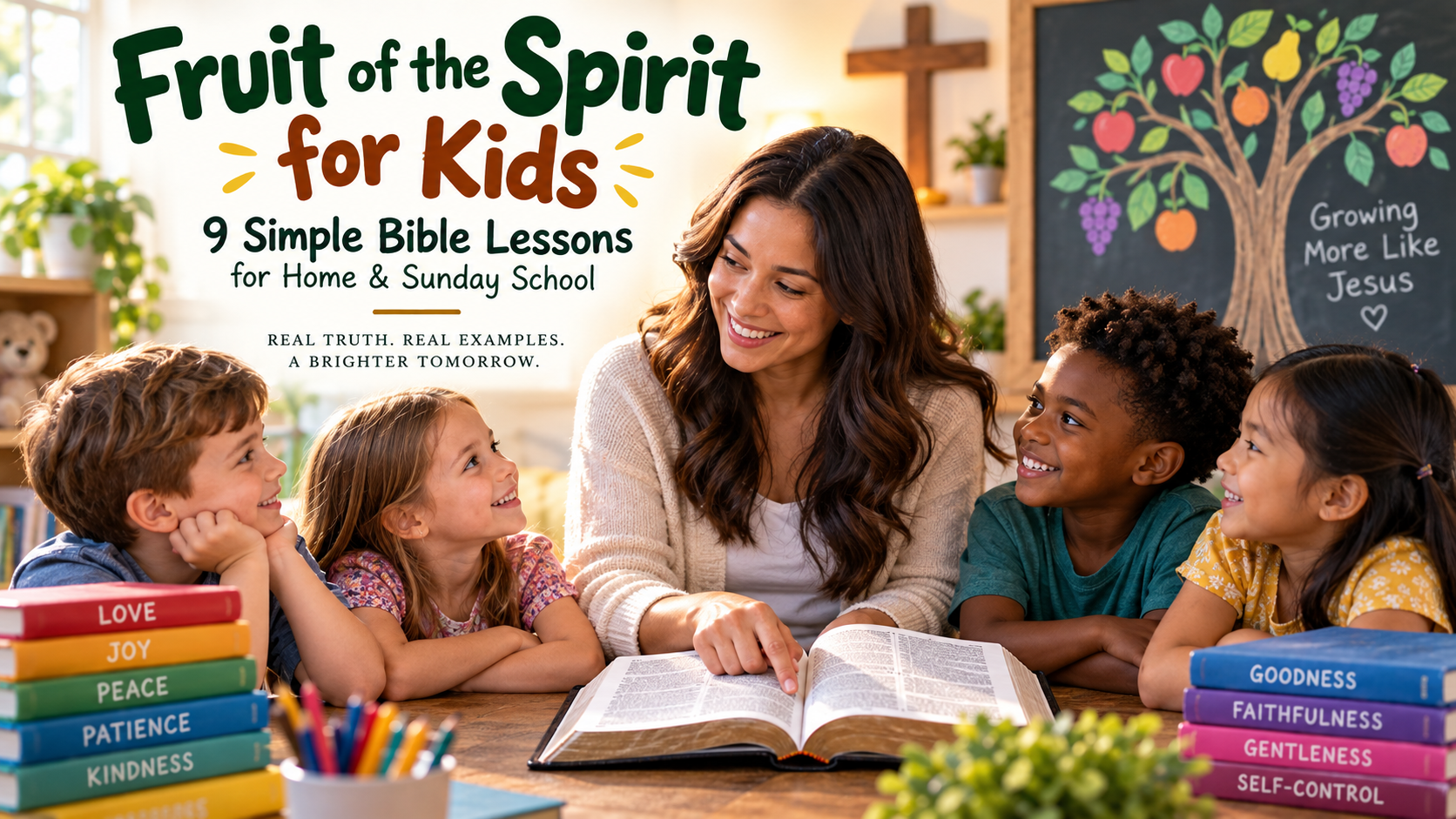
This guide gives you nine simple Bible lessons—one for each quality of the Fruit of the Spirit—with a Bible story, child-friendly explanation, discussion question, and practical activity.
Start by Reading Galatians 5:22–23
Before teaching the individual qualities, read Galatians 5:22–23 together.
Read Galatians 5:22–23 in the NIV on BibleGateway
If you are teaching younger children, you do not need to explain every detail of Galatians 5 immediately.
Begin with one simple truth:
God’s Holy Spirit helps followers of Jesus become more like Him.
Then introduce the nine qualities.
You might write them on a board or piece of paper:
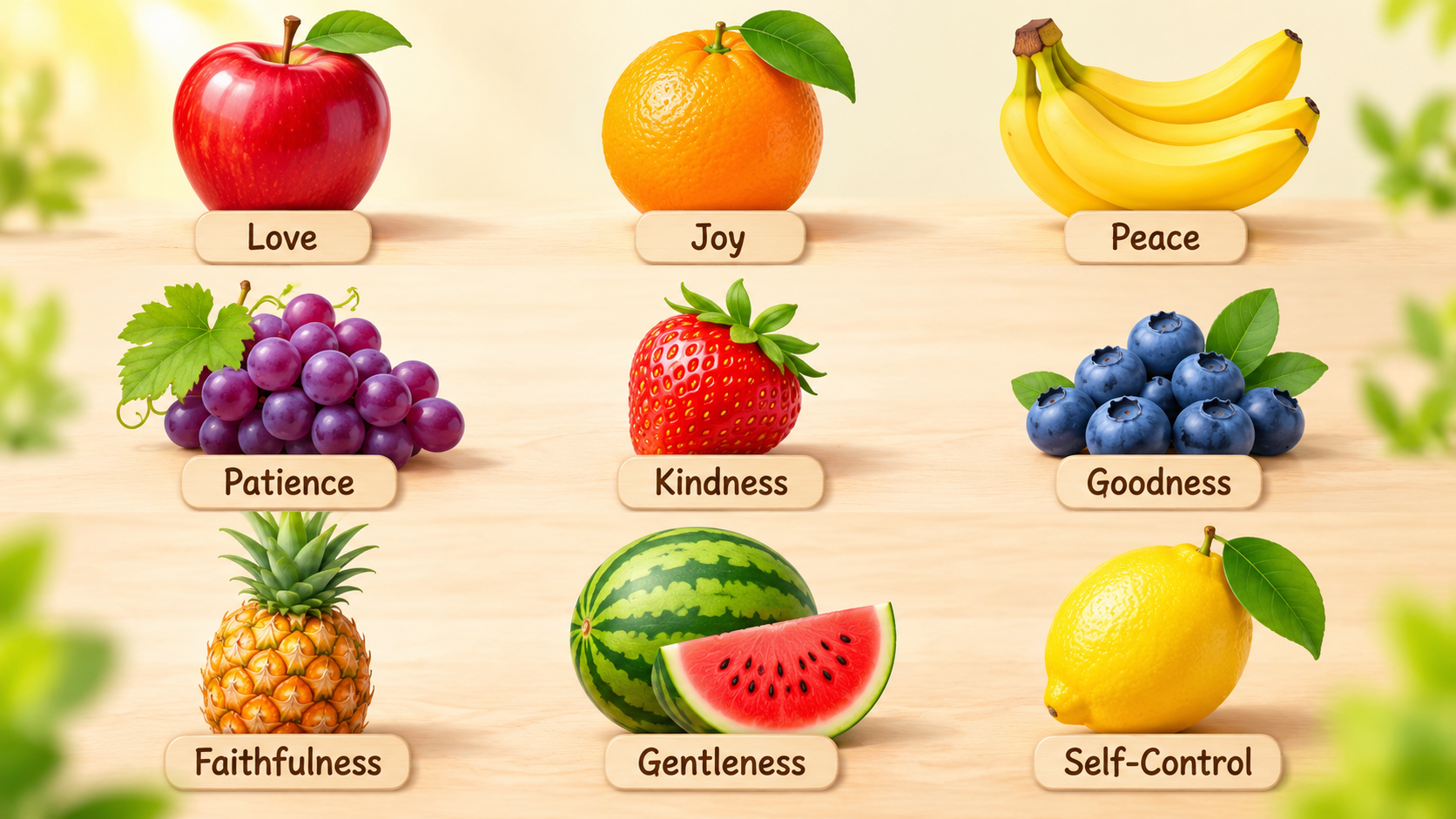
Love — Joy — Peace — Patience — Kindness — Goodness — Faithfulness — Gentleness — Self-Control
Ask the children:
“Which one do you think is easiest for you?”
Then:
“Which one is hardest?”
There are no perfect answers.
The goal is to begin an honest conversation.
What Is the Fruit of the Spirit? A Simple Explanation for Kids
Here is one way to explain it:
Imagine an apple tree.
How do you know it is an apple tree?
Eventually, apples grow on it.
The fruit shows what kind of tree it is.
In a similar way, people who follow Jesus should gradually begin showing a different kind of “fruit” in their lives.
Not apples or oranges.
Character.
Love.
Joy.
Peace.
Patience.
Kindness.
Goodness.
Faithfulness.
Gentleness.
Self-control.
But we need to make one point very clear to children:
The Fruit of the Spirit does not mean, “Try really hard to be a good person so God will love you.”
God’s love is not something we earn by behaving perfectly.
Instead, because we belong to Jesus, the Holy Spirit works in us and helps us grow.
Jesus used another fruit picture in John 15:1–8, where He spoke about branches remaining connected to the vine.
A branch cannot produce healthy fruit if it is separated from the plant.
In the same way, Christians need Jesus.
We pray.
We listen to God’s Word.
We obey.
We repent when we do wrong.
We depend on the Holy Spirit.
And little by little, God changes us.

One Fruit With Nine Qualities
Children may ask:
“Why does the Bible say fruit instead of fruits?”
That is a good question.
Paul presents these nine qualities together as the Fruit of the Spirit.
Think about a fruit bowl containing several different kinds of fruit.
Or think of one beautiful picture made from nine pieces.
God is not asking a Christian to choose:
“I’ll have love and kindness, but I don’t want self-control.”
The Holy Spirit is shaping a whole Christlike character.
Some qualities may develop more visibly than others at different times.
But all nine matter.
9 Fruit of the Spirit Bible Lessons for Kids
1. Love — The Good Samaritan
Bible Story
Read Luke 10:25–37.
Read the Good Samaritan in the NIV
Jesus told a story about a man who was badly hurt.
Several people passed him without helping.
Then a Samaritan stopped.
He cared for the injured man and made sure he received help.
Simple Lesson for Kids
Love is not only saying:
“I love you.”
Love acts.
Love notices when someone needs help.
Love cares about people even when they are different from us.
Love sometimes means giving our time, attention, or comfort to help someone else.
Everyday Example
A new child comes to school and has nobody to sit with.
Love may mean inviting that child to sit with you.
Ask the Kids
Who could you show love to this week?
Simple Activity
Ask each child to think of one person they can help.
Write:
“This week I can show love by ______.”
Then encourage them to actually do it.
2. Joy — Paul and Silas in Prison
Bible Story
Read Acts 16:22–34.
Paul and Silas experienced a terrible situation.
They had been beaten and put in prison.
Yet they prayed and worshiped God.
Their circumstances were painful, but their confidence in God had not disappeared.
Simple Lesson for Kids
Joy does not mean:
“I am happy about every bad thing that happens.”
Biblical joy goes deeper.
Joy remembers that God is still good and still with us even when life is difficult.
A child can feel sad and still trust God.
Those are not opposites.
Everyday Example
Your family trip gets canceled.
You can be disappointed.
But joy helps you remember that one disappointment does not mean God stopped loving you.
Ask the Kids
What is one thing about God that can give you joy even on a difficult day?
Simple Activity
Create a Joy List.
Have children write or draw three things they can thank God for.
3. Peace — Jesus Calms the Storm
Bible Story
Read Mark 4:35–41.
Jesus and His disciples were in a boat when a dangerous storm arose.
The disciples were frightened.
Jesus calmed the storm.
Simple Lesson for Kids
Peace does not mean nothing scary ever happens.
Peace means learning to trust God even when we are afraid.
Sometimes God changes the situation.
Sometimes He helps us walk through the situation.
Either way, we can bring our fear to Him.
Everyday Example
A child feels nervous about the first day at a new school.
Peace does not necessarily remove every nervous feeling.
The child can pray:
“God, I’m scared. Please help me remember that You are with me.”
Ask the Kids
What is something you worry about?
Simple Activity
Draw a storm cloud.
Inside the cloud, write something you worry about.
Below it, write:
“I can bring this to God.”
4. Patience — Simeon Waits for God’s Promise
Bible Story
Read Luke 2:25–35.
Simeon had been waiting for something God had promised.
He did not know exactly when the promise would be fulfilled.
Eventually, he saw Jesus.
Simple Lesson for Kids
Patience means learning to wait without allowing frustration to control us.
Waiting can be hard.
Children wait for:
birthdays,
Christmas,
turns,
food,
vacations,
answers,
and sometimes for difficult situations to improve.
Patience remembers:
“I do not have to get everything immediately.”
Everyday Example
Two children want the same game.
Patience helps one wait for a turn instead of grabbing it.
Ask the Kids
When is it hardest for you to wait?
Simple Activity
Practice a short waiting challenge.
Place a small treat or object on the table and have children wait for a set amount of time before touching it.
Then talk about how waiting felt.
5. Kindness — David Helps Mephibosheth
Bible Story
Read 2 Samuel 9.
King David intentionally looked for someone from Jonathan’s family whom he could help.
He found Mephibosheth and treated him with generosity and care.
Simple Lesson for Kids
Kindness means treating people with care.
Sometimes kindness is very small.
Holding a door.
Sharing.
Helping someone pick something up.
Sitting beside someone who feels lonely.
Speaking encouraging words.
The important part is noticing people.
Everyday Example
Someone drops all their pencils on the classroom floor.
You could walk past.
Kindness stops to help.
Ask the Kids
What is one small act of kindness you can do today?
Simple Activity
Create a Kindness Challenge.
Give each child three simple goals:
Help someone.
Encourage someone.
Share something.
See whether they can complete all three during the week.
6. Goodness — Joseph Chooses What Is Right
Bible Story
Read Genesis 39:1–12.
Read Genesis 39:1–12 in the NIV
Joseph was pressured to do something he knew was wrong.
He refused and left the situation.
Simple Lesson for Kids
Goodness means choosing what is right because it pleases God.
Sometimes doing good is easy.
Sometimes doing good costs us something.
You might lose popularity.
Someone may laugh at you.
You may have to admit something you did wrong.
Goodness asks:
“What is the right thing to do?”
—not simply:
“What is the easiest thing to do?”
Everyday Example
You see the answers to a test on someone’s desk.
Nobody would know if you looked.
Goodness means choosing honesty even when no one is watching.
Ask the Kids
Why can doing the right thing sometimes be difficult?
Simple Activity
Give children simple scenarios:
“You broke something.”
“You found money.”
“Someone asks you to lie.”
For each one, ask:
“What would goodness choose?”
7. Faithfulness — Daniel Keeps Praying
Bible Story
Read Daniel 6.
Daniel faithfully followed God even when doing so became dangerous.
He continued praying instead of abandoning his devotion to God.
Simple Lesson for Kids
Faithfulness means being dependable and staying committed to what is right.
A faithful person:
keeps promises,
tells the truth,
does what they said they would do,
and follows God even when it is difficult.
Faithfulness grows through many small choices.
Everyday Example
You promised to help clean up after an activity.
Then something more fun comes along.
Faithfulness means keeping your word.
Ask the Kids
Why is it important for people to be able to trust us?
Simple Activity
Give each child one small responsibility for the week.
At the next lesson, ask:
“Were you able to follow through?”
Do not shame children who forgot.
Use it as an opportunity to talk about learning faithfulness.
8. Gentleness — Jesus Welcomes the Children
Bible Story
Read Mark 10:13–16.
People brought children to Jesus.
Others tried to stop them.
But Jesus welcomed the children and treated them with care.
Simple Lesson for Kids
Gentleness does not mean weakness.
Gentleness means using our strength carefully.
We can be strong without being rough.
We can disagree without being cruel.
We can correct someone without embarrassing them.
We can speak truth without trying to hurt someone.
Everyday Example
Your younger brother accidentally breaks something you were building.
You feel angry.
Gentleness does not mean pretending you are happy.
It means controlling how you speak and respond.
Ask the Kids
What does a gentle voice sound like when you are upset?
Simple Activity
Say the same sentence two ways:
“Please give that back.”
First say it harshly.
Then say it calmly and gently.
Ask:
“Which way would make it easier to solve the problem?”
9. Self-Control — Jesus Resists Temptation
Bible Story
Read Matthew 4:1–11.
Read Matthew 4:1–11 in the NIV
Jesus faced temptation and did not give in.
He remained obedient to God.
Simple Lesson for Kids
Self-control means:
“I do not have to do everything I feel like doing.”
That is an important truth for children—and adults.
You may feel like shouting.
But you do not have to shout.
You may want to grab something.
But you do not have to grab it.
You may feel like saying something mean.
But you do not have to say it.
The Holy Spirit helps us learn to make wise choices instead of allowing every feeling or impulse to control us.
Everyday Example
Someone makes you angry during a game.
You want to push them.
Self-control helps you stop, step away, and choose a better response.
Ask the Kids
What is something you sometimes need help controlling?
Simple Activity: Stop — Pray — Choose
Teach children three simple steps:
STOP — Do not react immediately.
PRAY — Ask God for help.
CHOOSE — Choose the response that honors God.
This is simple enough for children to remember during real situations.
A Simple Fruit of the Spirit Chart for Kids
| Fruit | Simple Meaning | Kid-Friendly Example |
|---|---|---|
| Love | Caring about others | Helping someone who needs you |
| Joy | Rejoicing in God | Thanking God even on a hard day |
| Peace | Trusting God | Praying when you feel worried |
| Patience | Waiting without losing control | Waiting for your turn |
| Kindness | Treating people with care | Helping someone who feels left out |
| Goodness | Choosing what is right | Telling the truth |
| Faithfulness | Being dependable | Keeping your promise |
| Gentleness | Using strength carefully | Speaking calmly when upset |
| Self-Control | Controlling your actions and impulses | Stopping before doing something wrong |
Fruit of the Spirit at Home
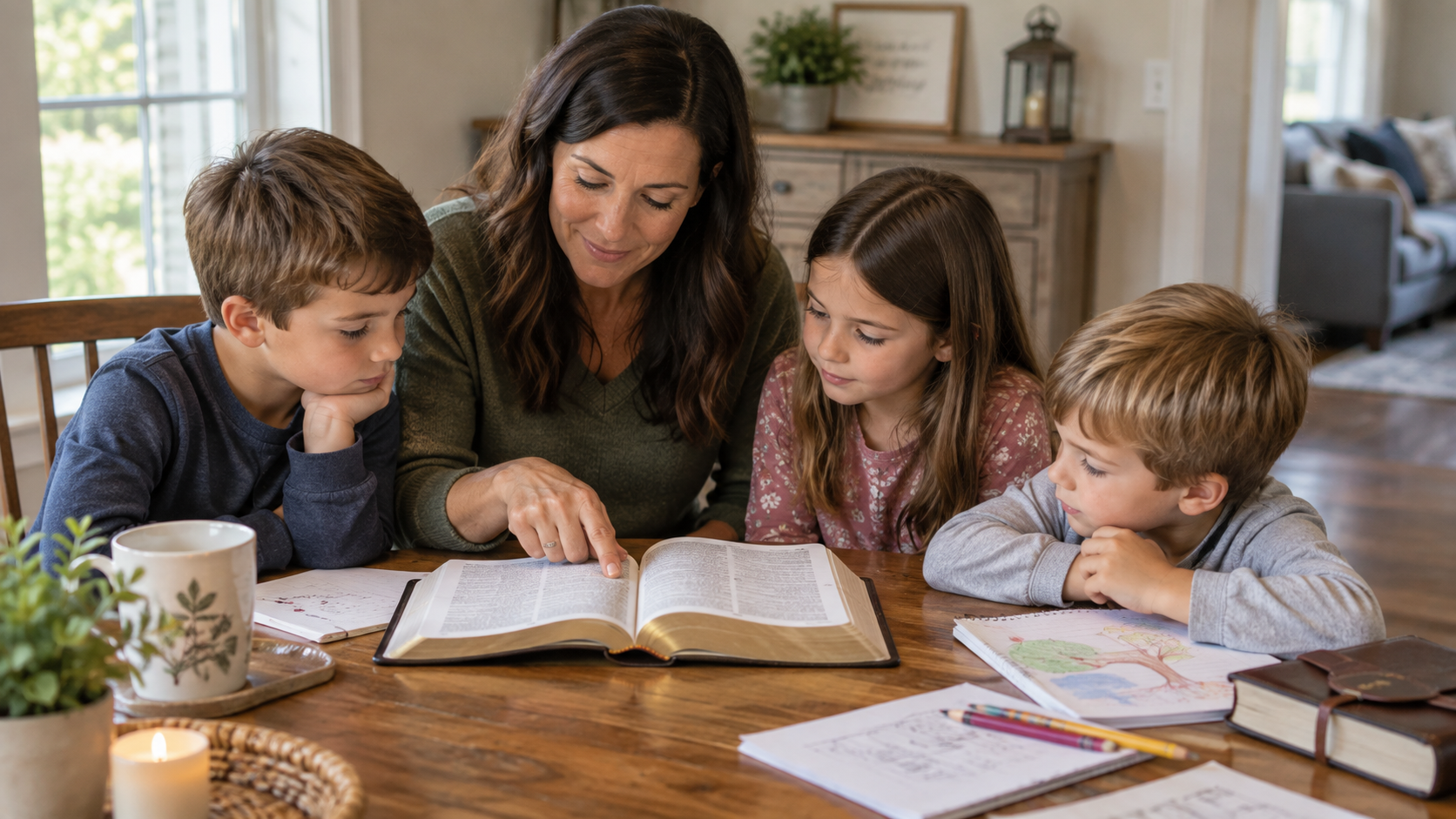
Parents do not need a formal Sunday-school classroom to teach these lessons.
Ordinary family life provides opportunities every day.
When siblings argue, ask:
“Which Fruit of the Spirit could help us right now?”
When a child has to wait:
“Which fruit are we practicing?”
When someone helps another family member:
“That was a good example of kindness.”
When a child admits wrongdoing:
“That took courage. Let’s talk about goodness and faithfulness.”
The goal is not to turn every family conversation into a sermon.
It is simply to help children connect biblical truth with real life.
Fruit of the Spirit in Sunday School
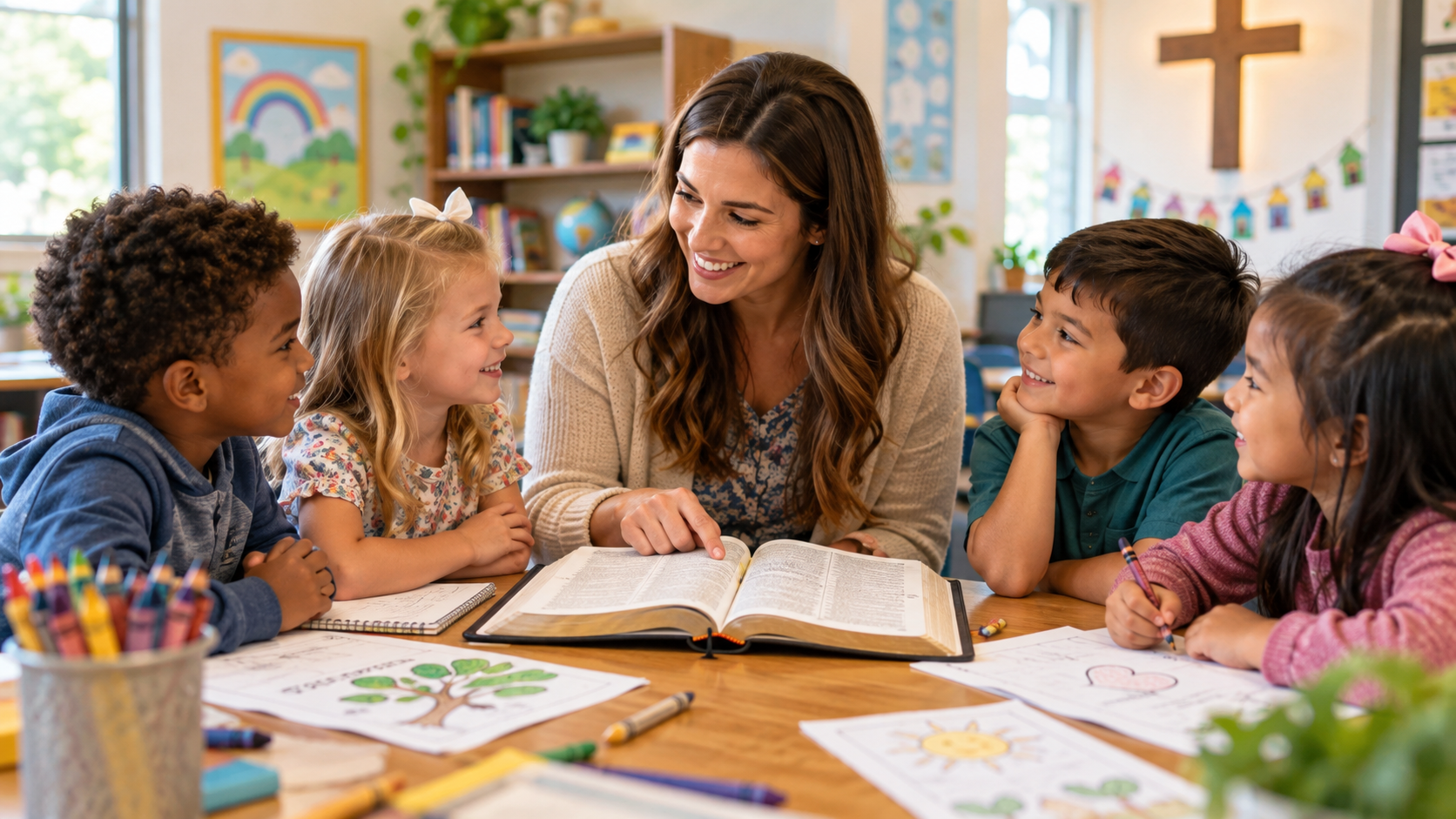
Teachers can also use the nine qualities as a multi-week series.
One simple structure is:
Week 1 — Love
Week 2 — Joy
Week 3 — Peace
Week 4 — Patience
Week 5 — Kindness
Week 6 — Goodness
Week 7 — Faithfulness
Week 8 — Gentleness
Week 9 — Self-Control
A nine-lesson format is already common in children’s ministry resources, which confirms that this is a natural way teachers search for and use Fruit of the Spirit material.
For every week, you can use the same basic pattern:
Bible Story → Simple Explanation → Real-Life Example → Question → Activity → Prayer
Consistency helps children know what to expect.
Don’t Turn the Fruit of the Spirit Into a Behavior Chart
This is especially important.
A child may hear:
“Be loving.”
“Be patient.”
“Control yourself.”
“Be kind.”
And eventually conclude:
Christianity means trying very hard to behave better.
But that misses the heart of Galatians 5.
Yes, children should learn obedience.
Yes, parents should correct behavior.
Yes, choices matter.
But the Fruit belongs to the Spirit.
We want children to learn:
“I need God’s help to become more like Jesus.”
Not:
“If I behave perfectly, God will finally love me.”
That difference protects the Gospel.
What Should I Do When a Child Fails?
Children will fail to show the Fruit of the Spirit.
So will adults.
A child loses patience.
A sibling says something cruel.
Someone lies.
Someone becomes selfish.
Someone has a tantrum.
These moments are not evidence that teaching failed.
They are opportunities to teach repentance and grace.
Try asking:
“What happened?”
Then:
“Which Fruit of the Spirit could have helped?”
Then:
“What can we do differently now?”
Maybe the child needs to apologize.
Return something.
Tell the truth.
Forgive.
Try again.
Christian formation is not:
Fail once → You are bad.
It is:
Recognize → Confess → Receive grace → Make it right → Keep growing.
Questions for Family or Sunday School Discussion
- What is the Fruit of the Spirit?
- Who helps Christians grow spiritual fruit?
- Why is fruit a good picture of spiritual growth?
- Which Fruit of the Spirit seems easiest for you?
- Which one seems hardest?
- How can love be more than just words?
- What can you do when you feel impatient?
- How can kindness help someone who feels left out?
- What does gentleness look like during an argument?
- When might you need self-control this week?
- Why is faithfulness important?
- How can prayer help us grow?
A Seven-Day Family Fruit Challenge
Families can also try this simple one-week exercise.
Day 1 — Love
Do something helpful without being asked.
Day 2 — Joy
Thank God for three blessings.
Day 3 — Peace
Pray together about one worry.
Day 4 — Patience
Practice waiting without complaining.
Day 5 — Kindness
Encourage someone.
Day 6 — Goodness and Faithfulness
Choose what is right and keep one promise.
Day 7 — Gentleness and Self-Control
Practice stopping before reacting when frustrated.
At the end of the week, ask:
“Which fruit did we notice most?”
And:
“Which one should we keep practicing?”
Frequently Asked Questions
What is the Fruit of the Spirit for kids?
The Fruit of the Spirit is the Christlike character the Holy Spirit develops in followers of Jesus: love, joy, peace, patience, kindness, goodness, faithfulness, gentleness, and self-control.
Where is the Fruit of the Spirit found in the Bible?
The nine qualities are listed in Galatians 5:22–23.
How do you explain the Fruit of the Spirit to a child?
A simple explanation is:
Just as a healthy tree produces fruit, the Holy Spirit helps people who follow Jesus grow Christlike character.
Then use ordinary examples children understand.
Is the Fruit of the Spirit nine different fruits?
Galatians uses the singular expression Fruit of the Spirit and then describes nine qualities. They belong together as a picture of Spirit-produced Christian character.
How can children practice the Fruit of the Spirit?
Children can practice through ordinary choices: sharing, waiting, forgiving, telling the truth, controlling anger, keeping promises, encouraging others, praying, and choosing what is right.
Can young children understand the Holy Spirit?
Yes, but explanations should be age-appropriate.
You can begin simply:
The Holy Spirit is God, and He helps people who follow Jesus know, obey, and become more like Christ.
As children grow, their understanding can deepen.
What is the easiest Fruit of the Spirit to teach children?
There is no single easiest fruit for every child.
Love and kindness are often easy to illustrate because children immediately understand helping and caring for someone. Self-control and patience also connect strongly with everyday childhood situations.
Should children memorize Galatians 5:22–23?
Memorization can be helpful, but understanding and application matter too.
A child who can recite all nine qualities but does not understand what kindness or self-control looks like has only completed part of the lesson.
A Prayer for Children to Grow in the Fruit of the Spirit
Father,
Thank You for loving us and for giving Your Holy Spirit to those who belong to Jesus.
Help us become more like Christ.
Teach us to love people.
Give us joy even when days are difficult.
Help us trust You and live in peace.
Give us patience when we have to wait.
Make us kind to people around us.
Help us choose what is good and right.
Teach us to be faithful and trustworthy.
Help us speak and act gently.
And give us self-control when we feel angry, tempted, or frustrated.
When we make mistakes, help us admit them, ask forgiveness, and try again.
Thank You for continuing to help us grow.
In Jesus’ name, Amen.
Final Encouragement for Parents and Teachers
Children do not need to understand every theological detail of Galatians 5 in one lesson.
Start small.
Teach one truth.
Tell one Bible story.
Ask one good question.
Practice one Christlike response.
Then repeat.
Fruit does not grow instantly.
Neither does Christian character.
A child may hear a lesson about patience today and still become impatient tomorrow.
That does not mean the lesson failed.
Keep teaching.
Keep modeling.
Keep correcting with grace.
Keep praying.
And remember that children are watching more than our lessons.
They also see how we respond when we are tired.
How we speak when someone makes a mistake.
How we handle anger.
Whether we apologize.
Whether we forgive.
Whether we show kindness.
Whether we demonstrate self-control.
One of the most powerful ways to teach children the Fruit of the Spirit is for them to see that same fruit increasingly growing in us.
Continue Growing
Use these internal links naturally:
The 9 Fruits of the Spirit Explained — the main pillar for parents and teachers who want a deeper explanation.
Fruit of the Spirit Bible Study: Questions, Reflection & Practical Application — for adult or group study.
Fruit of the Spirit in Relationships — Especially helpful for families.
Love as a Fruit of the Spirit — deeper teaching on biblical love.
Patience as a Fruit of the Spirit — useful for family and parenting applications.
Gentleness as a Fruit of the Spirit — especially relevant to discipline and conflict.
Self-Control as a Fruit of the Spirit — for deeper study of impulses, habits, and disciplined Christian living.