


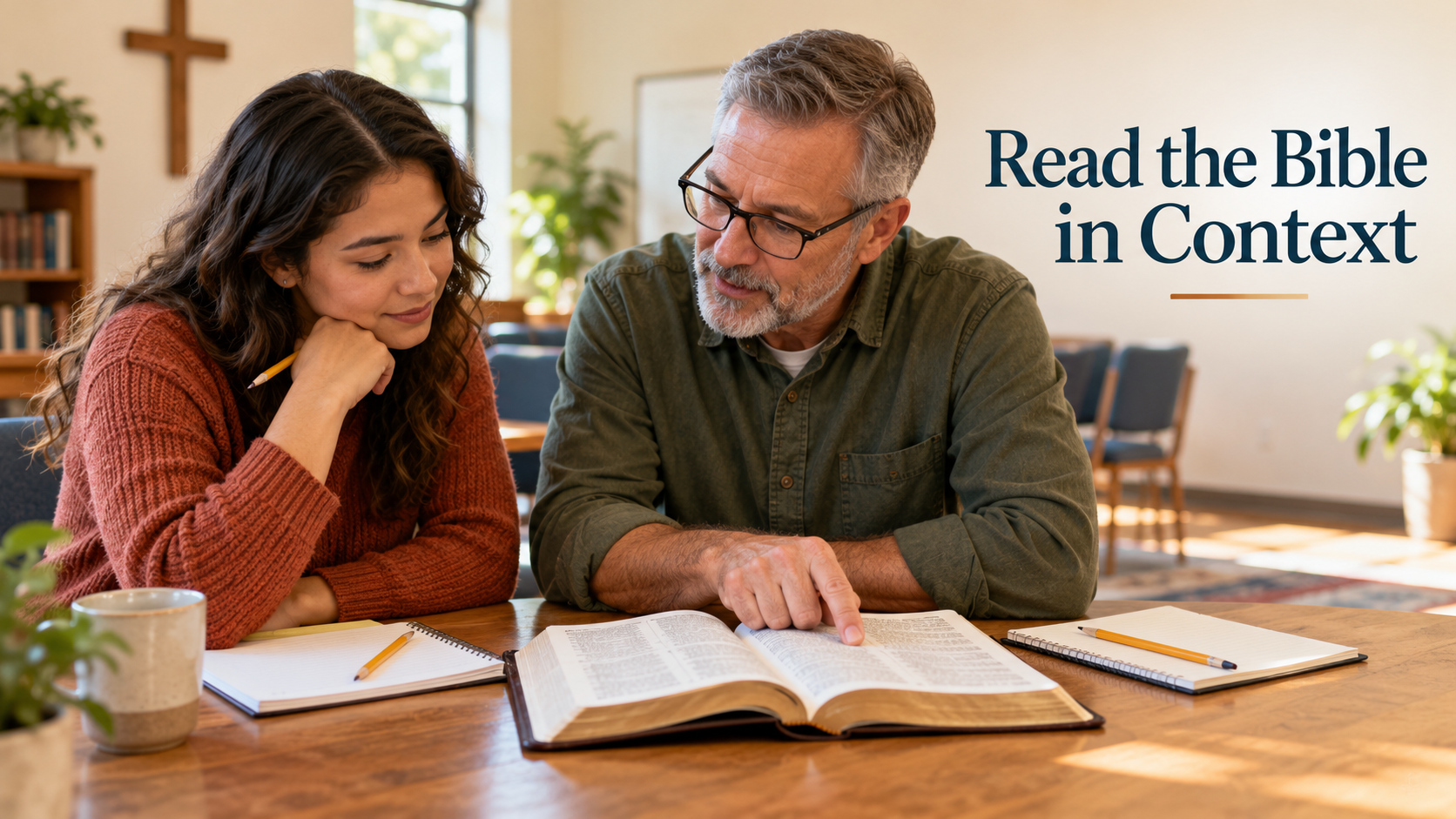
A new believer may recognize a familiar Bible verse but feel unsure about the paragraph around it. They might ask what the verse means, whether it is a promise for them, or how to apply it to a difficult situation. You want to help them understand God’s Word without making Bible reading feel too complicated.
Teaching someone to read the Bible in context means showing them how a verse belongs within a passage, a book, and the wider story of Scripture. A patient mentor can demonstrate that habit, practise it with the learner, and gradually help them use it on their own.
You do not need to introduce every study tool at once. Begin with a short passage, a few clear explanations, and room for honest questions. This guide offers a simple mentoring method, a worked example from Philippians, and a three-session practice plan.
What Does Reading in Context Mean?
Context is the surrounding information that helps us understand what a passage communicates. It includes nearby sentences, the purpose of the book, the people being addressed, the situation, and the kind of writing.
Think about receiving a message that says, “Please bring it tomorrow.” Without the earlier conversation, you might not know what to bring or where to take it. Reading the full exchange clarifies the request. In a similar way, the verses around a biblical statement often explain what the writer is discussing.
Reading in context helps us hear the passage faithfully before deciding how to respond. It does not make Scripture less personal or useful. It helps our encouragement, decisions, and obedience grow from what the passage actually teaches.
For a learner who needs an introduction to Bible reading, How to Understand the Bible When You Read It provides a useful starting point.
Begin With Encouragement and a Manageable Passage
Ask what the person already finds helpful and what feels confusing. Someone may enjoy reading a Psalm but feel lost in a letter. Another may understand a story yet struggle to connect it with daily life. Listen before deciding how much background they need.
Explain that questions are part of learning. They do not have to know every historical detail before they can begin reading, and they do not need to hide uncertainty. A mentor should make it easier to ask for help.
Choose a passage you have prepared and can explain responsibly. A complete paragraph or short scene is often more useful than a single sentence separated from its setting. Give enough background for understanding while keeping the first lesson manageable.
Pray together for humility and insight. God’s Word deserves careful attention, and believers also depend on the Holy Spirit as they learn and respond. The Holy Spirit Explained offers background on His work in the Christian life.
Use a Simple Mentoring Rhythm: Demonstrate, Practise, Review
At first, show the learner what you do when you approach a passage. Explain your observations in ordinary words: “I am reading the paragraph because this sentence continues the writer’s thought,” or “I want to check who is being addressed before applying this instruction.”
Then invite the person to try one part of the process. They might identify the speaker, summarize the paragraph, or explain how the sentence before the selected verse helps them understand it.
As they become more confident, let them lead a short reading and explain their reasoning. Offer help when needed, but allow them time to look at the passage before providing an answer. Review both what became clearer and what remains uncertain.
This patient approach fits the wider purpose of discipleship after being born again: learning to follow Christ with growing understanding and faith.

Five Habits to Model as You Read the Bible in Context
1. Read the Surrounding Paragraph
Start by reading more than the verse that caught the person’s attention. Ask what the passage is discussing and where its thought begins and ends. You may need to read earlier or later verses to understand the point.
Explain that chapter and verse numbers help us find passages, while a writer’s argument or a story may continue across those divisions. A chapter number is a useful guide for navigation; it does not always mark a complete change of subject.
Show the learner how to summarize the paragraph in one or two sentences. If the summary is difficult, read it again and identify the main subject before discussing personal application.
2. Identify the Speaker, Writer, and Original Readers
In a story, notice who is speaking and whom they address. In a letter, explain who wrote it and which community or person receives it. These details help the reader understand why a statement is made.
Use a reliable book introduction when background is needed. If you cannot establish a detail, acknowledge the uncertainty rather than inventing an explanation. Begin with the information the passage itself provides.
You might ask, “Is this an instruction to a church, a conversation with a particular person, or a description of an event?” The answer helps you consider how the passage relates to believers today.
3. Follow the Connections Between Ideas
Notice words that connect one thought with another. A reason, a contrast, or a conclusion can clarify how the sentences fit together. Also watch for a repeated subject or a question answered later in the passage.
Instead of turning this into a grammar lesson, demonstrate it naturally: “This sentence gives the reason for the instruction we just read,” or “Here the writer explains what he meant in the previous verse.”
Invite the learner to explain one connection using their own words. They may not express it perfectly at first. Help them check their explanation against the paragraph and try again.
4. Notice the Kind of Writing
The Bible includes narratives, poetry, wisdom, prophecy, letters, and other forms of writing. We read each with attention to how it communicates. A poetic image, a reported event, and a direct instruction may call for different questions.
For example, a narrative can describe a person’s wrongdoing without telling us to imitate it. A poetic image can convey truth through comparison. A New Testament letter often develops a teaching across several paragraphs.
You do not need to explain every literary category in the first lesson. Name the form you are reading and show how it helps you understand that passage. How to Study the Bible Effectively offers support for developing these reading habits.
Watch: New Testament Letters in Context
BibleProject’s video explains why New Testament letters should be read as connected writings. Watch it as optional preparation for the Philippians example below, then discuss how a verse contributes to the paragraph around it.

5. State the Main Teaching Before Applying It
Ask the learner to explain what the passage communicates before asking how it affects their week. A useful summary should fit the surrounding text rather than depend only on a phrase that sounds meaningful.
Then consider an appropriate response. Some passages deepen our understanding of God or the gospel. Others call for repentance, comfort, gratitude, prayer, or obedience. Application should follow the passage’s meaning and its place in Scripture.
When a passage includes a promise, identify its recipients and setting. Consider how it relates to believers today through the wider teaching of Scripture. Avoid turning every statement into a guarantee of a particular personal outcome.
The purpose of reading is also to respond faithfully. Living in Obedience Through Everyday Choices gives examples of connecting biblical teaching with ordinary life.
A Worked Example: Philippians 4:13 in Its Paragraph
Read Philippians 4:10–20 together before focusing on verse 13. Paul thanks the Philippians for their care and explains what he has learned about contentment in different circumstances, including need and abundance.
Verse 13 belongs within that discussion. Paul’s confidence in Christ’s strength concerns his ability to live faithfully through those circumstances. The surrounding verses also show gratitude for the believers’ practical support. The passage does not promise that every personal ambition will succeed.
Use the example to teach the reading process, rather than only giving the learner a corrected interpretation:
| Mentor’s prompt | What to help the learner notice |
|---|---|
| What is Paul discussing in verses 10–12? | The Philippians’ concern and his learning of contentment |
| What circumstances does he describe? | Both having enough and experiencing need |
| How does verse 13 connect with that discussion? | Christ’s strength sustains him within those circumstances |
| What do verses 14–18 add? | Appreciation for the believers’ practical generosity |
For a hypothetical application, consider a learner who is disappointed about a job opportunity. The passage can encourage dependence on Christ and contentment while they take responsible steps forward. It should not be used to guarantee that a particular application will lead to an offer.
Ask the learner to write a short summary and explain which verses support it. Then discuss what faithful trust could look like this week and pray together about that response.
A Three-Session Practice Plan
Use the following plan as a starting point. The suggested passages provide opportunities to practise reading in context; they are not a test someone must complete to prove spiritual maturity.
| Session | Passage | Mentor’s role | Learner’s practice |
|---|---|---|---|
| 1 — Demonstrate | Philippians 4:10–20 | Show how the paragraph clarifies verse 13 | Explain one connection between the verse and its surroundings |
| 2 — Practise together | Mark 2:1–12 | Guide observation of the event, speakers, and dispute | Summarize the scene and discuss its teaching about Jesus’ authority |
| 3 — Let the learner lead | James 1:19–27 | Listen, ask for support from the text, and clarify as needed | Explain the passage’s connected teaching and propose one faithful response |
Ask for a small amount of preparation between meetings. For example, invite the learner to read the next passage and note one observation and one question. Keep the assignment realistic for their responsibilities and reading confidence.
At the next meeting, begin with what they noticed. If their understanding needs correction, reread the relevant verses together and explain your reasoning. Why Every New Believer Needs a Discipleship Mentor describes the value of patient support during this stage.

Help Without Overwhelming the Learner
A new believer does not need a long list of unfamiliar terms to start reading thoughtfully. Explain one useful idea at a time and show how it works in the passage you are studying. Give background when it clarifies meaning, rather than adding every detail you have discovered.
Use study resources to answer a defined question. A book introduction may clarify the original audience; a reliable commentary may explain an unfamiliar custom. After consulting it, return to the passage and help the learner connect the explanation with the text.
Our Bible Study Resources Hub can help you find supporting studies. Your pastor or ministry leader can also recommend suitable resources for your church’s teaching context.
Allow uncertainty to remain when an answer needs more study. You can say, “I am not sure yet. Let’s write that down and check it carefully.” Honest research models humility and gives the learner a responsible way to approach a difficult passage.
Common Mistakes to Correct Gently
| Reading habit | A helpful mentoring response |
|---|---|
| Reading only a familiar verse | Invite the learner to read its full paragraph and explain the subject |
| Making personal application immediately | Ask for the passage’s meaning in its setting first |
| Assuming every event is an example to copy | Consider how the narrator presents the behavior and what the wider Bible teaches |
| Treating every promise as a personal guarantee | Identify who receives it, its circumstances, and its place in Scripture |
| Repeating a study note without understanding it | Ask the learner to explain how the note helps make sense of the passage |
| Depending on the mentor for every answer | Give the learner time to observe and summarize before offering help |
Correct the reading habit without shaming the person. You can explain that you also need to slow down, check context, and revise an interpretation when the text calls for it.
Notice Progress and Keep Practising
Growth may appear in simple ways. The learner reads beyond a favorite verse, asks who is being addressed, notices a connection between sentences, or admits that an application needs a clearer biblical basis.
Encourage those habits while continuing to help with difficult passages. Ask them to show how they concluded, and offer clear explanations when needed. Independence in reading grows through practice and appropriate support.
Keep learning connected with church life. A new believer benefits from sound teaching, fellowship, and opportunities to discuss what they are reading. The Power of Belonging to a Church Family explains that wider support.

Frequently Asked Questions
Must a new believer understand the whole Bible before applying a passage?
No. They can begin with a manageable passage and enough background to understand its main teaching. Their knowledge of the wider Bible can develop over time through reading, church teaching, and guided study.
Can a familiar verse still encourage me when I read it in context?
Yes. Its context often makes the encouragement clearer and more dependable. Reading carefully helps you trust what the passage teaches without adding a promise it does not make.
What if a passage has several possible interpretations?
Compare the reasons offered for each reading, examine the surrounding text, and seek reliable guidance. Acknowledge what is uncertain and avoid presenting your preferred view as settled when it is not.
Should we stop using devotionals?
Devotionals can support prayer and reflection. Encourage the learner to open the biblical passage itself too, so that a short devotional thought remains connected with its setting.
Reflection Questions
- Do I demonstrate how to find meaning, or mainly give the learner my conclusion?
- Which passage could we practise reading together this week?
- Am I adding useful background or overwhelming the learner with information?
- How can I encourage them to explain their own observations from the text?
A Prayer for Faithful Bible Reading
Father, thank You for Your Word. Give us humble hearts and patient attention as we read. Help us understand each passage faithfully and respond with trust, gratitude, and obedience. Guide me as I help another believer learn, and teach us to depend on Your Spirit as we grow in knowing Jesus. Amen.
Final Encouragement
Helping someone read the Bible in context can begin with one paragraph and a thoughtful conversation. Read together, explain how the ideas connect, and give the learner room to practise.
As those habits grow, the person can become more confident in reading Scripture carefully and responding to its teaching. Continue with patience, prayer, and the support of your church community.
Continue Growing in Your Faith
- 📖 How to Understand the Bible When You Read It
- 🌱 Discipleship After Being Born Again
- 🤝 Why Every New Believer Needs a Discipleship Mentor
- 🕊️ The Holy Spirit Explained
- 📚 Bible Study Resources Hub
Next Read: How to Study the Bible Effectively.