

Introduction — Who can use this study, objective, duration, and materials
You can use this Armor of God Bible study whether you’re leading a small group at church, hosting a family devotional, guiding an online meeting, or working through Scripture on your own. The objective is simple: help you and your group understand Ephesians 6:10–18, recognize the spiritual reality of the battle you face, and put on God’s armor in practical, humble ways that sustain faithful witness and perseverance. Plan for a 45–60 minute session. Bring a Bible, notebook, and pen; if you’re leading online, open your Bible app or BibleGateway to follow the text together.

Bible Study Purpose and Learning Goals
This study will teach you to read Ephesians 6:10–18 in context, identify the meaning of each armor piece, and apply the Truth–Error–Application framework to daily life. By the end, you should be able to explain why spiritual warfare is personal and communal, list practical ways to “put on” each piece of armor, and lead others through honest reflection and action.
Opening Prayer
Begin with a brief prayer asking God for clarity, humility, and courage to receive correction and practice obedience. Example: “Lord, open our eyes to see the truth in Your Word. Help us to receive strength from You, to stand against deception and fear, and to put on every piece of Your armor. Amen.” You can adapt this to your group’s style; make room for spontaneous prayer from participants.
Read Ephesians 6:10–18
Read the passage aloud together: Ephesians 6:10–18 (NIV). Take a moment for silent reflection after the reading. Ask everyone to note one phrase that stands out. In the context of Paul’s entire letter to the Ephesians, this passage closes his practical instructions for Christian living and moves from household and relational ethics (Ephesians 4–5) to the spiritual resources God provides for persevering in holiness.
Understanding the Setting and Main Message
Ephesians is a pastoral, doctrinal, and practical letter. Paul moves from identity in Christ (what you are in him) to the behavior that flows from it. The main message of Ephesians 6:10–18 is that you stand in God’s strength by receiving and practicing divine truth, righteousness, readiness with the gospel, faith, salvation, the Word, and prayer. This passage assumes a spiritual enemy—real, active, and intent on deception—but emphasizes that victory and standing come from God, not human cleverness.
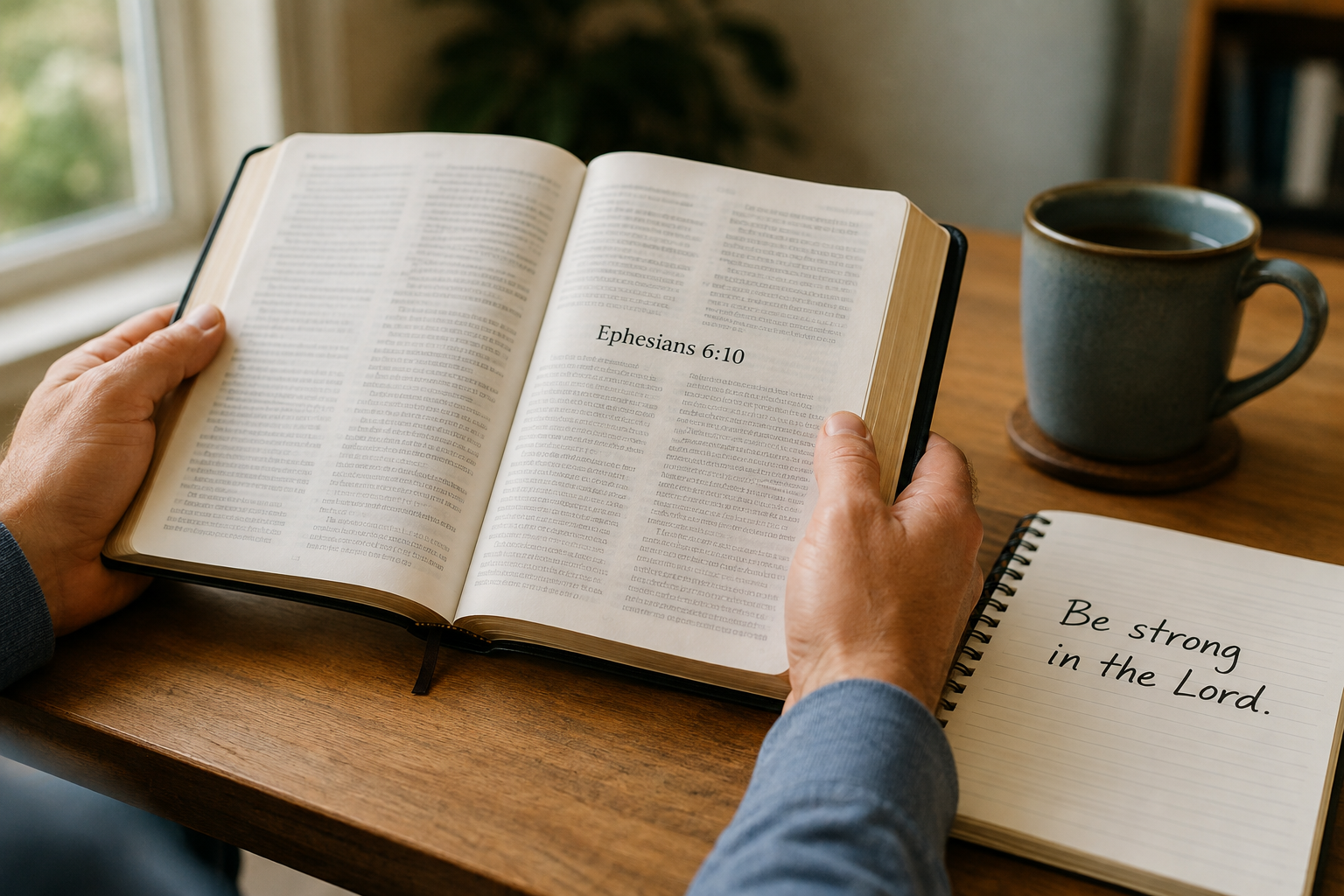
Be Strong in the Lord
Truth: Paul’s first command is to “be strong in the Lord” — your strength is not your own but derived from union with Christ. See Ephesians 6:10 (NIV).
Error: A common error is to rely on personal willpower, charisma, or strategies instead of God’s empowering presence. This leads to spiritual exhaustion and pride.
Application: Recognize your dependence on God before tackling spiritual struggles. Cultivate practices that reinforce your union with Christ—prayer, Scripture, and community.
For a deeper article on this theme, see “strong in the Lord”
Know the Real Battle
Truth: Paul clarifies that your struggle isn’t primarily against flesh and blood but against spiritual forces (read Ephesians 6:12 (NIV)). This doesn’t make human conflict irrelevant, but it reframes root issues as spiritual.
Error: You should not dehumanize others as your enemy, nor should you imagine the armor is magical protection from normal hardships.
Application: When you face conflict, ask what spiritual realities—lies, fears, idols, or sin—are at work, then respond biblically toward both God and people. Remember James’s call to resist the devil and submit to God (James 4:7 (NIV)) and Peter’s counsel to resist the devil with steadfastness (1 Peter 5:8-9 (NIV)).
Study Each Piece of the Armor
Below you’ll find for each piece: a one-sentence meaning, a key verse link, an observation question, a reflection question, a practical action, and a brief leader’s answer or guidance. Use the Truth–Error–Application framework as you teach.
Belt of Truth
- One-sentence meaning: The belt symbolizes a commitment to God’s revealed truth that steadies, protects, and prepares you for action.
- Key verse: Ephesians 6:14 (NIV).
- Observation question: What does Paul mean when he instructs believers to “stand firm” with the belt of truth?
- Reflection question: Which falsehoods or half-truths are most tempting for you to believe about God, others, or yourself?
- Practical action: Memorize a truth verse such as John 17:17 (NIV) or a short statement of gospel truth and recite it when you face doubt.
- Leader’s answer/guidance: Point participants to the Word as the primary source of truth. Encourage confession of specific lies and prayer for clarity. More on this piece is available at the detailed belt article. 👉 The Belt of Truth Explained: Living in God’s Truth Every Day
Breastplate of Righteousness
- One-sentence meaning: The breastplate protects your heart and life through the righteousness Christ gives and the righteousness you pursue.
- Key verse: Ephesians 6:14 (NIV).
- Observation question: Why does Paul pair truth and righteousness together as the first pieces of armor?
- Reflection question: How does knowing you are declared righteous in Christ (see Romans 5:1 (NIV)) change your approach to guilt and shame?
- Practical action: Practice daily confession and gratitude: confess one failure and thank God for Christ’s righteousness.
- Leader’s answer/guidance: Help people distinguish positional righteousness (what Christ gives) from practical righteousness (what we pursue). For further study, see 👉 The Breastplate of Righteousness Explained: Guarding Your Heart in Christ
Shoes of the Gospel of Peace
- One-sentence meaning: The shoes equip you to move with readiness to share the gospel and to walk in reconciled relationships.
- Key verse: Ephesians 6:15 (NIV).
- Observation question: What does readiness with the gospel suggest about your stance toward conflict and mission?
- Reflection question: Do you approach relational tension with peace or defensiveness, and why?
- Practical action: Practice a reconciliatory posture this week: initiate a calm conversation with someone with whom you have minor friction.
- Leader’s answer/guidance: Encourage humility in witness and peacemaking; remind the group that peace begins with the gospel (see Romans 8:1 (NIV)). For more on standing firm, see the shoes article. 👉 The Shoes of the Gospel of Peace Explained: Walking with Confidence
Shield of Faith
- One-sentence meaning: The shield of faith is trust in God that extinguishes the flaming doubts, accusations, and temptations the enemy hurls.
- Key verse: Ephesians 6:16 (NIV).
- Observation question: What kinds of “flaming arrows” does Paul imagine faith will extinguish?
- Reflection question: When your trust in God falters, what triggers that distrust—suffering, unanswered prayer, fear?
- Practical action: Record three past instances when God was faithful and read them in times of doubt to strengthen faith (see Romans 10:17 (NIV)).
- Leader’s answer/guidance: Teach practical faith-building habits: Scripture intake, testimonies, and obedience exercises. For a practical read on using faith daily, visit the shield article. 👉 The Shield of Faith Explained: How Faith Extinguishes Satan’s Attacks
Helmet of Salvation
- One-sentence meaning: The helmet protects your mind by reminding you that you are saved and secure in Christ, shaping how you think.
- Key verse: Ephesians 6:17 (NIV).
- Observation question: What connection does the helmet suggest between salvation and thought life?
- Reflection question: How does assurance of salvation affect your anxiety and identity?
- Practical action: When anxious or condemned, declare aloud the truths of Romans 8:1 (NIV) and record Scripture promises that anchor you.
- Leader’s answer/guidance: Help participants differentiate between assurance and presumption; encourage pastoral care for those struggling with assurance. You can read more about the helmet in this detailed article. 👉 The Helmet of Salvation Explained: Protecting Your Mind with God’s Truth
Sword of the Spirit (the Word of God)
- One-sentence meaning: The sword is the Word of God used defensively and offensively to expose lies and proclaim truth.
- Key verse: Ephesians 6:17 (NIV).
- Observation question: How does Paul’s image of the “sword” shape your understanding of Scripture’s role in conflict?
- Reflection question: Do you know Scripture well enough to use it under pressure? Where are your gaps?
- Practical action: Choose five key passages to memorize and practice speaking them aloud in response to common temptations (see 2 Timothy 3:16–17 (NIV)).
- Leader’s answer/guidance: Emphasize Scripture intake and memorization. Encourage use of Scripture in prayer and gentle correction. To dive deeper, read the sword article. 👉 The Sword of the Spirit Explained: Using God’s Word in Spiritual Warfare

Prayer, Alertness, and Perseverance
Truth: Prayer is the background and breath of spiritual warfare; Paul urges prayer for all saints and continual alertness (Ephesians 6:18 (NIV)). Prayer keeps you connected to the Commander.
Error: Treating prayer as an optional add-on or private pastime weakens the communal defense and blinds you to spiritual realities.
Application: Foster intentional, varied prayer—listening, intercession, and petitions for boldness. Pray for fellow believers and practice being watchful (compare 1 Thessalonians 5:8 (NIV)).
Support passages that reinforce prayer and the Word’s power include Isaiah 59:16–17 (NIV) and 2 Corinthians 10:3–5 (NIV).
Truth–Error–Application Summary
Truth: The armor is God’s provision—truth, righteousness, gospel readiness, faith, salvation, Scripture, and prayer—so you can stand in Him.
Error: The armor is not an amulet or promise of no suffering, nor a permit to dehumanize those who oppose you.
Application: Believe God’s promises, practice spiritual disciplines, pursue righteousness, prepare for ministry, trust in God during trials, use Scripture actively, and pray constantly for yourself and others.
Personal Reflection Questions
Take time alone or invite participants to journal. Below are prompts to guide your reflection; allow at least 10–15 minutes.
- What stands out to you most about the armor and why? (Observation)
- In which area of your life are you most tempted to rely on your own strength rather than God’s? (Interpretation)
- What specific lies do you hear most often, and which piece of armor counters each lie? (Application)
- Who can you invite into accountability for putting on the armor? (Community)
- How would you describe your current prayer life, and what one change would make it more consistent? (Action)
Write honest answers and identify one practical step to take in the next 48 hours.
Small-Group Discussion Questions
Use these to guide 45–60 minute group conversation; they progress from observation to application. Aim for 10–12 questions total.
- What phrase from Ephesians 6:10–18 (NIV) jumped out to you and why? (Observation)
- How does Paul’s command to “be strong in the Lord” change your view of spiritual strength? (Interpretation)
- Which piece of the armor feels easiest for you to “put on,” and which feels hardest? Why? (Personal)
- How do the belt of truth and the sword of the Spirit work together in resisting temptation? (Integration)
- Share a time when faith (shield) helped you withstand a major challenge. What happened? (Testimony)
- In conflict, how can the shoes of the gospel of peace shape your response to someone who wronged you? (Application)
- How does the helmet of salvation inform your mental and emotional health? (Application)
- What role does corporate prayer play in spiritual resilience, according to Ephesians 6:18 (NIV)? (Group Practice)
- How do the supporting passages—like 2 Corinthians 10:3–5 (NIV)—shape your understanding of spiritual battle tactics? (Theological)
- What practical habit will you commit to this week to strengthen one piece of the armor? (Commitment)
- How can your church body better support each other in putting on the armor daily? (Community Action)
- When should we seek pastoral or professional help for struggles that feel beyond normal spiritual warfare? (Care)
These questions are designed to invite honest dialogue, testimony, and mutual encouragement rather than yes/no answers.
Practical Scenarios
Work through these with your group or alone. For each scenario, identify the armor pieces most relevant and explain a biblical response.
Scenario 1 — Temptation or Compromise: You’re offered an opportunity at work that would boost your income but requires cutting ethical corners. Which armor pieces apply? Response: Belt of truth (rejecting rationalizations), breastplate of righteousness (protecting heart integrity), shield of faith (trusting God’s provision), sword of the Spirit (recalling Scripture about honesty and trust), and prayer (seeking God’s wisdom). Scripture-based response: Resist the temptation, recall James 4:7 (NIV) and bring the decision before God.
Scenario 2 — Fear or Discouragement: You’re overwhelmed by fear about the future and decisions feel paralyzing. Response: Helmet of salvation (reminding yourself of identity in Christ), shield of faith (trust God’s care), belt of truth (expose fearful thoughts as lies), and prayer (cast anxieties on God). Support passages: Romans 8:1 (NIV) and Romans 10:17 (NIV) for faith from hearing the Word.
Scenario 3 — Conflict with Another Person: A fellow church member criticizes your ministry publicly. Response: Shoes of the gospel of peace (approach for reconciliation and witness), belt of truth (honest humility), breastplate of righteousness (examine your heart), shield of faith (trust God’s reputation), sword of the Spirit (speak truth in love with Scripture as guide), and prayer. Biblical response: Seek private reconciliation (Matthew 18 model), forgive when appropriate, and pursue communal humility.
Remind the group: People are not the enemy—sin and spiritual forces are. Treat others with dignity even when opposing harmful actions.

Seven-Day Armor Challenge
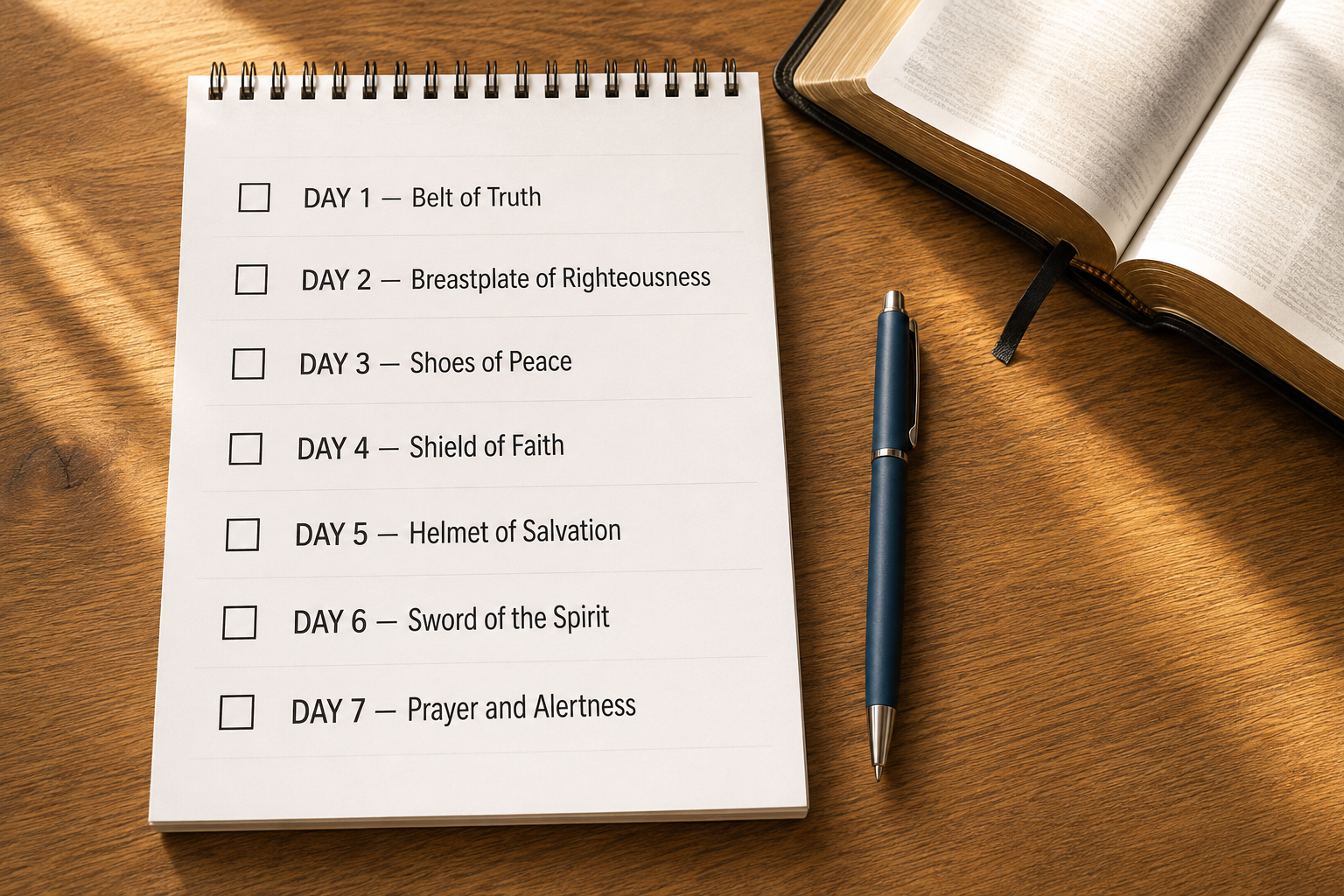
This manageable week-long plan helps you form habits; each day focuses on one short practice tied to an armor piece. Commit to 5–15 minutes daily.
Day 1 — Belt of Truth: Read and memorize John 17:17 (NIV); journal one lie you need to reject. Day 2 — Breastplate of Righteousness: Confess one pattern of sin and thank God for justification (Romans 5:1 (NIV)). Day 3 — Shoes of the Gospel of Peace: Send a peace-seeking message to someone you’ve been avoiding. Day 4 — Shield of Faith: List three past testimonies of God’s faithfulness and pray them back to God. Day 5 — Helmet of Salvation: Write out and speak aloud three identity statements from Scripture (e.g., “I am in Christ”). Day 6 — Sword of the Spirit: Memorize a short verse (e.g., 2 Timothy 3:16 (NIV)) and practice using it in a mock temptation. Day 7 — Prayer and Perseverance: Spend 10 minutes praying for your church, leaders, and one unbelieving friend, then commit a plan for ongoing prayer with an accountability partner.
Repeat this challenge monthly or adapt it to your group’s pace.
Frequently Asked Questions
How long should the study take?
Plan 45–60 minutes for the full lesson. If you prefer more discussion or deeper reflection, split it across two sessions. Shorter personal readings can take 15–30 minutes.
Can children participate?
Yes—adapt the language and activities. For young children, focus on one or two pieces of armor per session and use simple visuals and a short memory verse.
Is prayer part of the armor?
Yes. Prayer is integral—Paul instructs continual prayer for all the saints (Ephesians 6:18 (NIV)). It connects you to God and to one another.
How can a leader handle personal disclosures?
Create safety norms before you begin, remind participants of confidentiality limits, encourage pastoral follow-up for serious issues, and provide resources for counseling when needed.
Can the study be divided into several sessions?
Absolutely. You can make it a six-week series, covering one armor piece per week, or stretch it into a full term with focused application activities.
Is the armor a promise of no suffering?
No. The armor equips you to stand faithfully amid suffering and spiritual opposition but does not guarantee a trouble-free life. See Isaiah 59:16–17 (NIV) for the prophetic image of God’s armoring.
What if someone questions the language of “enemy”?
Affirm that the enemy Paul names is spiritual forces (see Ephesians 6:12 (NIV)), not every disagreeable person. Encourage love and accountability toward people while resisting spiritual deception (compare 2 Corinthians 10:3–5 (NIV)).
Continue Growing in the Armor of God
For deeper study and ongoing growth, explore these guides:
- The Armor of God Explained: The Meaning of Each Piece
- The Armor of God for New Believers: A Simple Beginner’s Guide
- The Full Armor of God in Daily Life: Real Examples for Modern Christians
Final Summary and Commission
You’ve read Ephesians 6:10–18 (NIV), learned what each piece of armor represents, and practiced applying the Truth–Error–Application framework. Remember: the armor equips you to stand in God’s strength, resist deception, care for your heart, witness with peace, trust in God, think like the redeemed, and wield Scripture with prayer. Go forward in humility, unity, and obedience—never treating people as the enemy but faithfully resisting the spiritual forces that seek to deceive and destroy.
Closing Prayer
Close with a prayer that acknowledges God’s provision, asks for the Holy Spirit’s help in putting on the armor, and commits the group to obedience, unity, and perseverance: “Father, thank You for equipping us. Teach us to put on every piece of Your armor, to stand firm in truth and love, and to depend on You in all things. Strengthen our faith, guard our minds, guide our words, and make us instruments of peace. Amen.”