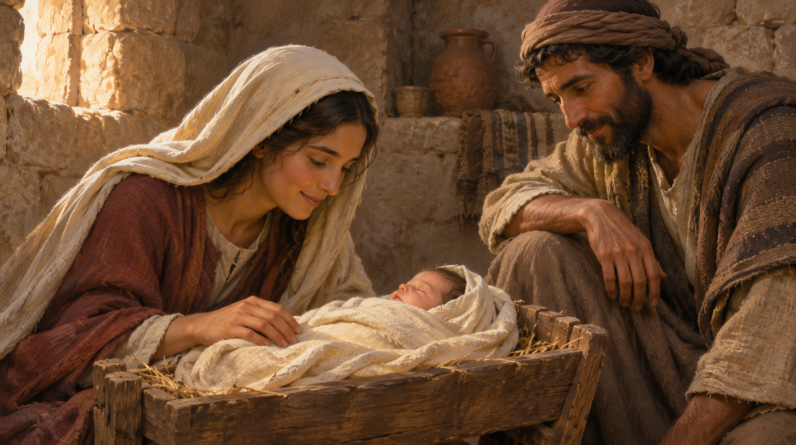



This Christmas Bible study follows four passages in Luke 1–2: the announcement to Mary, Mary’s praise, Jesus’ birth, and the shepherds’ response. Each lesson includes reading, observation questions, a short explanation, and a practical response. Use the lessons over four meetings, four personal study days, or one longer gathering.
You do not need an impressive presentation to begin. Bring a Bible, a notebook, and a willingness to listen. The purpose is to understand what Luke records about Jesus and respond with trust, gratitude, and love. Read the linked passages in your own Bible before discussing the questions.
A Story That Begins With Listening
Before the journey to Bethlehem, Luke describes Mary visiting Elizabeth. In Luke 1:39–45, Mary enters the house and greets her relative. Elizabeth, filled with the Holy Spirit, blesses Mary and recognizes the significance of the child she carries. The meeting becomes a moment of encouragement within a much larger work of God.
Luke does not give us every conversation between these women. He gives enough to show that the news about Jesus was received in a real relationship. Mary had someone who welcomed her, and Elizabeth spoke about God’s work. Their meeting invites us to make room for others as we listen to Scripture together.
Perhaps someone in your group arrives tired, quiet, or uncertain. You do not need to guess what is happening inside that person’s heart. Offer a welcome, read the passage, and let them participate without pressure. A study can have warmth before anyone has answered a question. Our guide to family worship at home offers practical help for creating that simple rhythm.

How to Use This Christmas Bible Study
For four meetings, allow about 20–30 minutes per lesson. Begin with a short prayer, read the passage aloud, and give everyone a moment to notice its details. Spend most of the time on the questions. Finish by choosing one response and praying together. A larger group may need longer; a family with young children can discuss just one question.
If you have one 60–75 minute meeting, read the four passages beforehand. At the gathering, choose one observation question and one response from each lesson. Avoid rushing through every prompt merely to finish. A careful conversation about one passage can be more fruitful than many hurried answers.
Distinguish observation, meaning, and application. Observation asks what the passage says. Meaning considers what those details reveal in their context. Application asks how to respond faithfully today. When an answer goes beyond the passage, name it as a possibility rather than a fact. For background, read our explanation of Jesus’ birth and why it matters.
Lesson 1: Mary Hears the Announcement
Read Luke 1:26–38. Notice where Mary lives, what the angel announces, and how she responds. Write down the descriptions of the promised child before discussing Mary’s example. Jesus is the center of the announcement.
Observation questions: What does Gabriel say about the child’s identity and kingdom? What question does Mary ask? What explanation and reassurance does Gabriel give? How does Mary respond at the end? Ask each person to point to the verses supporting their answer.
Leader notes: The announcement connects Jesus with David’s throne and a kingdom without an end. The explanation of the conception directs attention to God’s action. Mary’s question concerns how this will happen; her final response expresses willingness to serve the Lord. Our account of the angel’s visit to Mary can support further study, but let the passage lead your discussion.
Meaning and response: How does the announcement direct Mary’s attention beyond her immediate circumstances? Where do you find obedience difficult when you cannot see the outcome? Do not assume your situation carries the same promise Mary received. Instead, identify a command God has already made clear, such as speaking truthfully or caring for someone, and choose one step of obedience.
Pray in ordinary words: Father, help us understand who Jesus is. Give us humility to receive Your Word and courage to obey what You have made clear. Teach us to trust You without pretending we know every outcome. Amen.

Lesson 2: Mary Responds With Praise
Read Luke 1:46–55. Listen for what Mary says about God. Notice the movement from her own experience to God’s mercy, His treatment of the proud and humble, and His faithfulness to Israel.
Observation questions: What reasons for praise does Mary name? Which descriptions show God’s character? What does she say about wealth, power, and humility? How does the final part connect her praise with God’s promises? Allow the group to notice both personal gratitude and the wider biblical story.
Leader notes: Mary’s praise gives God the credit. Her words challenge the assumption that importance belongs only to the powerful or wealthy. She also remembers God’s mercy toward His people. This passage should not become a formula promising that every believer will become materially comfortable before Christmas. Its focus is God’s character and saving work.
Meaning and response: What might change if your Christmas gratitude began with who God is, before moving to what you have received? Write a short prayer naming one truth about His character. Then consider whether someone who is often overlooked could receive your attention this week. Our devotional on the true gift of Christmas can help you continue reflecting on Christ beyond the meeting.
Pray together: Lord, You are merciful and faithful. Forgive our pride and our habit of measuring people by their possessions. Teach us to praise You sincerely and treat others with dignity. Amen.
Lesson 3: Jesus Is Born in Bethlehem
Read Luke 2:1–7. Notice the movement from the emperor’s decree to a particular family and a newborn child. Luke names rulers and places, then describes Mary’s care for her son.
Observation questions: Why does Joseph travel to Bethlehem? What connection with David does Luke mention? Which details about the birth and the manger are actually recorded? What details from familiar pictures or performances are absent from these verses?
Leader notes: Joseph’s connection with David helps explain the journey. Mary gives birth while they are in Bethlehem, wraps the child, and places Him in a manger. The passage does not name an innkeeper, describe a sequence of rejected doors, or list animals at the birth. Avoid treating a familiar Christmas production as if every detail came from Luke.
Meaning and response: What do these circumstances help you notice about the humility of Jesus’ coming? How can you honor Him without making Christmas depend on an impressive setting? Consider simplifying one activity so you have time for someone who needs care. Our study of Jesus as fully God and fully man offers further background on the significance of His real humanity.
Pray together: Thank You, Father, for sending Your Son. Help us receive Christ with gratitude and serve without needing attention or praise. Make our homes places where people are treated with kindness. Amen.

Lesson 4: The Shepherds Hear and Respond
Read Luke 2:8–20. Follow the sequence: the announcement, the heavenly praise, the visit, the sharing of the news, and the return. Notice that the shepherds’ response continues after their visit.
Observation questions: How does the angel identify the child? What sign is given? What do the shepherds decide to do? What do they tell others afterward? How does Mary respond, and what marks the shepherds’ return? Compare the different responses without deciding that every believer must express faith in exactly the same way.
Leader notes: The announcement identifies Jesus as Savior, Messiah, and Lord. The shepherds find the child as they were told and share the message about Him. Mary considers what has happened. The shepherds return praising God. These details keep the focus on the child and the message, rather than on the excitement of a remarkable night.
Meaning and response: Which part of the announcement helps you understand Jesus more clearly? How can you speak about Him simply and truthfully? Our article on the shepherds’ faith provides further reflection. Choose one person you can encourage through a kind conversation or an invitation to read the account together, allowing them freedom to respond.
Let the Study Lead to Love
After the final lesson, each person can name one thing learned about Jesus and one practical response. Keep it concrete: make a neglected phone call, apologize for an unkind word, share a meal, or spend time with someone who has been lonely. These acts do not earn salvation. They can express gratitude for the Savior you have been studying.
If prayer feels unfamiliar, use our beginner’s guide to prayer. No one needs to produce a long speech. Thank God for Christ, ask for help, and remember one another. Follow up gently at your next meeting, without turning personal responses into a performance report.

A Closing Prayer
Father, thank You for making Your mercy known through Jesus. Help us read Your Word carefully, welcome one another patiently, and respond with sincere faith. Let what we learn shape our speech, our choices, and our care for others. Keep Christ at the center of our Christmas and our ordinary days. In Jesus’ name, amen.
Continue Growing
Build a steady habit with a simple daily prayer routine.
Continue with short Christmas devotionals.